
China Declares War on Paper Silver: Shanghai Futures Tightens Rules as Physical Stockpiles Collapse
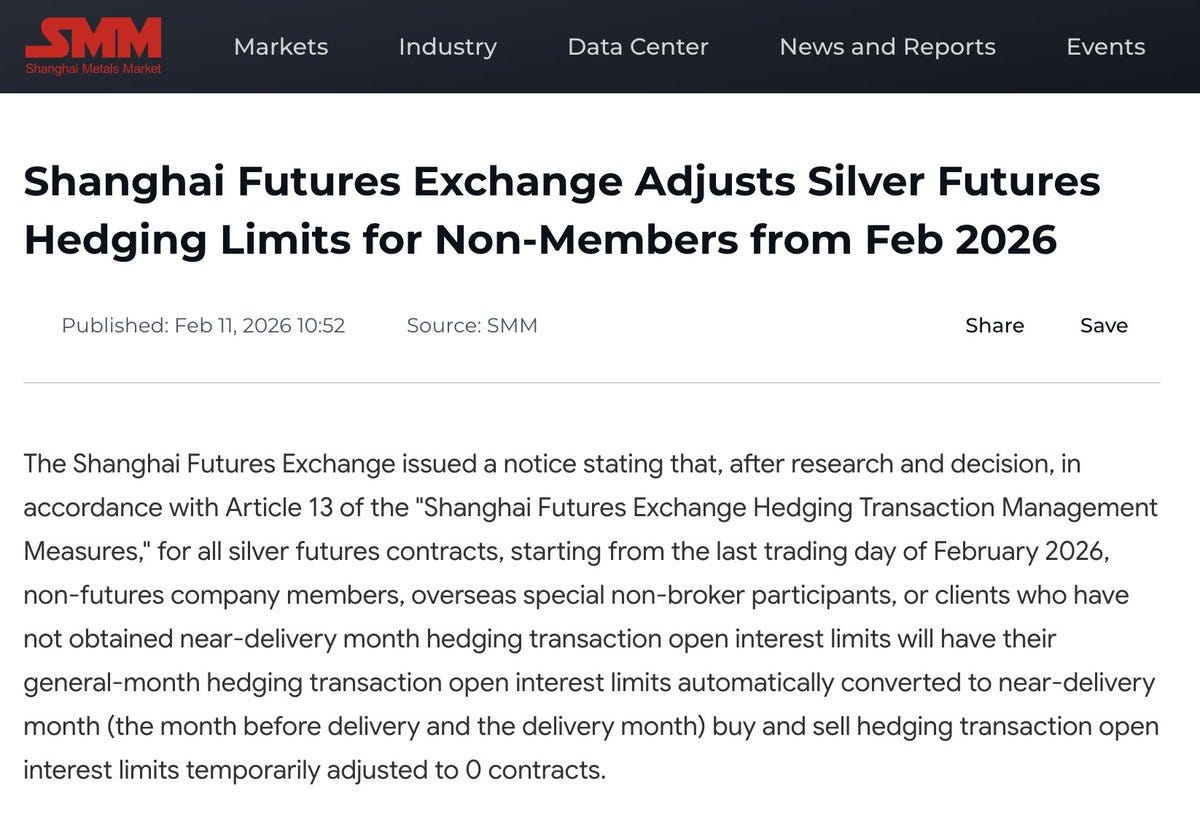
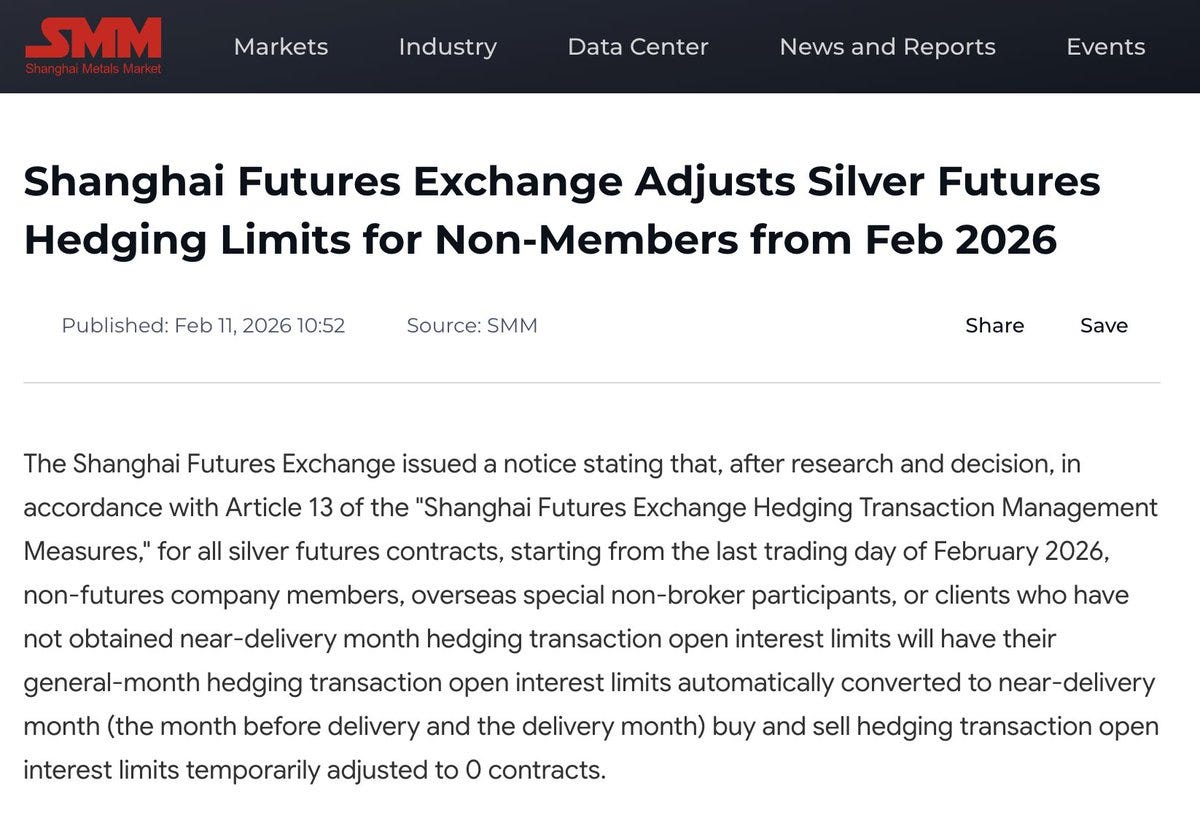
The Shanghai Futures Exchange has ignited a global silver storm. In a stunning announcement, effective February 27, 2026, SHFE will impose brutal new limits on near-term silver futures positions — a measure designed to protect China’s vanishing physical reserves and crush speculative distortions.
The New Silver Firewall
Starting February 27, all hedging positions in both the delivery month and the month prior will be forcibly reduced to zero—unless an entity has a pre-approved special hedging quota. Only bona fide industrial users — refiners, electronics producers, and solar manufacturers — will be allowed to maintain positions through physical delivery.
Speculative traders must roll out early or liquidate. The message is unmistakable: China will no longer allow paper speculation to drain its remaining physical supply.
China’s Silver Crisis and Its Response
China’s registered silver inventories have cratered to below 350 tonnes, their lowest in more than a decade and down nearly 88% from the 2021 peak. The market is screaming distress: the forward curve is locked in deep backwardation, with near-month contracts commanding massive premiums.
This is not normal. It’s a crisis signal — a shortage so severe that China is prioritizing its domestic industries before the cupboard goes bare. Every ingot now matters to the nation’s energy, tech, and defense objectives.
Shockwaves for the West
The ripple effects will be immediate. Western exchanges like COMEX and LBMA, already scraping bottom-tier inventories, now face the prospect of sharply lower inflows from China. The physical silver that once trickled from Shanghai vaults into global supply chains is staying home.
Speculative liquidity may remain in New York and London, but the real metal — the stuff that powers factories and fabs — is moving East. As China exerts physical control, the Western paper markets will increasingly reveal their hollow core.
The New Resource Reality
China’s crackdown, combined with tightened export licensing and new industrial mandates, marks the next phase in the global resource war. This is not a short-term regulatory tweak. It’s a strategic barricade — a declaration that China’s silver belongs to China.
The West is scrambling to respond through critical mineral stockpiles, but the lead is already slipping away.
The Bottom Line
This February 27 rule change is more than a bureaucratic adjustment. It’s a strategic strike — dismantling speculative excess, defending dwindling reserves, and reshaping the global silver trade.
The age of paper silver dominance is ending. Physical ownership now defines power.
Don’t Fall for any Psyops the Predator Class Shoves our way
We must strengthen our hands and resist the temptation to sell
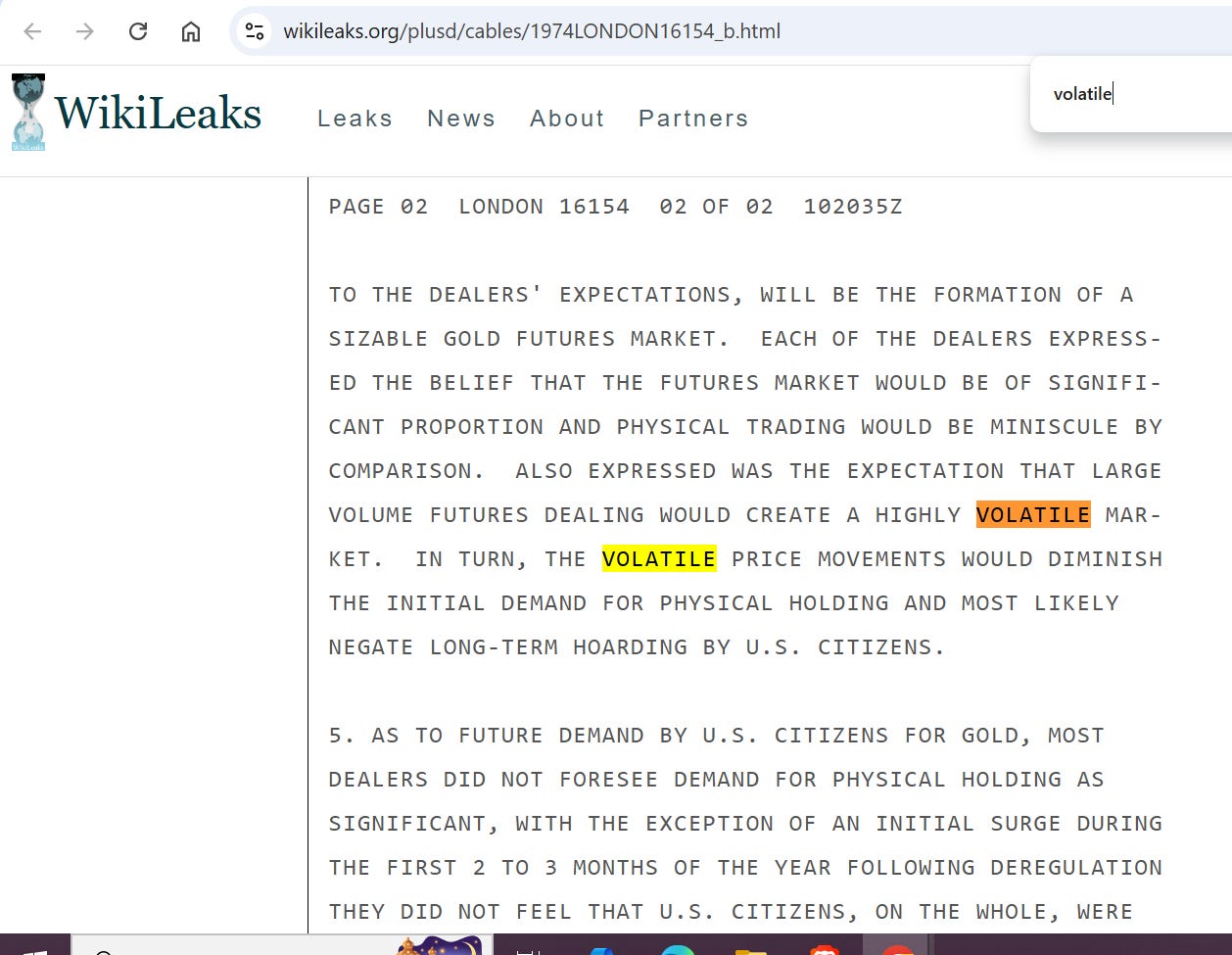
Here is a screenshot from a cable with detailed description below
This is a 1974 U.S. government cable about gold and using futures-driven volatility to discourage physical ownership.
The specific Wikileaks cable
The cable is:
-
Title: “LONDON WHOLESALE GOLD DEALERS’ VIEWS ON U.S. GOLD SALE AND PRIVATE U.S. OWNERSHIP”
-
Wikileaks ID: 1974LONDON16154_b
-
Date: December 10, 1974
-
URL: https://wikileaks.org/plusd/cables/1974LONDON16154_b.html
This memo, from the U.S. Treasury in London to the State Department, was highlighted years later by James Anderson (SD Bullion) and Craig Hemke (TF Metals) in his discussion of how the gold futures market was used as a policy tool.
What the cable actually says
Commentary quoting the cable notes that U.S. officials expected “large volume futures dealing” to create a “highly volatile market,” and that this volatility would:
-
“diminish the initial demand for physical holdings”
-
“most likely negate long-term hoarding by U.S. citizens.”
In other words, policy makers anticipated that a sizable futures market, with the resulting volatility, would psychologically deter ordinary investors from buying and hoarding physical metal.
How TF Metals framed it
TF Metals (Craig Hemke) used this memo to argue that:
-
The mid‑1970s shift to gold futures (“digital alchemy”) allowed authorities to restrain price with “pretend gold.”
-
Crucially, the memo shows they understood that price volatility itself could be weaponized to scare off long‑term physical holders.
In other words, “we invented futures to demoralize investors,” it does document an official expectation that a large futures market and resulting volatility would curb physical demand and hoarding—functionally, the core of the claim TF Metals popularized
Volatility is not just a market feature; it is a weapon. In precious metals, violent, scripted price swings function as a psychological operation designed to demoralize investors, push them out of positions, and suppress long-term physical demand.
Sharp spikes followed by brutal smashes condition traders to associate gains with imminent pain. After enough whipsaws, many investors conclude that gold and silver are “too dangerous,” exactly as London dealers anticipated in 1974 when they predicted that a large futures market and “highly volatile” prices would “diminish…demand for physical holdings” and “negate long-term hoarding.” The goal isn’t fair price discovery; it’s behavioral control.
This tactic hits the weakest hands first. Leveraged speculators, operating on margin, are repeatedly forced out in cascading selloffs, reinforcing the narrative that only fools hold through drawdowns. Over time, mainstream participants internalize the message: don’t buy, don’t hold, don’t trust the metals.
Yet volatility has the opposite effect on committed stackers. They recognize the pattern as a derivatives-driven psyop that cannot create a single new ounce of physical metal. For them, volatility discounts real wealth; for everyone else, it’s a fear engine. That asymmetry is the point: use paper volatility to shake out the many and consolidate physical metal in the hands of the few
end of segment
-
our opinions are not our sponsors opinions
-
the editorial department is separate from the promotions department
-
not financial advice