
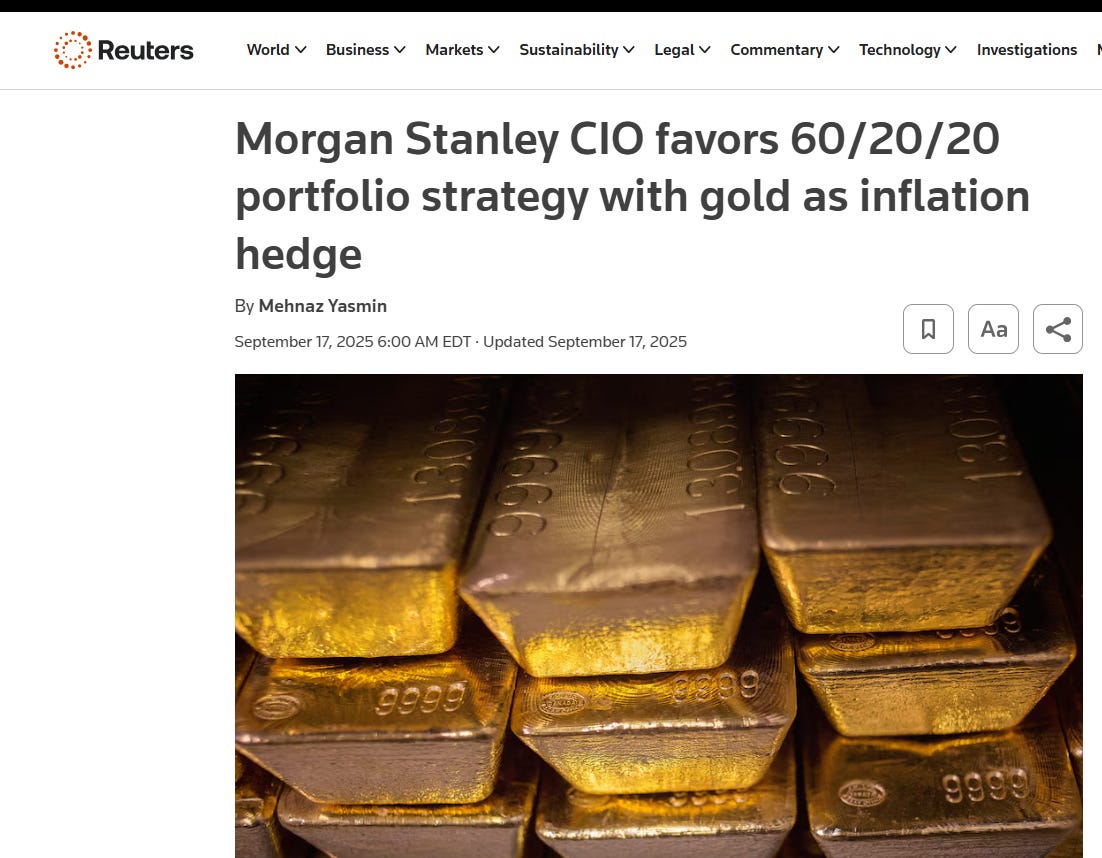
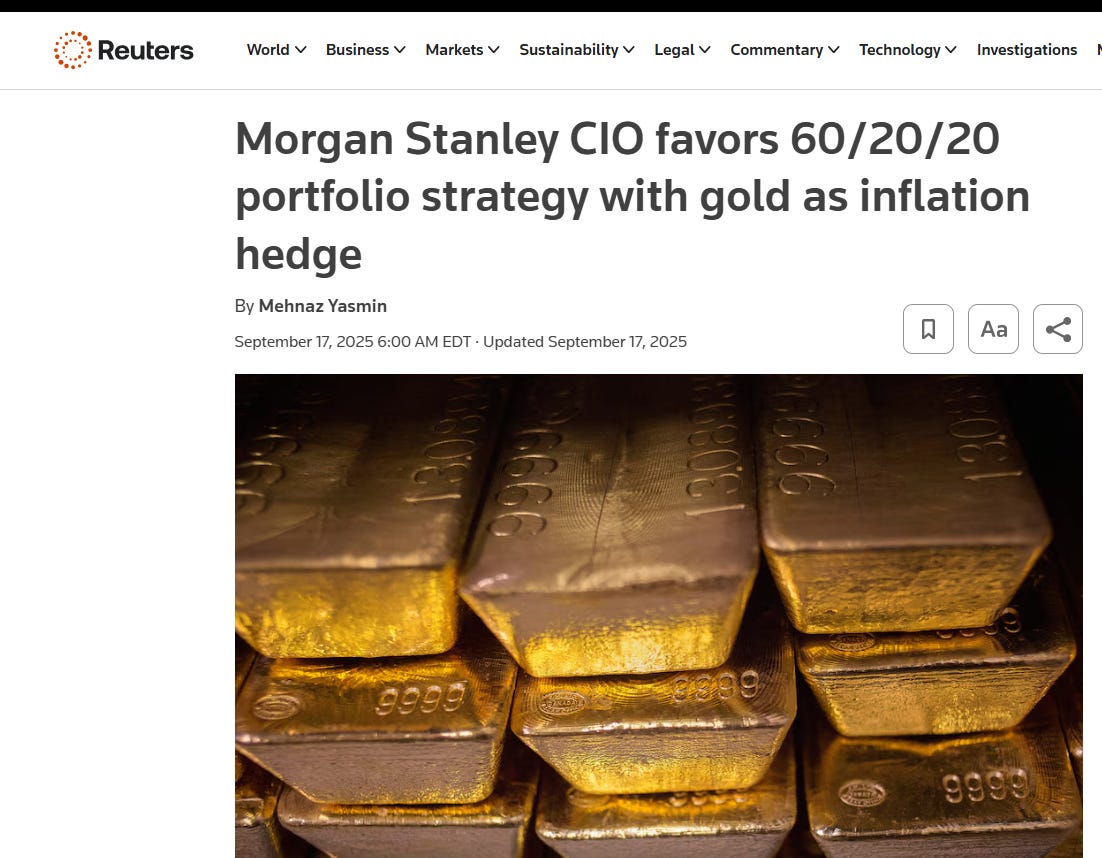
Foreword: What does it mean when a mainstream “normie” says you should have 20% Gold Allocation?
If even a fraction of the $62.8 trillion now invested in U.S. stocks begins rotating into gold—at the 20% allocation level now endorsed by Wall Street giants—it will unleash the largest and most sustained wave of gold buying in financial history. This is not a mere rebalancing, but a generational capital shift. American institutions and individuals have never before moved even close to this much money into gold at once; the sheer scale is like a tidal wave, dwarfing any previous demand surge anywhere on the globe. The potential influx would overwhelm current supply and drive gold prices to levels few thought possible, cementing a new era for the metal.
Central Bank Buying Gold is Nothing compared to this Shout out by Morgan Stanley and Jeff Grundlach
For the past three years, relentless headlines trumpeted historic central bank gold buying—over 1,000 tonnes each year, from China to Poland to Turkey, stoking bullish fervor among gold watchers. Yet, as massive as that was, the total value amounts to only about $100–130 billion in new demand. This is a rounding error compared to Wall Street’s new 20% gold allocation mandate, unleashed by Morgan Stanley’s CIO and Jeffrey Gundlach. If even a fraction of the $62.8 trillion in U.S. investment portfolios adopts this stance, we’re staring at up to $12.56 trillion seeking gold exposure—nearly 100 times greater than all central bank purchases combined. Suddenly, it’s crystal clear: the real gold rush is only beginning. Institutional U.S. capital doesn’t just dwarf official buyers—it will redefine the global gold market overnight.
For the past three years, gold enthusiasts have rightfully highlighted central banks’ record-breaking gold binge—over 1,000 tonnes every year, making headlines and fueling price surges. But this “historic” demand—about $100–130 billion total—now looks trivial compared to what’s coming.
With central banks buying gold at record pace—and China stacking even more for infrastructure, strategic reserves, and international leverage—the market faces unprecedented, relentless new demand. With Morgan Stanley’s 20% U.S. portfolio recommendation, a $12.56 trillion gold rush is igniting. Each day, gold must surge higher, bridging the gigantic gap until it reflects the true, projected weight these global buyers demand. Gold’s trajectory has only one direction: up—until supply meets this colossal new reality.
Central banks, especially China, continue to buy gold relentlessly, not only for reserves but for new infrastructure projects and monetary sovereignty. Now combine this with Morgan Stanley’s 20% portfolio recommendation—up to $12.56 trillion in potential U.S. gold demand. Each day, gold must climb higher as the market works to balance this staggering, historic influx. With continued central bank buying and unprecedented institutional interest, prices are compelled to march steadily upward until gold attains its rightful weight in global portfolios
With Morgan Stanley’s CIO Mike Wilson and Jeffrey Gundlach both calling for 20% minimum gold allocations, if U.S. portfolios, pensions, and IRAs start to shift, we’re talking about up to $12.56 trillion in potential gold demand—nearly 100 times more capital than the combined efforts of every central bank on the planet. This is not just a new chapter for gold; it’s a seismic event, a legitimate transformation of the financial world. Central banks were just the opening act—the real gold rush is only now about to begin
Wall Street Capitulates: Gold and Silver’s Moonshot Has Begun
The gold and silver renaissance is unfolding before our eyes, and this week marked the point of no return for mainstream finance. For decades, America’s largest banks and brokerages shunned gold, treating it as a relic best left to doomsday preppers and eccentric commodity speculators. They refused to assign even a token portfolio allocation. Now, the tide has turned—Morgan Stanley, along with rival giants, is publicly recommending a 20% allocation to gold in their flagship portfolios, a watershed shift that Wall Street’s most successful investors call absolutely necessary. Billionaire Jeffrey Gundlach, widely regarded as “the Bond King,” calls 25% not excessive, a statement that would have seemed outlandish just months ago when the consensus “expert” allocation was zero. This seismic realignment guarantees a tsunami of institutional capital flooding into the precious metals sector—fuel that will propel gold prices higher, and light a rocket under silver.
From Zero to Twenty Percent—Why It’s Everything
If just half of the 20% Wall Street gold allocation recommendation is implemented, that would mean $6.28 trillion in fresh gold demand—by far the largest influx in history.
This is not a minor adjustment. The pivot from zero weighting to 20% allocation signals a fundamental shift in the investing landscape. For context, a 60/40 portfolio—the cornerstone of conventional asset management—now officially includes a gold slice so large it rivals legacy allocations to entire stock market sectors. For gold bugs who have spent years banging the drum while being mocked by the financial elite, this is vindication on an epic scale. But this story is no longer just about gold. The real breakout is coming—fast—in silver.
Silver’s Relentless Run: $30 to $46—And the Imminent Break Above $50
Silver is not just keeping pace, it’s setting the tempo. For months, mainstream analysts dismissed silver’s potential, citing sluggish price action while gold ran ahead. But in every historic bull run, silver is the signal: when it runs, it signals a true breakout. That’s happening now. Consider the data—silver spent months grinding higher from $30 to $40, a slow burn fueled by reluctant buyers. But in recent weeks, silver catapulted from $40 to a weekly close over $46, rising 8% in just one week, putting year-to-date gains at nearly 60%. The move above $40 happened with explosive speed. What took months to accomplish before is now compressed into days. The gravity-defying sprint above $50 is not just possible—it’s mathematically likely, perhaps as soon as next week.
If history is a guide, once silver shatters $50, it won’t look back. That level will become support, with each subsequent pullback bought aggressively by funds that used to shun the metal. Remember: silver’s total market size is minuscule compared to the oceans of money now being told—by their own advisers—to buy gold and, increasingly, silver.
Wall Street’s Gold Rush Is Silver’s Supernova
The catalyst for this turbo-charged rally isn’t just speculative fever. It’s institutional buying, the arrival of Wall Street’s “big fish” in a very small pond. The gold ETFs and mining stocks are suddenly outperforming nearly every other market sector, drawing billions from traditional bonds and equities. The GDX, the flagship gold miner ETF, is up 120% year-to-date; the junior version, GDXJ, has surged 125%. These triple the returns of the metal itself—proving that the gearing effect of the mining shares is alive and well. More importantly, gold stocks are now leading the metal, not lagging—a classic hallmark of early-stage bull markets.
While most central banks have been quietly amassing gold reserves for years, now it’s Wall Street’s turn, and these institutions are only just beginning to wade in. They aren’t buying silver yet, but retail and funds are, and when the big banks finally catch on, expect silver’s price to move with a violence never seen before.
Inflation Will Not Fade—Precious Metals Are the Ultimate Shield
Behind all the price action lies the uncomfortable reality: inflation is no longer a temporary blip. The Trump administration’s economic plan—whatever its merits—boils down to massive money printing and endless cheap credit to keep assets inflated. But every “boom” engineered by paper money guarantees future inflation, and as the dollar erodes, real assets outperform. The S&P may be up 14% this year, but gold’s rise of 43% means equities are sinking in real, inflation-adjusted terms.
This is not just a victory lap for gold bugs—it’s the beginning of a generational swing. When people see their portfolios falling behind true inflation, the fear of missing out will trigger a stampede. Portfolio managers, desperate not to be left behind, will pile into gold and silver with increasing urgency, especially at quarter-end when they report their holdings to clients.
Now Is the Time: Don’t Wait
The conclusion is clear. The era of dismissing gold and silver is over. For the first time in a generation, those who have patiently accumulated precious metals stand to benefit from not just incremental gains, but explosive, transformative returns. The window to buy silver under $50 is closing rapidly—maybe in days. With 20% gold allocations now mainstream, silver’s tidal wave is just beginning. History is being rewritten at warp speed.
Own silver—and keep buying, while Wall Street catches up.
Encore performance
3 More Reasons to Buy Precious Metals (ESPECIALLY MINERS)
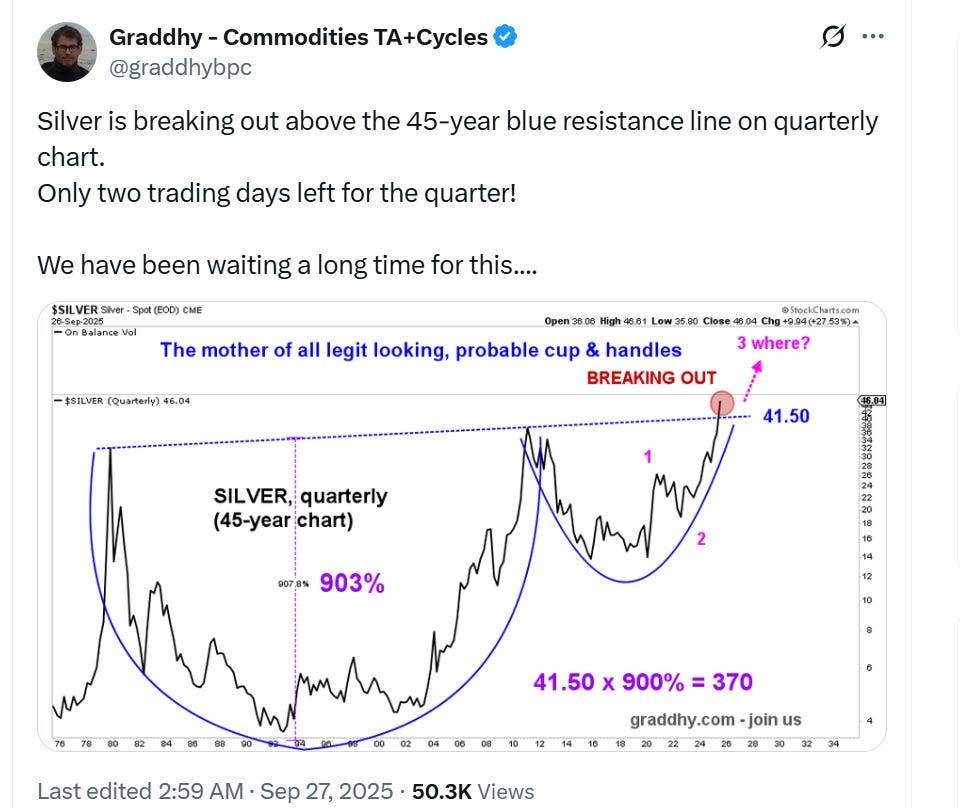
Three new developments have lit a fire under an already explosive precious metals market, intensifying demand right as the quarter closes.
#1 silver in the U.S. has finally broken out above a legendary 45-year resistance line on the quarterly chart, shattering a barrier that has defined the metal’s limitations for almost half a century. With only two trading days left in the quarter, this historic technical breakout signals a long-awaited new era for silver, unleashing pent-up buying as technical traders scramble to reposition. Momentum is now undeniable.
#2, China has become the engine pulling the global silver market into uncharted territory. While Western investors cheer new highs on COMEX—where Friday’s close landed at $46.36/oz—Chinese traders have already catapulted spot prices above $47.60, and retail buyers on JD.com have been forced to pay as much as $52.30/oz just for physical silver. This huge premium reflects frenzied demand and acute scarcity of investment-grade silver in the world’s biggest growth economy.
#3, arbitrage is about to erase these price gaps and further turbocharge Western markets. When the China premium reaches over $5/oz versus New York or London, Western traders can’t ignore it—arbitrage forces their hand. As China’s buyers snap up supply, expect a rapid price catch-up on COMEX and LBMA next week. These powerful forces—technical breakout, China’s turbocharged demand, and unavoidable arbitrage—guarantee that silver’s rally isn’t near finished, it’s just getting started.
end of segment
-
our opinions are not our sponsors
-
editorial department is separate from promotions department
-
not financial advice