


Quantum computing has sounded the alarm that could render blockchain—and Bitcoin in particular—fundamentally obsolete. As the technological race hurtles forward, the cryptographic underpinning of digital currencies faces mathematical extinction, not by mere gradual obsolescence but by sudden, irreversible compromise. The countdown to Bitcoin’s judgment day has truly begun as quantum computers approach the capabilities necessary to shatter its security—and the world is running out of time to adapt.
The SHA-256 Breaking Point
Bitcoin’s security cornerstone, SHA-256 encryption, wasn’t considered breakable for decades. Yet, the ground has shifted. As quantum computing milestones are reached, the vulnerabilities in SHA-256 are no longer theoretical. The chilling reality is encapsulated in this emerging consensus: “the mathematical certainty is now established: 13 million qubits breaks SHA-256 in 24 hours. We’re 99.2% of the way there in qubit count alone.” That quote marks the point at which the quantum threat transcends mere possibility and becomes an impending inevitability.
Google’s Willow chip—a breakthrough quantum processor with 105 qubits—cannot break Bitcoin today. But it has “started a clock that cannot be stopped.” Today’s quantum leap means that each advancement brings us closer to the day when the very foundation of Bitcoin’s encryption will expire. The invisible time bomb ticking in the wallets of every crypto holder is no longer hypothetical; the ongoing progress in quantum hardware means the timer is running.
Wealth Hoards Under Quantum Siege
The ramifications are catastrophic. Satoshi Nakamoto’s legendary cache of 1 million BTC—almost $35 billion—sits in “exposed public keys” vulnerable to quantum attack. Whoever achieves cryptographically-relevant quantum computing first could instantly become the wealthiest individual on Earth, overnight, in what one observer has called the Satoshi Singularity: a $1 trillion Sword of Damocles hanging over the crypto world.
Nor is this a distant scenario. Nation-states, knowing the writing is on the wall, are already archiving every Bitcoin transaction. The “Harvest Now, Decrypt Later Apocalypse” points to a future where privacy evaporates. What is encrypted today becomes public knowledge tomorrow, as quantum breakthroughs will make historical Bitcoin transactions instantly decipherable—unmasking identities and financial records dating back to Bitcoin’s creation.
The 25% Vulnerability Clock
The urgency is compounded by Deloitte’s alarming finding: 25% of all circulating Bitcoin—roughly 5 million BTC worth over $300 billion—remains locked in vulnerable address formats. These coins could be emptied the moment a quantum computer crosses the critical threshold. With such a large proportion at risk, Bitcoin faces existential peril.
The Hard Fork Ultimatum
Bitcoin is now at its ultimate test: can the community coordinate the most complex global hard fork in history to upgrade cryptographic primitives before disaster strikes? With no central authority and over 100 million users, successfully implementing quantum-resistant upgrades may be the greatest decentralized coordination feat ever attempted.
Post-Quantum Renaissance … and Quantum Arms Race
There is hope—if action is swift. Algorithms like Algorand’s quantum-resistant FALCON signatures and NIST-certified CRYSTALS-Dilithium offer alternatives, but their mere availability is not enough. Bitcoin’s ossified culture and slow-moving consensus mechanisms make adaptation a herculean task. Meanwhile, the quantum arms race has begun: the nation that first achieves 13 million error-corrected qubits will gain unprecedented access to all legacy encrypted data, including Satoshi’s fortune and military secrets. It’s the new space race—only faster, more lucrative, and utterly destabilizing.
The Civilizational Lesson
Security is no longer static—“it’s a process.” In the quantum era, every encrypted dataset has an expiration date, and Bitcoin’s clock just started ticking. Financial sovereignty and digital privacy now depend on constant evolution of cryptographic standards. The question is not if quantum computing will break Bitcoin’s encryption, but when—and whether adaptation will outpace destruction.
Political Dysfunction and Accelerating Risk
Compounding this threat, the real-time geopolitical landscape is increasingly dire. The Trump administration’s decision to cut cybersecurity funding—even as quantum threats loom—diverts precious resources away from protecting critical infrastructure. As funding shifts to anti-immigration initiatives, national vulnerability increases just as the quantum clock strikes its final minutes. The disconnect between technological risk and political reaction exacerbates the danger.
Conclusion
The quantum countdown represents a radical shift in the fate of blockchain and Bitcoin. The technology that once guaranteed digital freedom and financial privacy can now be rendered not just obsolete but utterly compromised. With 13 million qubits poised to break SHA-256 in a single day and critical mass all but achieved, only rapid adaptation and global coordination can keep the crypto dream alive. The clock started today—there is no time left for complacency.
More Bitcoin vs Gold News
Tucker Carlson broadcasts Facts that Bitcoin was invented by USA Military
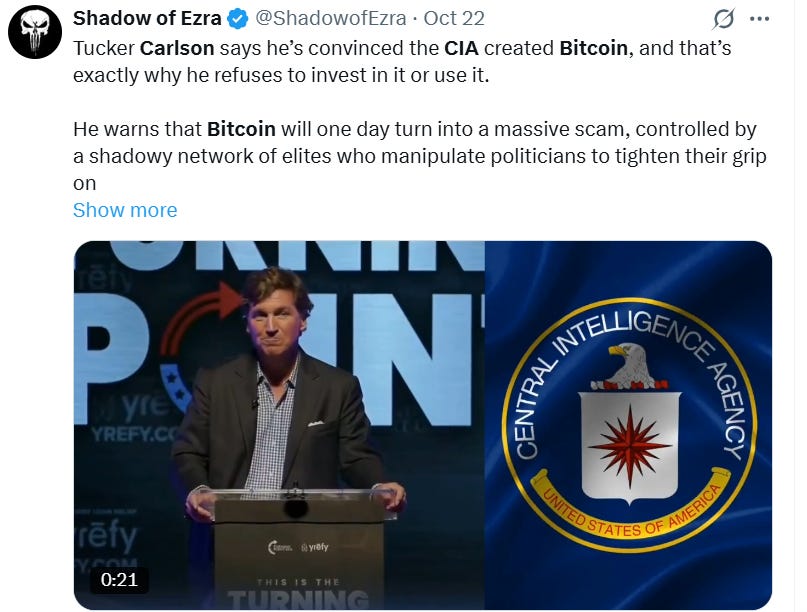
New revelations have amplified the sense of urgency and distrust surrounding Bitcoin and its fate in the quantum era. Just this week, Tucker Carlson broadcasted suspicions that intelligence agencies—including the CIA and NSA—were directly involved in Bitcoin’s invention, not simply as a vehicle for personal financial sovereignty but as a global tracker of money flows. This theory has fueled debate about Bitcoin’s true purpose and raised serious questions about privacy and state surveillance.
Stablecoin con
Adding to this skepticism, a top advisor to President Putin recently warned of a potential “con” behind stablecoins—with claims that they’re being engineered as stealth tools to encourage global investment in US Treasuries through opaque mechanisms, benefiting American financial dominance while masking real risk from participants worldwide.
The Great Debate is On

In light of these controversies, the gold-versus-Bitcoin debate is heating up once again. Peter Schiff, long-time gold advocate and prominent critic of cryptocurrencies, is set to debate the newly-pardoned Binance CEO—who was granted clemency by President Trump—on which store of value is best poised to survive the quantum computing upheaval. This event promises to be a pivotal moment, raising fundamental questions about privacy, trust, and the future of money in an increasingly quantum-threatened world.