
by Niko Moretti
Spanish excerpt:
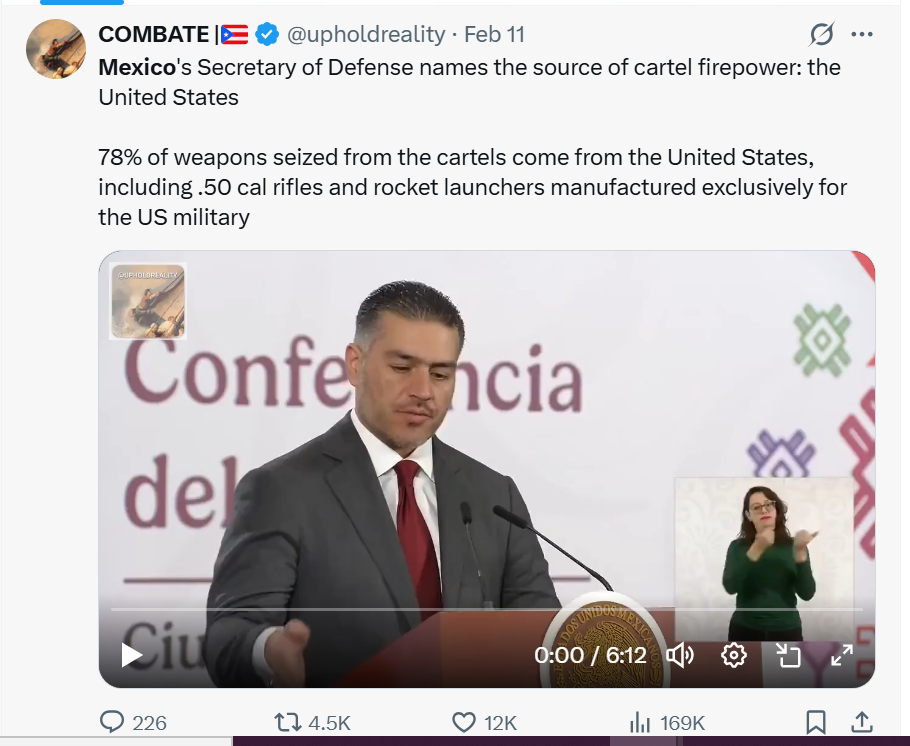
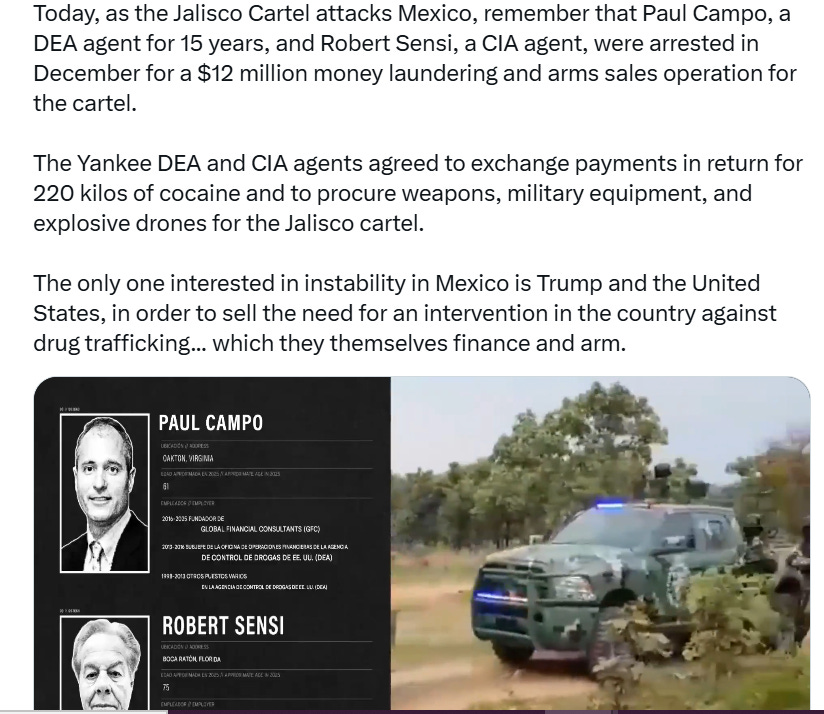
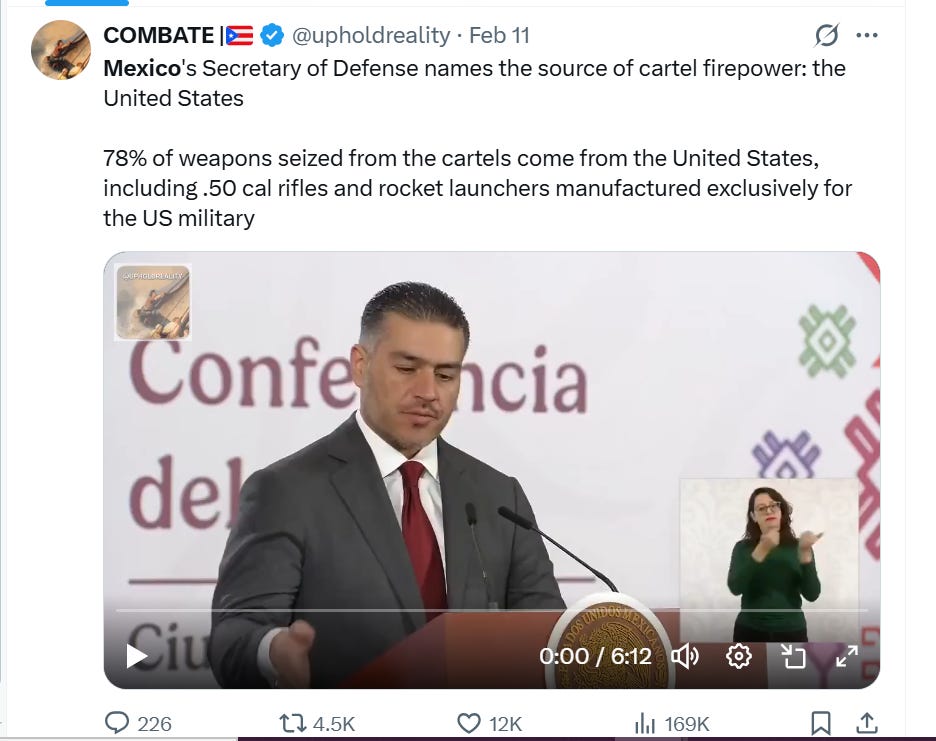
Hoy que el Cartel Jalisco ataca México, recordar que Paul Campo, agente de la DEA durante 15 años, y Robert Sensi, agente de la CIA, fueron arrestados en diciembre por una operación de 12 millones de dólares de lavado de dinero y venta de armas para el cártel. Según la acusación, los exagentes estadounidenses acordaron intercambiar pagos a cambio de 220 kilos de cocaína y conseguir armas, equipo militar y drones explosivos para el Cártel de Jalisco Nueva Generación. En un país saturado de sangre, la línea entre la “guerra contra las drogas” y el negocio de la guerra se ha vuelto indistinguible: quienes supuestamente persiguen a los narcos terminan abasteciéndolos.
In English:
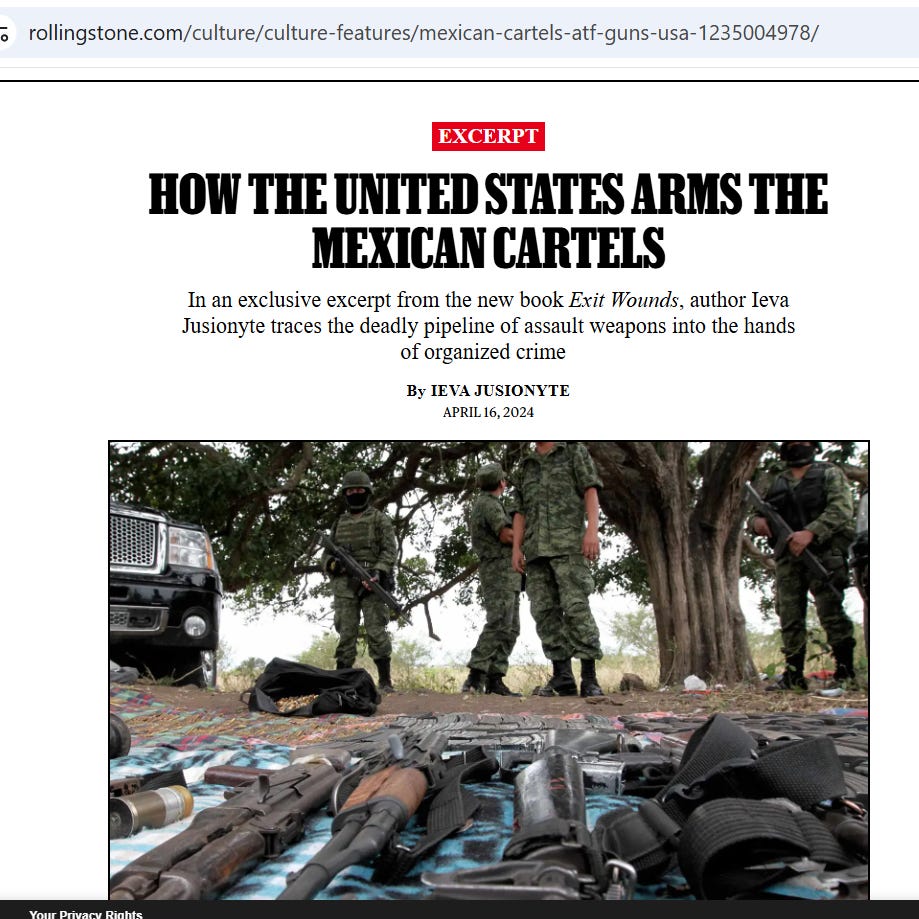
Why You Shouldn’t Touch Mexican Silver Miners: CIA Chaos, Cartel Warzones and Years of Slow‑Motion Shareholder Destruction
Mexico is not just the World’s #1 silver producing nation; it is a live laboratory for a new phase of managed instability, where miners are collateral damage and foreign shareholders are a slowly boiling frog. – Jon Forrest Little
Amid blockades, narco wars, extortion, protection payments, nationalizations, and a government openly reshaping “strategic” sectors, what sane person risks capital in Mexican silver miners?
If you still want silver exposure, fine—but choose literally any jurisdiction that isn’t Mexico.
Here is a short long list of recent disruptions in Mexico.
Equinox Gold’s Los Filos: 2020 blockade and shutdown
-
In September 2020, Equinox Gold’s Los Filos mine in Guerrero was shut down by what the company called an illegal blockade from the Carrizalillo ejido, which accused the firm of breaching social and health commitments.
-
Operations were halted as community leaders alleged racism, broken agreements, and COVID‑19 failures, showing how a major mine can be paralyzed overnight by local unrest.
-
Cartel extortion and mine blockades (early 2020s onward)
-
Legal and industry accounts describe Mexican cartels evolving into diversified criminal enterprises that extort miners, steal concentrate, and impose “taxes,” with some operators losing a large share of revenue.
-
Cases include operations suspended over theft and prolonged blockades linked to organized crime, effectively forcing companies into de facto protection payments.
-
-
Newmont Peñasquito: four‑month shutdown in 2023
-
Newmont suspended operations at its Peñasquito mine on June 7, 2023, after the union launched a strike demanding higher profit‑sharing.
-
The mine remained shut for roughly four months, with a final agreement only approved in October 2023, underscoring how a flagship asset can be frozen for an entire quarter.
-
-
Barrick Gold: deliberate absence from Mexico (ongoing)
-
Barrick Gold, one of the world’s largest gold producers, operates across North America, South America, Africa, the Middle East, and Asia‑Pacific but has no producing mines in Mexico.
-
That absence is itself a data point: a top‑tier operator has chosen to deploy capital everywhere else, despite Mexico’s geology.
-
-
Endeavour Silver pivots away from pure Mexico exposure (mid‑2020s)
-
Long branded as a Mexican silver producer, Endeavour has increasingly emphasized growth outside the country, including advancing new projects in Peru.
-
The strategic pivot reflects growing concern over permitting friction, community tensions, and security in Mexico’s traditional silver belts.
-
-
Indé Mine seizure, Durango: December 2025
-
In December 2025, armed men backed by municipal police and state officials forcibly seized ECI’s Indé mine in Durango, locking the company out of its own plant and infrastructure.
-
Company statements linked the attackers to a criminal organization embedded in local government—an example of state power and organized crime converging against a foreign miner.
-
-
Vizsla Silver kidnappings: January–February 2026
-
Ten Vizsla Silver employees were kidnapped while traveling to the Panuco project in western Mexico.
-
Authorities later confirmed that five of the abducted workers were found dead, a brutal signal of how far the security situation has deteriorated.
-
-
Clive Thompson’s “Crisis in Mexico” report: February 2026
-
Veteran analyst Clive Thompson described Mexico’s silver heartland as suffocating under roadblocks, cartel fees, and escalating violence that is driving engineers and geologists away.
-
He highlighted hardening travel protocols, hidden protection payments, and a sector being hollowed out by fear and disruption, urging investors to rethink exposure to Mexican silver mines.
-
-
Morena’s self‑branded Fourth Transformation (4T) is a state‑first, anti‑neoliberal project that openly aims to roll back decades of privatization and re‑assert control over “strategic” sectors. The party presents it as the fourth great turning point in Mexican history—after Independence, the Liberal Reform and the Revolution—framing tighter resource nationalism as a patriotic correction to the “neoliberal nightmare.”
-
In April 2022, Mexico’s Congress passed AMLO’s lithium reform, declaring lithium a “strategic mineral” and giving the state exclusive rights over its exploration, exploitation and use, effectively nationalizing future lithium mining.
-
The government then created a state vehicle under the Energy Ministry to control lithium assets, sidelining private and foreign concessionaires and freezing several planned projects.
-
In the power sector, Morena has pushed constitutional and regulatory changes to re‑empower the Federal Electricity Commission (CFE) and Pemex, reversing 2013 market‑opening reforms.
-
A key plank is guaranteeing CFE at least 54% of generation and giving priority dispatch to state‑owned plants, even if they are more expensive and polluting than private competitors.
-
In March 2023, Mexican marines and police seized Vulcan Materials’ SAC‑TUN aggregates mine and port at Punta Venado, Quintana Roo, in a gunpoint takeover that triggered USMCA and diplomatic protests.
-
In 2025, outgoing president López Obrador then decreed more than 200 square miles around the Vulcan site a protected natural area, effectively freezing extraction and “repurposing” private U.S. assets.
-
At the same time, Morena’s energy nationalism includes deepening ties with Russia and other non‑US partners for refining, gas and upstream cooperation at Pemex.
-
Meanwhile China executives are purchasing Silver concentrate bypassing Comex.
-
Despite a Trump‑era tariff threat targeting countries that supply oil to Cuba, Pemex has kept a contract to ship crude and products to the island, with President Claudia Sheinbaum calling it a humanitarian obligation.
For foreign resource investors, this mix—lithium nationalization, electricity re‑statization, armed seizures like Vulcan, and a Pemex that prioritizes geopolitical “sovereignty” over Washington’s red lines—adds another hard political layer on top of Mexico’s already escalating security risk.
-
-
Any silver mine operating under Morena’s 4T should be modeled not just for cartel exposure and blockades, but for the real possibility that, once classified as “strategic,” its legal and economic terms can be rewritten—or its physical assets seized—by decree.
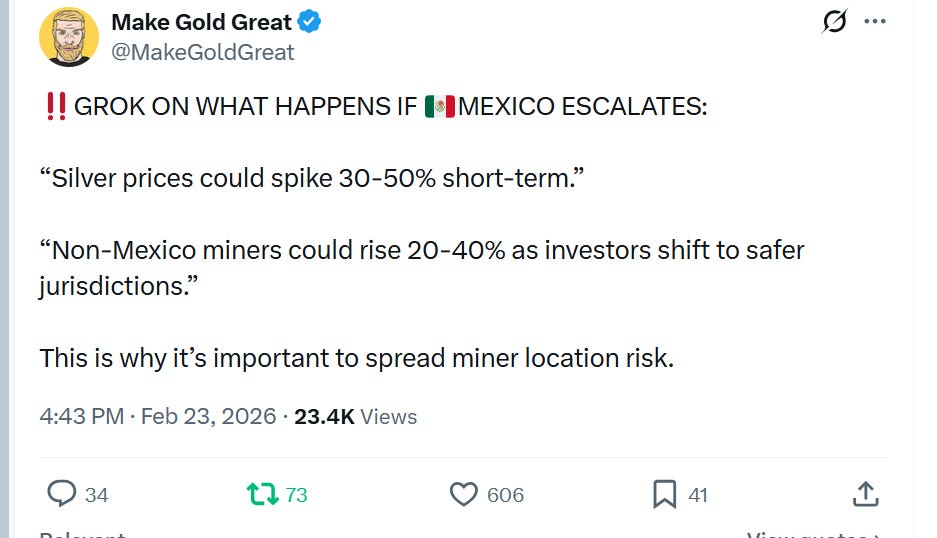
The CIA and its ecosystem are once again playing both sides of the border—feeding cartels while selling the cure—then this turmoil will not be a brief buying opportunity. It could be years of instability and bloodshed that strip value out of Mexican silver mining equities, one write‑down, one blockade, one “incident” at a time.
Today, as the Jalisco Cartel tears through Mexico, it’s worth remembering that Paul Campo, a 15‑year DEA veteran, and Robert Sensi, a former CIA officer, were arrested in December for allegedly running a 12‑million‑dollar money‑laundering and weapons‑for‑cartel operation. Prosecutors say the ex‑agents agreed to broker payments in exchange for 220 kilos of cocaine and to secure weapons, military gear, and explosive drones for the Jalisco New Generation Cartel. In a country drowning in blood, the line between the “war on drugs” and the war business has all but vanished: the people tasked with hunting traffickers keep turning up as their suppliers.
“War on Drugs” or Business Model?
This is not an isolated scandal. It fits into a long, ugly tradition: when Washington talks about “stability” in Latin America, what often follows is a black ledger of covert operations, proxy armies, and economic experiments that leave local societies shattered. In the 1950s it was Guatemala. In the 1970s it was Chile and Argentina. In the 1980s, the Iran–Contra network quietly turned Central America into a trafficking superhighway while U.S. agencies looked the other way or worse, played a part. Each time, the script is similar: a declared enemy, a moral crusade, a torrent of money, and a generation of civilians left to bury the bodies.
The Silver Belt Built on a Fault Line
-
Mexico is sliding into its own version of that script—with something new on the table.
-
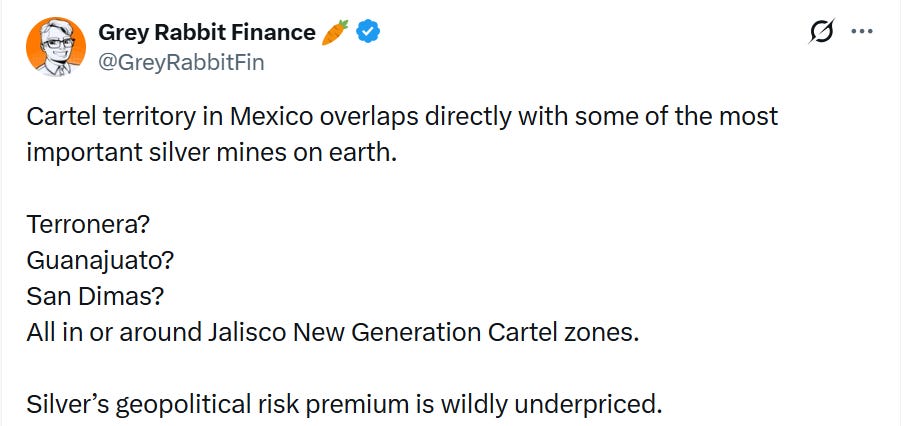
The battlefield now runs straight through some of the richest silver ground on the planet.
-
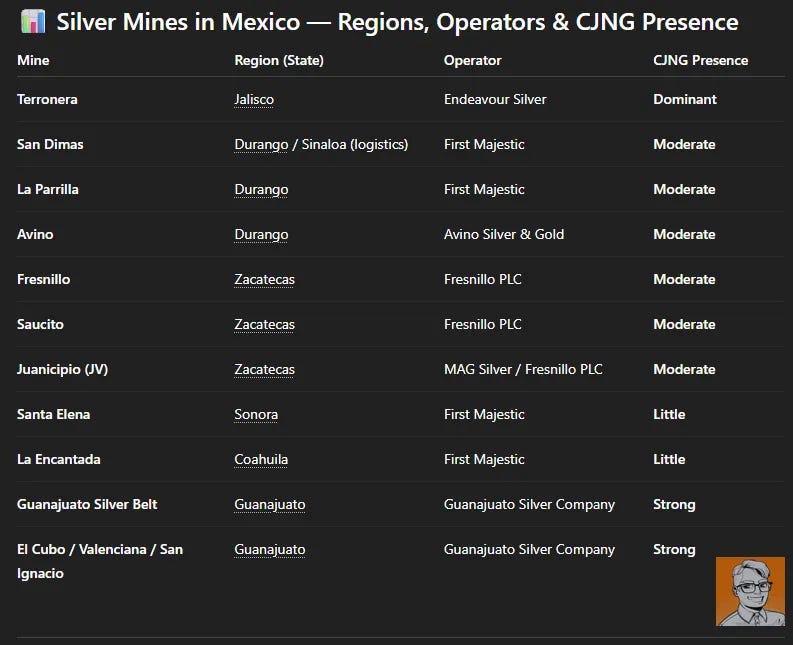
Terronera in Jalisco.
-
San Dimas and La Parrilla in Durango.
-
Avino in Durango.
-
Fresnillo, Saucito, and Juanicipio in Zacatecas.
-
Santa Elena in Sonora.
-
La Encantada in Coahuila.
-
The historic Guanajuato Silver Belt, including El Cubo, Valenciana, and Ignacio.
-
On paper, these are world‑class assets in a friendly NAFTA‑era jurisdiction.
-
In reality, they sit on or near territory disputed or dominated by the same cartels that U.S. agents keep getting caught doing business with.
Your Mining Stock vs. Their War Zone
The official story sells a familiar fantasy to North American investors: Mexico is politically messy, yes, but the “rule of law” holds where it counts. You might see some tax changes, a labor reform here, a royalty tweak there—nothing a good technical report and a discounted cash flow model can’t handle. What’s almost never priced in is what happens when the “war on drugs” mutates into a semi‑official, semi‑theatrical conflict designed less to stop narcotics than to justify budgets, contracts, and interventions.
Here’s how that machine works.
-
First, you tolerate or enable the flow of guns south and drugs north. Sometimes, as with gun‑walking schemes, you literally sign off on it.
-
Violence explodes, and cartel names like CJNG become global brands of terror.
-
Then you televise the chaos back to U.S. voters: burned‑out trucks, mass graves, families fleeing.
-
Suddenly it’s not just a law‑enforcement problem; it’s a national‑security crisis.
-
Politicians talk about “taking the gloves off,” labeling cartels as terrorist organizations, even sending in U.S. troops.
-
Defense stocks rally. Security contractors get new contracts. The “war on drugs” is renewed, upgraded, re‑packaged.
When Ore Bodies Become Hostages
What never makes the brochure is what that looks like on the ground where silver is actually mined. It’s not just a higher line item for “security.” It’s convoys hijacked on state roads, extortion at the mine gate, explosives going missing, workers kidnapped on their way to night shift. It’s local politicians choosing between doing business with the cartel or ending up in a ditch. It’s community protests that start as labor disputes and get co‑opted by criminal groups. For a Toronto or New York fund manager, that shows up as delays, cost overruns, “community issues,” and then, one quarter, an impairment charge that quietly vaporizes a chunk of NAV.
This is exactly why Ross Beaty — founder of Pan American Silver and chairman of Equinox Gold — has warned about exposure to Mexico. In discussing the shutdown of Los Filos, he noted that when they were forced to close the mine due to instability, “if we were only holding that one asset, our valuation would have gone to zero.”
Barrick Gold, the world’s second-largest gold miner, operates across the US, Canada, South America, Africa, the Middle East and Asia-Pacific, but has no producing mines or projects in Mexico. Is this a coincidence or some masterful due diligence?
The deeper the CIA and its cousins burrow into this terrain—arming, infiltrating, manipulating factions under the cover of fighting them—the more unpredictable the map becomes. Today the Jalisco New Generation Cartel is the monster. Tomorrow it’s a splinter group that got better terms from another foreign patron. Each shift re‑draws risk across Jalisco, Durango, Zacatecas, Guanajuato, Sonora, Coahuila—exactly where North American investors have parked billions of dollars of capital in underground ore that can’t just be picked up and moved.
CIA Playbook, Investor Bloodbath
History gives you the likely ending. U.S. clandestine adventures in Latin America almost never deliver long‑term stability. They deliver spikes of violence, waves of migration, and then, eventually, another “crisis” that must be managed, funded, securitized.
The locals pay in blood. Foreign capital pays in slow‑motion theft: nationalizations at the bottom of the cycle, new taxes and royalties imposed when balance sheets are weakest, or outright loss of control when states cut deals with armed groups just to keep the lights on.
If your brokerage app shows a neat list of Mexican silver names, none of that is reflected in the price. The market still values these companies as if they operated under Canadian risk with Mexican wages. It assumes that whatever happens with cartels, Washington will ultimately prefer “stability” over chaos. But the emerging pattern suggests something darker: chaos itself is an asset class. The same state that claims to fight drugs has a decades‑long record of cultivating, weaponizing, and riding that chaos for strategic and financial gain.
Mexico, then, is not a benign “emerging market discount” story; it is the front line of a manufactured instability cycle in which silver mines are fixed targets and shareholders are the last to know they’ve been drafted. If the CIA‑era playbook of arming, infiltrating, and “managing” cartels continues, North Americans buying Mexican silver equities are not just betting on ounces in the ground—they’re betting against an empire that profits from chaos. And in that kind of war, the ore stays where it is, but your capital doesn’t.
If the military‑industrial complex is arming both sides of the border—U.S. agencies letting guns flow south while defense contractors cash in on the “war on drugs”—you are the feedstock in their machine. Every dollar you put into a Mexican silver miner operating in cartel country becomes potential collateral damage: shutdowns, blockades, kidnappings, seizures. While defense stocks tick higher on every new escalation, your equity bleeds out in write‑downs and “security incidents.” The question isn’t just, “Is silver cheap?” It’s, “Do you really want to be the counterparty that supplies the losses this system needs to keep feeding?”
end of segment
-
our opinions are not our sponsors opinions
-
the editorial department is separate from the promotions department
-
not financial advice