
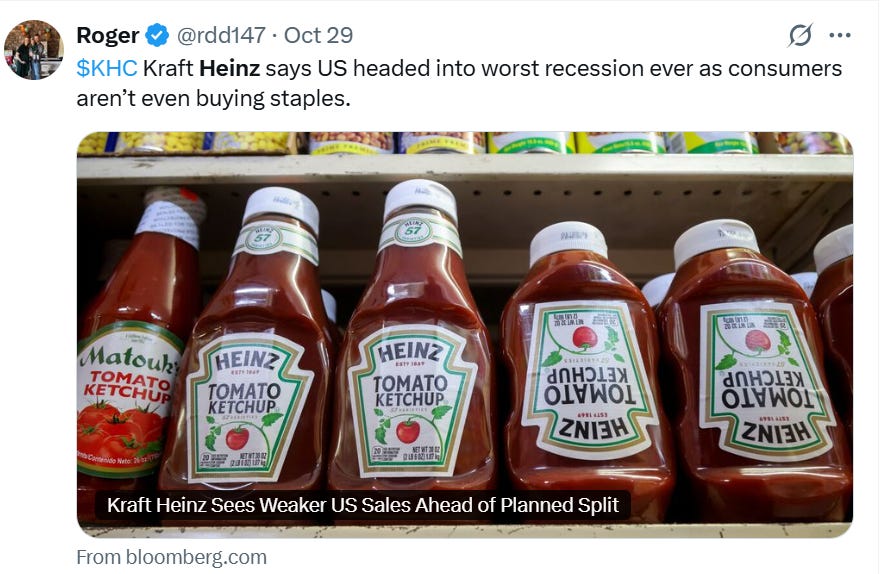
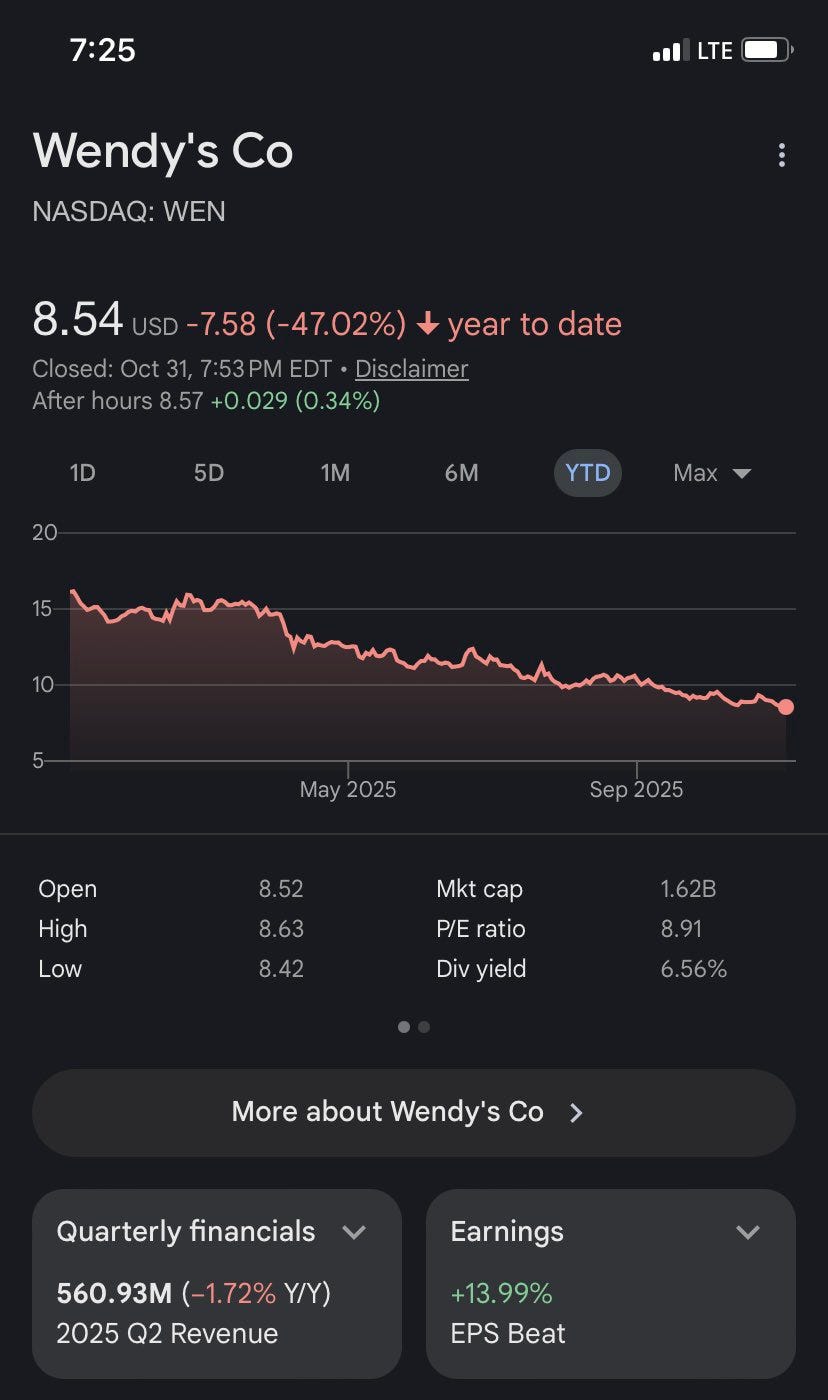
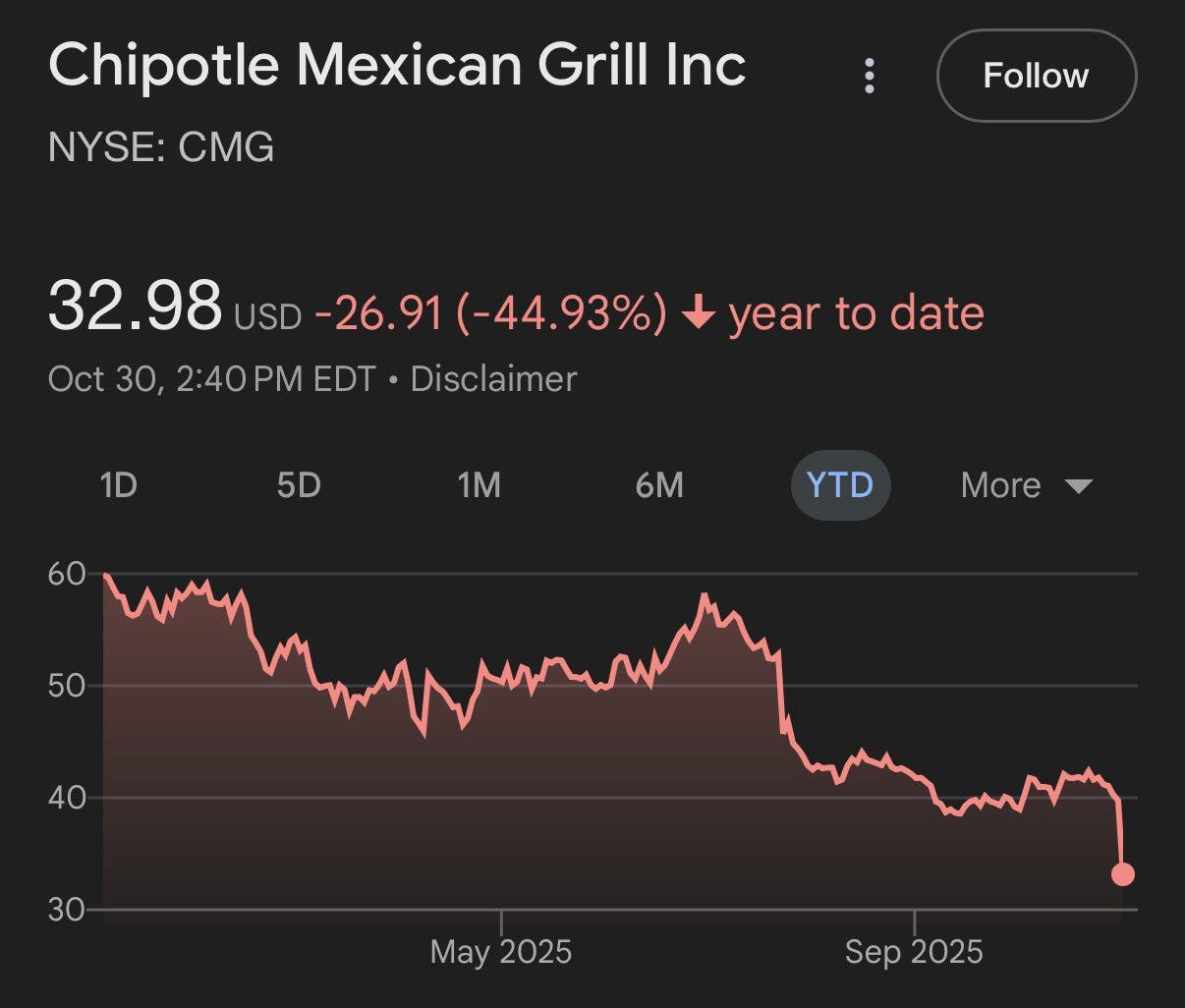
The collapse of American purchasing power is no abstract chart—it’s now a burrito bowl and ketchup packet crisis. Chipotle’s sales have cratered 45% this year as 25-to-35-year-olds simply stop eating out, while Wendy’s is down 44.93% and Heinz can’t sell condiments worth a dime.
Meanwhile, UPS and Amazon are axing tens of thousands as consumers drown in debt and despair. The dollar, since being severed from gold, has lost 97% of its worth—another 11% gone since President Trump returned to a broken, counterfeit economy built on fake stimulus and grotesque “liberation day” tariffs masquerading as patriotism. These policies are gasoline poured on a collapsing monetary order. Oil no longer anchors prices because the empire’s wars, sanctions, and economic shadow boxing have incinerated stability. The United States wages economic war not only abroad but upon its own people—each paycheck now a casualty of monetary insanity.
Debt Trap, Fractional Reserve Banking, Money Printing & Usury.
Intentional Acts of Coercion.
The Cantillon Effect, amplified by money printing, usury, and fractional reserve banking, shifts new money to elites first, driving up asset prices while inflation erodes workers’ real income. Endless fiat printing, often to fund wars, spreads inequality and leaves ordinary people impoverished, forced into high-interest credit cards—often exceeding 20%—from companies like Capital One. Predatory marketing, even leveraging celebrities like Samuel L. Jackson, targets minority and poor communities, enticing them into high-cost debt traps (“What’s in your wallet?”), or into unaffordable rent-to-own scams like Aaron’s, deepening cycles of poverty and desperation.

Aaron’s Rent to Own often charges two to three times the retail value for furniture, appliances, or electronics via weekly payments, with effective interest rates sometimes exceeding 100%—and in cases, reaching up to 311% on certain products like computers or microwaves. A couch, dining room set, or computer priced at $600–$800 retail can cost $1,500–$2,500 or more by the end of the lease term. This is predatory because it targets people with poor credit, offering instant access but trapping them into exorbitant long-term payments that far exceed market value, exploiting financial hardship and leaving customers with little recourse if they fall behind.
Aaron’s Rent to Own offers products ranging from essential home items like washers, dryers, couches, tables, and chairs to unnecessary goods like gaming consoles—PlayStation and other electronics. Families with poor credit or low cash reserves are lured into flexible payment plans that seem affordable at first but, over a year or two, result in total payments exceeding 300% of the retail price. What looks like a solution becomes a predatory trap: customers can pay $2,100 for a couch worth $700, or over $1,000 for electronics selling for $300, deepening financial stress for those already vulnerable.
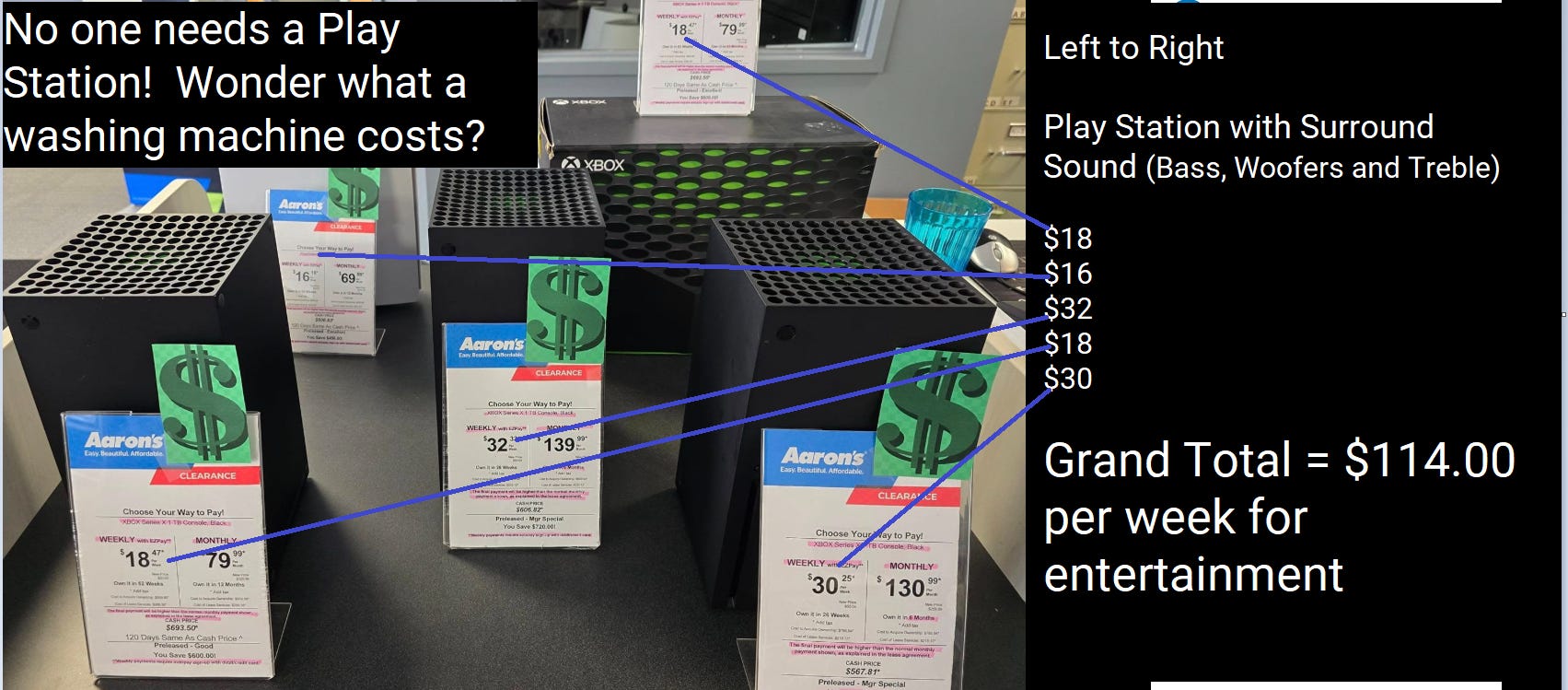
Aaron’s treatment of the poor reflects the U.S. economic system: both are predatory by intent. Debt traps, enabled by fractional reserve banking and unchecked money printing, create systemic usury and coercion, pushing the most vulnerable into cycles of poverty. Like U.S. monetary policy’s inflation and war funding, Aaron’s lures desperate families into leases with obscured terms and punishing interest, extracting far more than the original value through complex, often misleading contracts. These practices are not accidental but intentional acts of economic leverage over those with the least power.
USA Treatment of Latin America Summarized
DEBT TRAP
USA is Like Aarons (PREDATOR) and Latin America is the PREY
The USA and IMF set a debt trap for Latin American emerging markets through loans attached to strict conditions, including austerity, privatization, and market liberalization. These measures often suppress growth, worsen poverty, and reduce sovereignty, forcing countries into cycles of borrowing just to pay interest on old debts. As debt mounts—partly fueled by surging global interest rates set by the US—countries surrender control over key sectors and endure deep social cuts, leaving their economies dependent on foreign lenders and vulnerable to crisis, all while inequalities expand.
Three marquis examples of U.S. exploitation in Latin America are Honduras bananas, Cuban sugar, and regional coffee. In Honduras, United Fruit and Standard Fruit (Dole) used political and military leverage to control land, labor, and resources, making the nation a “banana republic” serving U.S. interests. Cuba’s sugar industry was dominated by American sugar barons, with profits flowing north while workers remained impoverished. Coffee in countries like Colombia and Guatemala fueled U.S. fortunes as local growers faced debt, dispossession, and violence, while U.S.-backed regimes ensured market access and suppressed reform efforts
U.S. exploitation of Latin America extends well beyond bananas, sugar, and coffee to modern agribusiness giants like Purina, Nestlé, Cargill, and Dole. These corporations dominate export sectors, control land, and shape agricultural production to serve developed country markets, with little concern for local food security or labor rights.
For instance, Nestlé’s and Purina’s investment in massive pet food facilities in Mexico reflects how Latin America’s agriculture isn’t just shaped for people’s needs, but for export—including lucrative U.S. pet and cat food markets, now worth hundreds of millions annually. Their supply chains exploit cheap labor, sometimes even involving allegations of forced or slave labor, and further entrench monoculture farming that depletes land and ecosystems. As capital flows north and profits leave local economies, generations of growers and workers face declining real income, land dispossession, and environmental damage. Agribusiness consolidation deepens dependency, with regional governments cutting family farm support and land reform, leaving Latin American agriculture—and even local diets—increasingly shaped by U.S. consumer demand
Activists promoting land reform and food sovereignty in Latin America have frequently faced violent, U.S.-backed opposition, especially when their work threatens elite interests tied to extractive industries and agribusiness. Graduates of the School of the Americas in Georgia, notorious for training Latin American military in counterinsurgency, torture, and assassination, were involved in massacres, torture, and suppression of popular movements, labor organizers, and religious figures advocating equality.
U.S. and CIA opposition to land reform in countries like Honduras stems from American corporate interests—especially those of United Fruit (now Chiquita) and Dole—who owned vast swathes of arable land. Progressive political parties sought land redistribution to benefit the poor, threatening U.S. company profits and control. The U.S. labeled these reforms as “communist,” pressuring or deposing reformist leaders through diplomatic, economic, and covert CIA interventions to protect monopoly interests, maintain favorable conditions for American business, and prevent shifts in land ownership that might reduce U.S. leverage in the region.
The CIA supported coups and paramilitaries targeting those pushing for change. Catholic nuns, including Ita Ford and Maura Clarke, and Archbishop Oscar Romero were assassinated in El Salvador for denouncing injustice and calling for solidarity with the poor.
Romero’s “Christ Loves the Poor” promoted social equality, but his advocacy was met with brutal repression. Overall, thousands of activists have been killed or disappeared, reflecting a systematic pattern of intentional, organized resistance aimed at maintaining U.S. dominance and suppressing grassroots movements for justice and self-determination
Every new act of American aggression in Latin America follows a script as old as empire itself. The U.S. provocation and bombing of Venezuela is not an anomaly but the latest verse in a long hymn of domination—an extension of the same colonial logic that once seized sugar fields, banana plantations, and oil wells. It is a formulaic pattern, cloaked in the language of “freedom” and “democracy,” yet always driven by access, extraction, and control. Whether through debt traps or drone strikes, Washington’s actions echo the same refrain: subordination of nations that dare to act independently beyond its economic orbit.
CURRENT US POLICY ——> 200 year old Monroe Doctrine ——→ MOOT
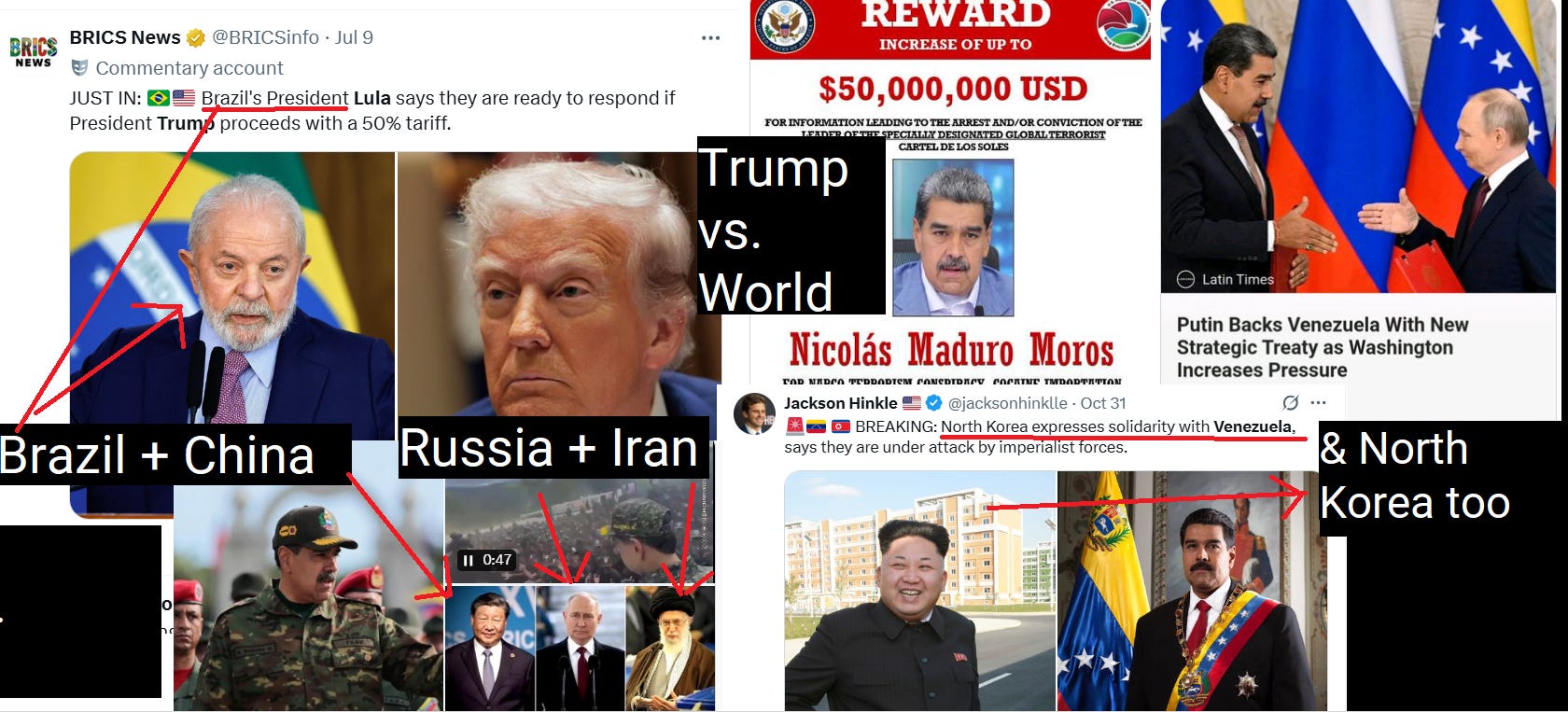
Trump’s aggressive Venezuela policy has created a visible hole in the Monroe Doctrine, rather than deterring rivals; it invites Iran, Russia, China, and North Korea to assist Caracas and undermine longstanding U.S. regional authority
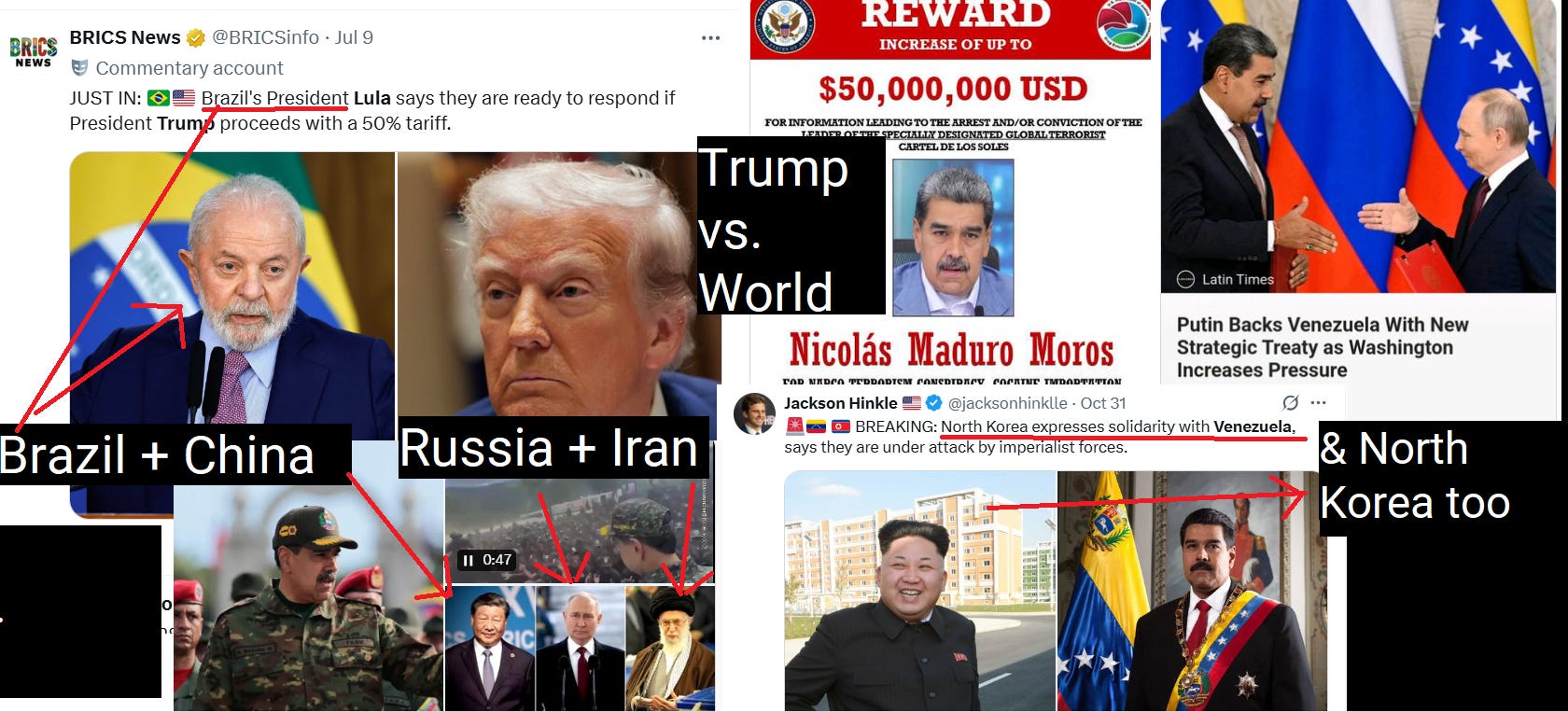
Fury Across the Globe as World Leaders Unite Against Trump’s Undeclared War
China, Russia, North Korea, Iran, and Brazil condemn President Trump’s lawless aggression in Venezuela, denouncing his ruthless military strikes, the $50 million bounty, and the campaign of irrational economic warfare waged through tariffs, sanctions, and erratic social media threats.
another Sunday Silver Sermon
Silver and gold have long represented honest trade and genuine economic value among people and nations, embodying foundational qualities of sound money. Precious metals are portable, divisible, fungible, and enduring stores of value—attributes that ensure their acceptance in commerce and wealth preservation across generations.
In stark contrast, fiat money is created at will by central authorities, often printed to fund foreign interventions, endless deficit spending, and government programs untethered from real productivity. This uncontrolled expansion of fiat currency devalues savings, fuels cycles of inflation, and directly contributes to social hardships like skyrocketing rents, predatory rent-to-own schemes, and economic misery for working families.
Meanwhile, the United States—whose currency underpins the global system—relies heavily on deficit spending sustained by a military-industrial complex deeply entwined with its economy and politics. This system funnels massive resources into both kinetic wars abroad and domestic war-making capabilities, all propped up by an ever-expanding supply of paper money. As a result, militarism and the printing press go hand in hand, eroding the promise of genuine prosperity and siphoning value away from Main Street to perpetuate endless cycles of conflict and financial engineering.
Gold and silver stand as ethical anchors—rooted in tangible value—while unchecked fiat money enables the perpetual motion machine of aggression, speculation, inflation, and social injustice.
end of segment
our opinions are not our sponsors opinions
editorial department is separate from promotions department
not financial advice