
SILVER IS ABOUT TO EXPLODE – AND THIS TIME, IT’S FUNDAMENTAL
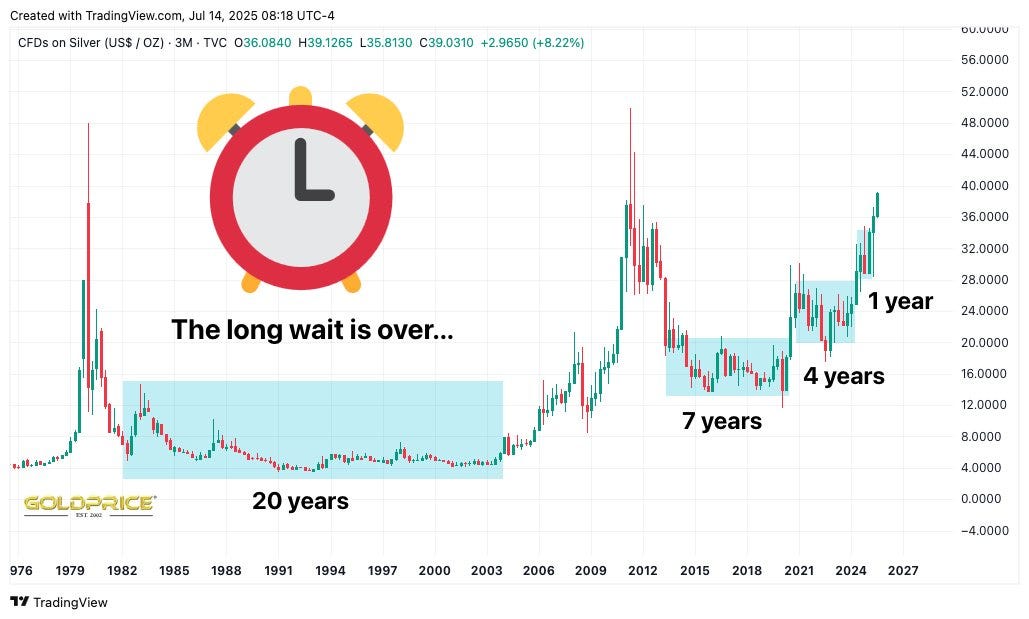
For over four decades, silver has moved in cycles of long, frustrating consolidation, followed by rapid, aggressive surges that reprice the market almost overnight. In the last 45 years, there have been four major periods of stagnation. The first lasted 20 years. The second, 7. The third, post-COVID, hung on for 4 years. Most recently, we’ve emerged from a new 12-month holding pattern. The trend is clear: the consolidation periods are shrinking. The liftoff phases are coming faster—and with more force.
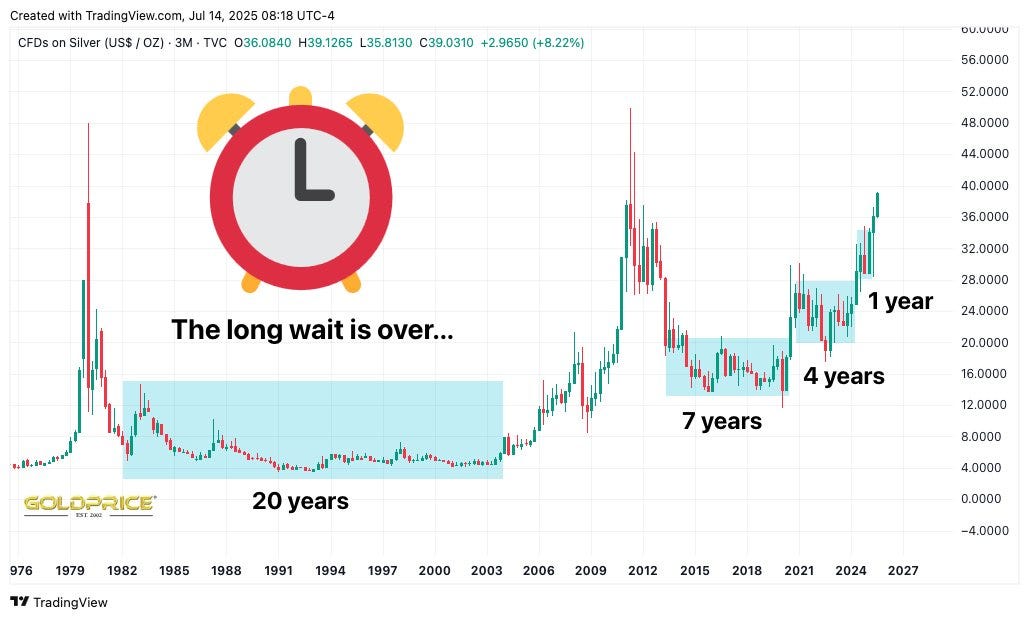
image credit | @thesilverhermit via Twitter | follow him please
This isn’t random. Silver has always behaved this way. One moment it appears comatose, the next it tears through resistance with zero regard for consensus or forecasts. But what’s about to occur now has no historical precedent.
We are staring down the barrel of the most powerful move in silver’s history—and this time, it’s not rooted in hype or hope, but in raw, inescapable fundamentals.
RELENTLESS INDUSTRIAL DEMAND IS OUTSTRIPPING SUPPLY
The surge of silver demand from industrial and technological sectors has gone from strong to absolutely historic. Photovoltaic (solar) demand is setting records year after year. In 2025 alone, nearly 180 million ounces are projected to be used by the solar industry—a staggering 14% of total demand. There is no substitute for silver in photovoltaic cells. As governments race to meet net-zero emission targets, this demand is non-negotiable and accelerating.
Battery technology is moving in the same direction. Silver-based chemistries are being actively developed to enhance power density, recharge times, and conductivity. As electric vehicles and grid storage become dominant industries, silver’s role becomes more critical—yet few grasp the magnitude of what this implies for supply chains.
Meanwhile, silver’s strategic applications in military and aerospace hardware are expanding rapidly. As global tensions escalate, defense budgets are being dumped into weapons systems, satellites, surveillance tech, and communications hardware that quietly rely on silver as a critical component. These aren’t price-sensitive buyers; they procure regardless of market conditions, putting even more pressure on already fragile global inventories.
Beyond these sectors, everything from 5G infrastructure to advanced robotics, hyperscale data centers, medical technologies, and precision electronics is devouring silver. We do not live in a copper world—we live in a conductive world, and silver sits at the top.
THE SUPPLY SIDE IS FAILING TO KEEP UP
While demand breaks new ground, supply is failing—systemically and irreversibly. We’re now in the fifth straight year of a structural supply deficit. The Silver Institute estimates a deficit of 117 million ounces for 2025. But that is a very conservative figure (I would double that given the news we broke yesterday)
That comes off the back of over 678 million ounces of net shortages from 2021 to 2024—a figure that has already gutted global above-ground inventories and left the market vulnerable to even the slightest supply shocks.
Exploration budgets are down. Ore grades are in terminal decline. New mines take 7 to 10 years just to reach production, and permitting is only getting more difficult. Add to that the threat of geopolitical instability in key mining regions—from Latin America to North Africa—and you’ve created a supply dynamic that is not just tight but potentially catastrophic.
THE MACRO BACKDROP: A TINDERBOX
Zoom out further, and the macro environment is nothing short of explosive. Global debt levels are past any rational point of return. Central banks are trapped between inflation and insolvency. Fiat currency trust is eroding. And geopolitical conflict is more widespread and volatile than at any point in the last 50 years.
The financial system is showing structural fractures. Escalating banking crises, failing bond markets, and rapid de-dollarization measures by emerging powers have transformed silver from a neglected metal into a monetary pressure valve. Investors who once saw silver as optional, now see it as essential.
When capital can no longer find safety in traditional instruments, it flees into reality—into tangible assets. Into metal. Silver, with its industrial necessity and monetary heritage, is uniquely positioned to benefit from both panicked capital and production-driven demand simultaneously.
CONCLUSION: THIS IS NOT A DRILL
Silver’s next move isn’t routine. It’s not speculative. It’s the result of physical imbalances, soaring demand, and crumbling trust in the artificial scaffolding of modern finance. This move won’t be gradual. It will be violent. It will be fast. And it will leave most behind.
The time for patience is over. The great revaluation has begun.