
Context:
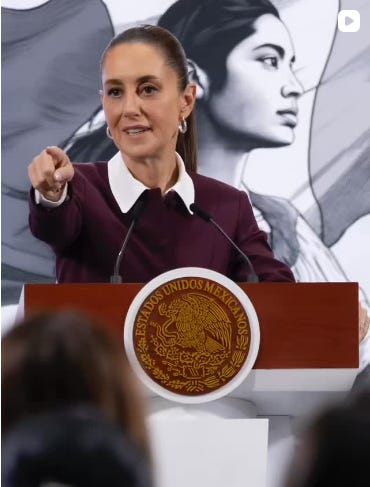
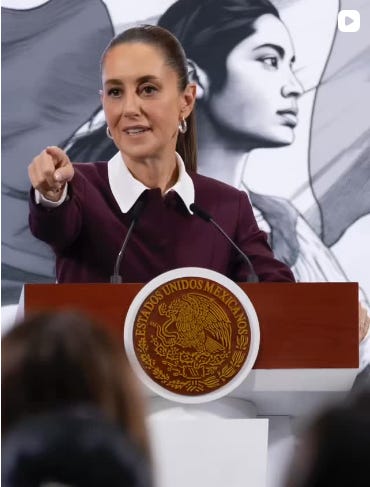
Morena’s current party logo, displayed at all campaign stops (situated behind Mexico’s President Claudia Sheinbaum Pardo,0 is rich in symbolism.
It features a young Indigenous woman holding Mexico’s national flag, reflecting a deep connection to the country’s Indigenous heritage and emphasizing the empowerment of all Mexicans, especially marginalized groups.
The name “morena” itself means “brown” or “tan,” relating both to Mexico’s majority population and invoking the image of La Virgen de Guadalupe, a powerful symbol for the nation’s vulnerable communities.
The woman’s leftward gaze specifically signifies a pursuit of justice, freedom, and progressive ideals, underscoring Morena’s vision of societal transformation. The flag further highlights Morena’s commitment to national values and sovereignty. This emblem encapsulates the party’s focus on social justice and inclusive national identity.
Inside Mexico’s Silver Revolution: How the Morena Party’s Grassroots Crusade Is Remaking a Nation
In 2025, Mexico finds itself at the heart of an unprecedented transformation—one that is being felt from its sunbaked rural villages to the world’s most sophisticated trading floors. But what, precisely, has swept this country into such a whirlwind of change? And who are the people behind it?
To understand this revolution, we need to start at the grassroots. The rise of the Morena party isn’t just a story of politicians and policy papers; it’s the story of campesinos, factory workers, Indigenous peoples, and everyday citizens who, for generations, watched Mexico’s mineral riches flow out of the country while they struggled to provide for their families. So, how did those who were once sidelined by powerful elites become the driving force behind the nation’s transformation?
Under Morena, these marginalized voices joined forces—turning popular frustrations into power. Their message was simple: “The resources of Mexico belong to the people of Mexico.” But what happens when such a call moves from protest slogans into the heart of government?
The answer: profound change. The Morena administration quickly set about remaking Mexican society. Wages rose. Pensions were extended to all elders. Universal healthcare and free education became rights rather than privileges. Vast public works projects, from green technology initiatives to new homes for the marginalized, sprang up across the country—all fueled by a radical redirection of resource wealth. Can sweeping social justice programs truly lift up those historically pushed to the margins?
Yet while these policies won broad support at home, they sent shockwaves abroad. Why? Because at the core of Morena’s vision is an uncompromising commitment to resource nationalism. No new mining concessions would be granted, President Claudia Sheinbaum announced, and existing contracts came under new scrutiny—especially those controlled by foreign interests. So, with Mexico’s doors closing to overseas mining giants, what would become of the country’s legendary mineral wealth?
Bit by bit, Morena brought critical industries back into Mexican hands. Oil, lithium, and the massive Vulcan quarry all shifted to state control.
And in a move that left global markets reeling, Mexico—the world’s leading producer of silver—declared it would bring the entire silver sector under state management. How would the world react as the so-called “era of Mexican silver” began?
The consequences were immediate. Commodity prices soared. Investors, particularly from the United States and Canada, rushed to sell off their mining stakes, spooked by the specter of nationalization. Meanwhile, Mexico’s new strategy saw it selling silver and other resources directly to China, forging fresh alliances with Russia and BRICS partners. Would this realignment—away from the U.S. and toward new global players—help Mexico achieve true economic independence, or invite fresh risks?
One fact remains clear: the profits that once enriched foreign shareholders are now funding free clinics, expanded public transportation, and environmental restoration at home. Morena insists this is long-overdue restorative justice for the nations’ workers, farmers, and Indigenous communities. But will these reforms prove as sustainable as they are bold, and can this new model inspire others across Latin America and beyond?
As Mexico steps into its so-called Fourth Transformation, the world is left watching and wondering. Is this the long-sought moment when the riches of a nation finally begin to serve its people? The answer, it seems, will be written not just in laws and decrees, but in the lived realities of those who, for the first time, have a direct hand in shaping their country’s future.
Breaking News Today
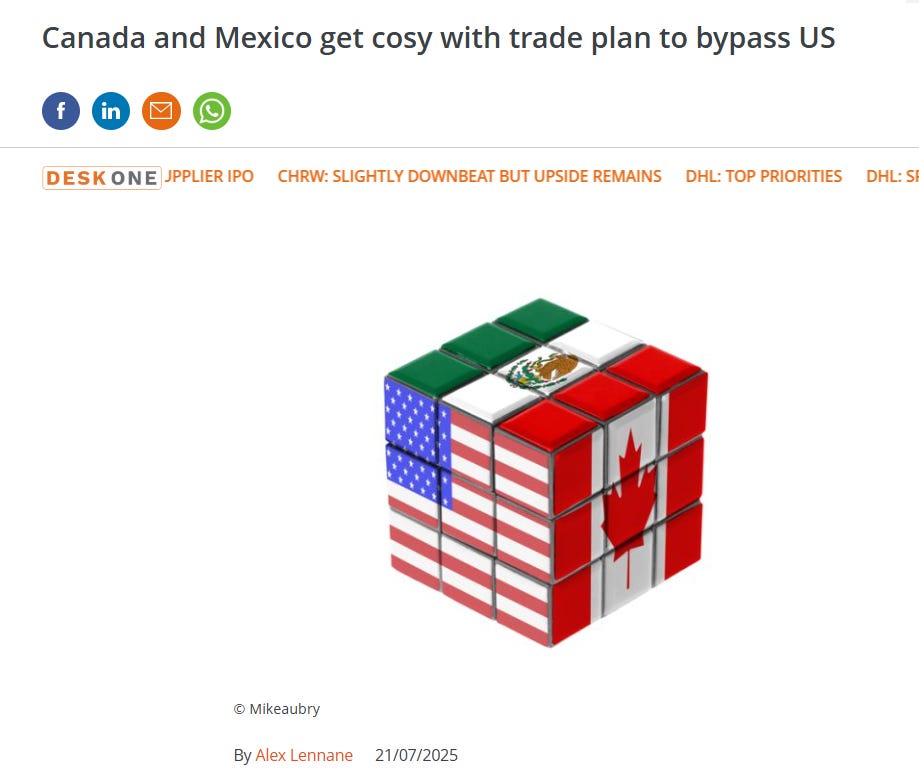
Canada and Mexico are launching the $120B Northern Corridor, a new trade route created to bypass U.S. tariffs and customs. It will reduce reliance on the U.S. and avoid Trump-era tariffs, it’s set to boost their economies.
Throughout history, whenever barriers have been erected—be they economic, legal, or political—people have always found a way around them. Trade is the great testament to human ingenuity’s refusal to be boxed in. From the smugglers of colonial Rhode Island evading British tariffs, to modern-day transshipment schemes shuttling goods through third countries, the lesson is ever the same: if there’s an obstacle, someone will create a new path of less resistance.
Today’s boldest reminder comes in the form of the $120 billion Northern Corridor, the colossal trade route now being built by Canada and Mexico. This project isn’t just a highway—it’s a paradigm shift in North American trade, a decisive response to the cascade of tariffs unleashed by the United States in the last several years. With President Trump’s administration imposing tariffs as high as 30% on steel and auto parts from both neighbors, the economic incentive to innovate became overwhelming. The result? Canada and Mexico are carving a direct logistical and economic bypass, rerouting commerce, and recalibrating continental power.
The Northern Corridor knits together rails, ports, and digital customs in a seamless artery that avoids U.S. soil, customs, and tariffs entirely. Canadian lithium, nickel, steel, and lumber flow straight to Mexico by rail and ship, while Mexican auto parts and batteries reach Canada without touching a single U.S. border checkpoint. It’s an embodiment of “where there’s a will, there’s a way” economics. By 2028, it’s projected to shift more than $69 billion of annual trade that previously crossed the U.S., depriving American ports and logistics firms of lucrative transit fees and customs revenue.
This is not an aberration but a historical constant. When new taxes or barriers emerge, so do workarounds—whether clever, subversive, or entirely legal. In the colonial period, American merchants exploited every inlet and cove to move goods beyond British control. Smuggling was not just a criminal enterprise; it was a political act, a way to nullify laws perceived as unjust or excessive. In our own era, tariff evasion combines advanced strategies: misrepresenting countries of origin, transshipping goods through loophole havens, or simply reclassifying products with trivial modifications to secure a lower duty. The moment the U.S. cranked up tariffs on Chinese steel, shipments started pouring in via Malaysia or Vietnam, often with little more than new paperwork or light repackaging to mask their source.
What the Northern Corridor demonstrates is the scale such ingenuity can reach when entire nations align their interests. Far from just skirting a tariff, Canada and Mexico are building green logistics infrastructure, integrating blockchain-based digital customs, and harmonizing regulations at a continental level. They’re not only escaping an economic penalty—they’re ushering in what they hope will be a cleaner, faster, more autonomous system. The fact that global shippers are already lining up to use this new route—at a projected cost per ton far below U.S. alternatives—underlines its staying power.
The political message is just as clear. “Canada prefers cooperation, but we are prepared to decouple from the U.S. if forced,” Canadian officials have warned. Mexico, for its part, is leveraging the corridor’s green credentials and digital integration to woo Asian and European partners, deepening its own economic resilience. Whether or not the U.S. rolls back tariffs in the future, the economic logic of the bypass may prove irreversible. Once new supply chains are drawn, history shows, they rarely revert: “Path dependency” means the route of least resistance becomes the new normal.
None of this should surprise the student of history. Tariffs and blockades have always been blunt tools; evasion, circumvention, and adaptation are the sharper instruments wielded by those on the receiving end. Sergey Glazyev, the Russian strategist, recognized as much when, under sanctions, he insisted “there will always be someone willing to trade a barrel of oil for a gram of gold.” It’s invariant: every barrier begets a workaround.
The Northern Corridor’s bypass is audacious, but it is not unprecedented. It is the latest, largest entry in a story as old as trade itself. Build a wall, and someone will dig under, climb over, or simply walk around. Human ingenuity—and the ever-restless logic of commerce—guarantees it.
end of segment