
by Jon Little intern Niko Moretti
The Tariff Tantrum: When Recklessness Replaces Reason
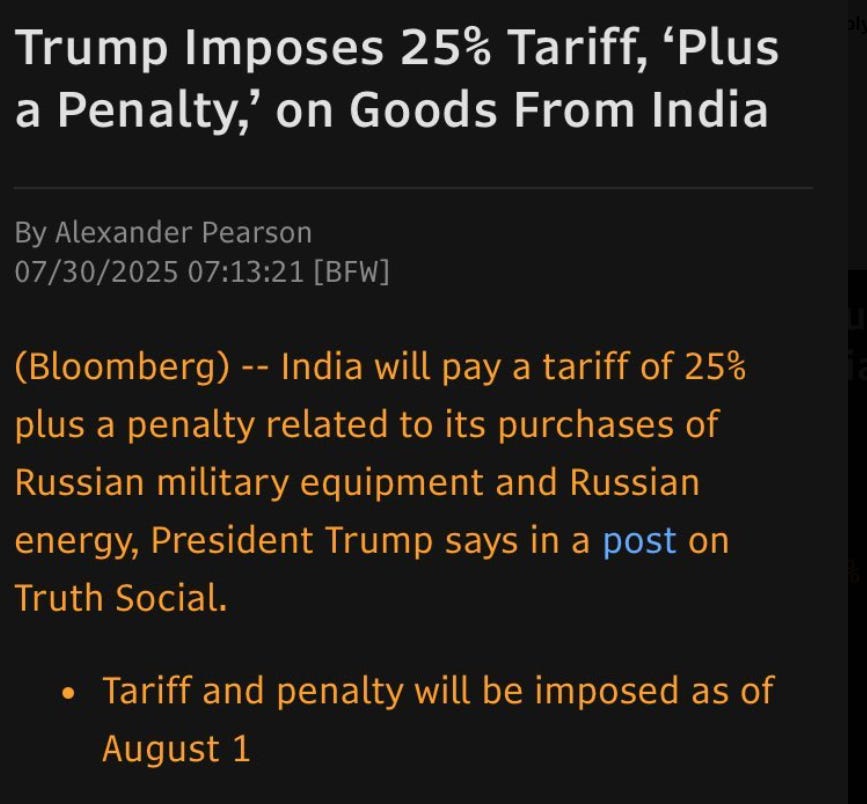
It is a spectacle of blistering incompetence when the “leader of the free world” acts with the scattergun recklessness more suited to a rogue nation’s economic strategy than a superpower’s stewardship. And yet, here we are. President Trump—doubling down on his failed economic bravado—has just slapped India with a 25% tariff, plus an undefined “penalty,” for buying Russian military equipment and not rolling over fast enough to American trade demands.
Are You Not Entertained? Or Just Bullied and Baffled?
Before you read on—stop and ask yourself: How much faith can you have in a president whose only consistent trade doctrine is volatility, confusion, and shortsightedness?
Planning Gone Poof: The Trump Effect on American Business
How did we reach the point where U.S. business leaders can’t plan their quarterly budgets, price their goods, or even confidently move a truck or shipping container across the border without bracing for the next jolt in Trump’s economic rollercoaster? When decision-makers are left blind—unsure which country, which product, or which supply chain will be taxed next—what happens to American jobs, investments, and consumer prices?
Tariff Promises, Empty Pockets: The Jobs That Never Came
You might be wondering: Didn’t Trump promise that tariffs would bring jobs “roaring back” to the USA?
Let’s be clear: They did not. Main Street bears the cost every time tariffs are ratcheted up—U.S. manufacturers pay more for factory inputs, pass those costs to consumers, then risk losing customers to foreign competitors. Even international banks and the IMF now forecast that ongoing tariff turmoil will shave up to 1% off U.S. GDP, and push the global economy steadily downward. Meanwhile, CEOs are scrambling to build “geopolitical war rooms” just to keep up with the capricious whims of this administration.
Welcome to the Funhouse: Is This Your Idea of Smart Dealmaking?
Does this sound like the “smart dealmaking” Trump’s base hallucinated in 2016?
With “Friends” Like These: Who Needs Enemies?
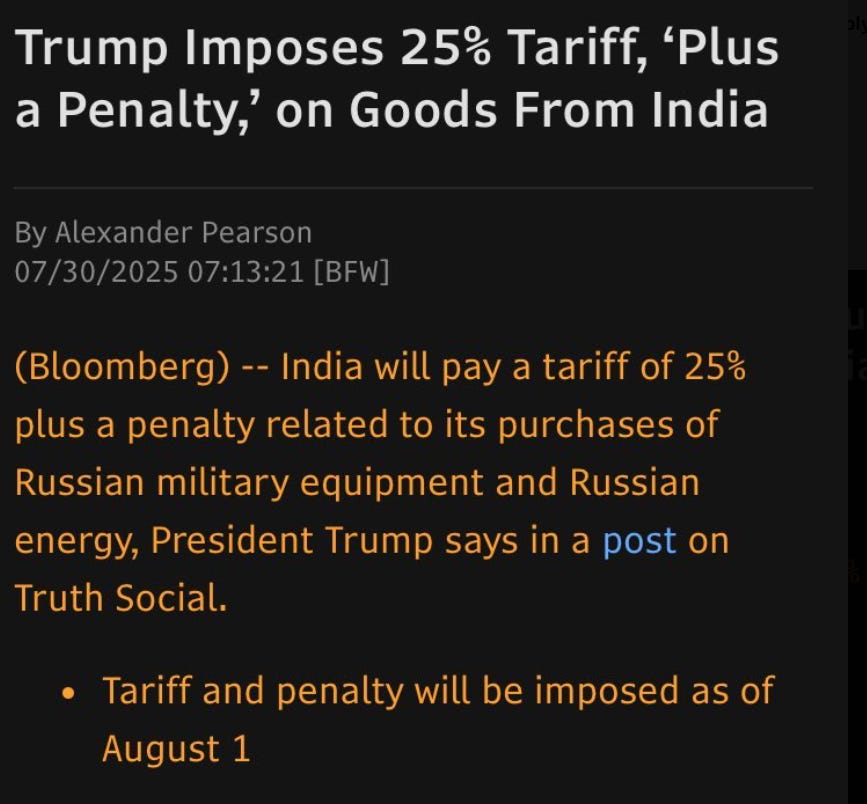
Ask yourself: If India is now, in Trump’s words, “our friend,” why treat friends with a stick instead of a carrot? Why the heavy-handed coercion—tariffs, penalties, and public humiliation—against one of the most populous democracies on earth, and an aspiring counterweight to China?
The Global Group Chat: Allies Fed Up With America’s Bully-in-Chief
Now, let’s look around the room. Ask Canada, Mexico, the UK, the EU, Japan, and South Korea—America’s historic allies—how they’re dealing with this adversarial chaos. None are unscathed: each has faced threats, actual tariffs, and targeted trade bullying from Trump. One academic simulation showed a unified allied retaliation would hammer the U.S. economy—because collectively, these nations buy over 50% of all U.S. exports, and have the power to impose symmetric pain.
Deal Artistry or Playground Tantrum?
Does that sound like the art of the deal—or the tantrum of a child?
The India-Saudi Tightrope: Geopolitics for Dummies
Unpack the India conundrum further, and things get murkier. India and Saudi Arabia—unlike the firm anti-U.S. alignment of China and Russia—are trying to play both sides, maintaining open doors to the West while hedging involvement in BRICS and maintaining energy or defense deals with Moscow. So what is India: a U.S. partner, a Russian backchannel, a leader of the Global South, or—most cynically—a mole within each club? Why join exclusive blocs like BRICS if you’re unwilling to commit, and invite such public penalties for “nonalignment”?
Looking for Nuance in a Fog of Ignorance
Yet even here, Trump’s approach is laughably ignorant: India has never been aligned closely with most BRICS members on military, monetary, or strategic issues, and is deeply skeptical of the bloc’s cohesion. Many insiders whisper that “I” in BRICS might as well stand for Iran or Indonesia—the fit with India is, to say the least, uneasy.
Diplomacy by Bludgeon: Making Enemies, Not Deals
So why wield the tariff cudgel now, against a “partner” who might be, if not a staunch ally, then the least problematic “swing state” in the global order? Why provoke a crisis when, by all accounts, India’s balancing act reflects decades of being alternately dominated and betrayed by Western interests?
Spoiler: It’s Not Strategy, It’s Stupidity
Here’s the ugly truth: it’s not strategy, it’s stupidity. The Trump administration’s ignorance of history, nuance, and economic reality has fueled chaos that will outlast the president’s term, with business leaders worldwide forced to react to headlines rather than long-term logic. U.S. global leadership, built slowly and painstakingly since 1945, is being demolished with all the research and foresight of a Twitter tirade.
Winning? Ask the Rubes Cheering the Wreckage
Ask yourself: If “making America great again” requires putting a loaded gun to the head of every trading partner—leaving business, consumers, and allies to suffer the whiplash—who, exactly, is winning?
Cheering for Carnage: The Sorry State of Trump’s Support Base
Lastly, ponder the voters who still cheer this trainwreck. Are they wilfully blind, intellectually bankrupt, or simply so desperate for easy answers that any demagogue will do? Because supporting trade war blunders, jubilant economic nihilism, and clownish international bluster is not a sign of patriotism—it’s proof of pitiable, low-functioning critical thinking.
The Final Question: How Low Will America Go?
America, you deserve better. The rest of the world is wondering how much more stupidity you’re willing to inflict upon yourself—before you finally pull the emergency brake.
Gold and Silver are Just Loving this Chaos
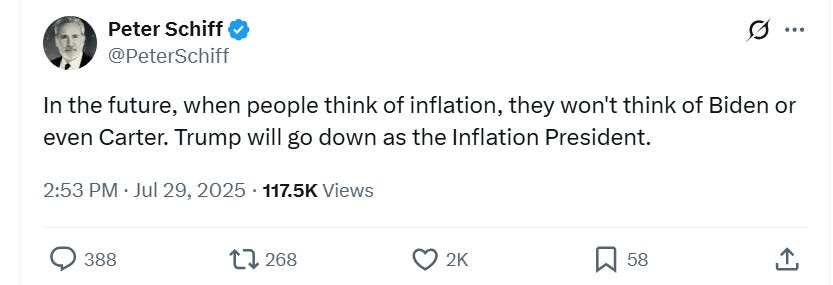
As the curtain falls on this era of economic absurdity, one truth gleams through the wreckage: in times of maximum doubt, gold and silver rise from mere commodities to oracles of lost faith. If prosperity is built on trust, then today’s world—shaken by the tumult of Trump’s trade wars, ethics scandals, and vanishing approval—has instead invested in its deepest anxieties. As Jon Forrest Little wryly observed, “gold and silver drop like a rock when people trust the system, but skyrocket to the moon when they don’t”—and trust, at this crossroads, is nowhere to be found.
What has this administration truly achieved? It has transformed gold and silver from historical relics to essential life rafts. Central banks, sovereign funds, and institutional giants now scramble to hoard anything that glitters, while ordinary people, battered by collapsing jobs and a terminally ill dollar, clutch for “poor man’s gold” as a last hedge against disaster. From Wall Street suites to blue-collar strongholds, the message is unmistakable: chaos is currency, and Trump is gilding the vaults of every precious metals dealer on the planet.
You may ask: Who has benefited most from this manufactured madness? Not the American worker, certainly—not with record deficits, relentless layoffs, and an economy sabotaged by clumsy tariffs and erratic posturing. But for bullion and those astute enough to distrust a crumbling system, these are golden days indeed.
Call it poetic irony, or just cruel economics: the bigger the bluster, the deeper the distrust, the higher the metals soar. As faith in leadership evaporates—under the weight of scandal, fractured allegiances, and a discredited dollar—hard assets become the last refuge for those unwilling to go down with the ship. Gold and silver, once quaint insurance policies, are now rallying symbols for a world in retreat from institutional folly.
So remember well: chaos may be temporary, but distrust breeds value for generations. As America stares down its own manufactured storms, it is gold and silver—not slogans, not tariffs, not vainglorious politicians—that will weather the age. In this hall of mirrors, even calamity has its winners.
end of segment
-
our opinions are not our sponsors opinions
-
editorial department is separate from promotions department
-
not financial advice
-
buy all gold and silver dips as they are gloriously coiling for next leg up