
By Niko Moretti, Financial News Analysis
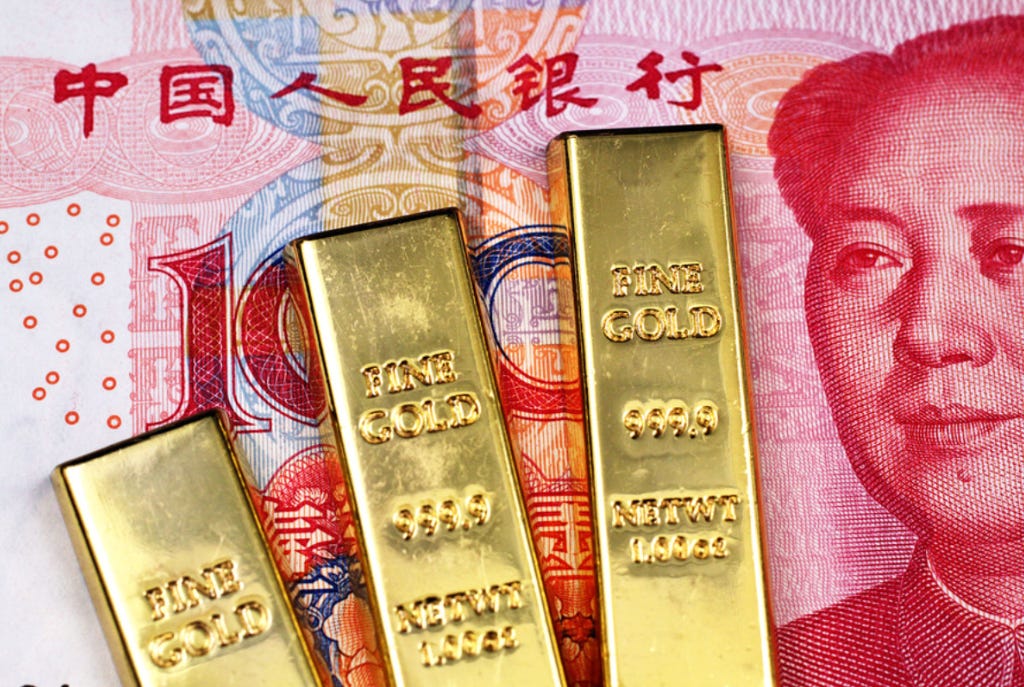
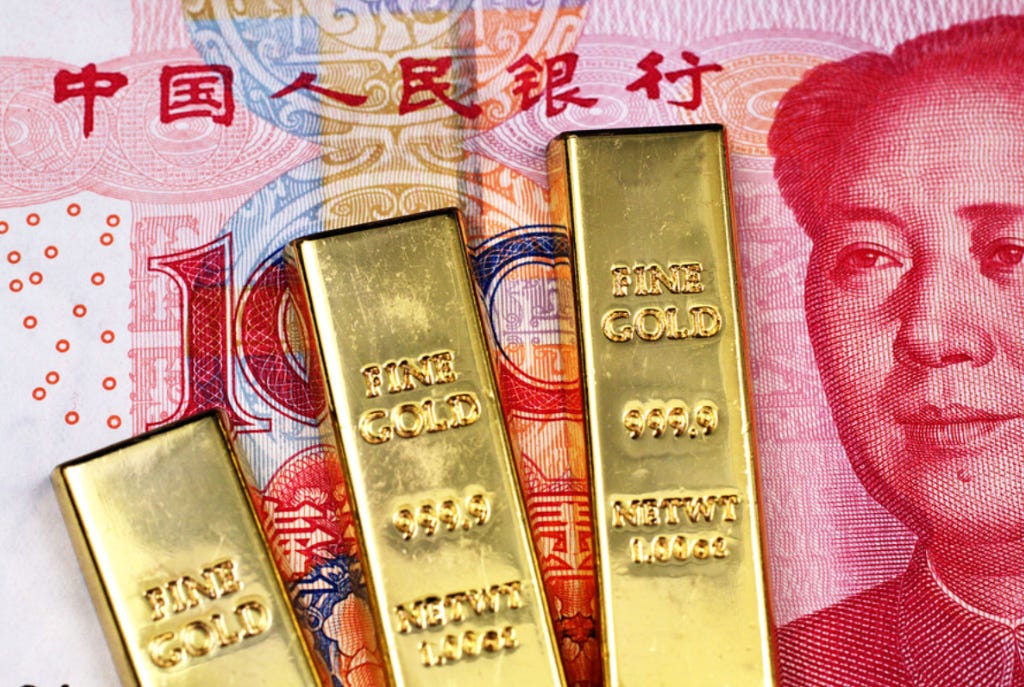
China has just detonated a gold market bombshell. In February 2025, Beijing’s insurance regulator issued a mandate requiring major insurers to allocate a minimum of 1% of their assets to physical gold bullion. At first glance, that figure appears modest. In reality, it is seismic. The decision redirects tens of billions of dollars away from U.S. Treasuries and into non-dollar reserves, advancing China’s de-dollarization strategy while upending the structure of global gold supply and demand.
Now the real question isn’t what this means for China, but what happens if the West follows suit. The consequences could be explosive—catapulting gold higher, reshaping capital flows, and undermining the very foundation of the U.S. Treasury market.
The Scale of China’s Gold Shift
China’s insurers hold an enormous ¥32-38 trillion ($4.5-$5.3 trillion) in assets. That makes the mandated 1% gold allocation worth ¥320-380 billion ($45-53 billion)—roughly 630-750 tonnes of physical gold. Spread over the three-year implementation period, this translates into an annual demand increase of 210-250 tonnes, equivalent to about 15–20% of total global mine supply at current production of 3,694 tonnes per year.
That demand surge comes on top of record central bank buying (exceeding 1,000 tonnes annually) and stagnant mine output. Supply constraints mean only one logical outcome: higher prices. In fact, gold futures are already reacting. Trading above $3,300/oz in August 2025, consensus forecasts project a rise to the $3,700-$4,500 range by year-end, with upside shocks possible if recession fears accelerate flows into safe havens.
But this could just be the beginning. The West is watching in real time—and Western institutions have a long history of following trends set by China’s state planners when they prove successful.
When Western Insurance Funds Follow the Chinese Lead
Globally, insurance and pension funds sit on a multi-trillion-dollar mountain of assets far larger than China’s insurance pool. U.S. insurance companies alone manage over $12 trillion in assets. European firms add another $11 trillion. Together, Western insurance funds represent at least five times the firepower of China’s insurers.
Currently, U.S. and European insurers allocate virtually nothing to gold. If they mimic China’s 1% rule, it would translate into $230 billion in new demand, or roughly 4,000 tonnes of gold at current prices. To put that into perspective, that’s more than one full year of total global gold mine production.
Such a sudden shift would overwhelm supply chains, push premiums for physical bullion far above paper contracts, and almost certainly drive gold prices several thousand dollars higher nearly overnight. $5,000 gold would cease to be a speculative headline—it would become the floor, not the ceiling.
At the same time, Treasuries would feel the pain. China’s $769 billion in Treasury holdings are already in decline. But if Western institutions also begin trimming U.S. government debt in favor of gold, the implications for U.S. borrowing costs are enormous. Yields would rise, debt service costs would balloon, and the Fed might be forced into deeper monetization to cap rates.
What If the Mandate Doubles to 2%?
Here’s where the multiplier kicks in. At 2% allocation, Chinese insurers alone would command 1,260-1,500 tonnes of gold over three years—or roughly 40% of annual global mine supply.
If Western insurers followed at a 2% allocation, demand could surge toward 8,000 tonnes in a compressed timeframe, more than twice global annual mine production. Such a calibrated move would wipe out the remaining distinction between “paper gold” markets in London and the actual allocation of bullion in Shanghai and Zurich. Futures and options could no longer contain physical premiums widening into the double digits. Custodians would scramble to source bars.
Prices would not simply march higher—they would spike. Conservative models put 2% global institutional allocation in the $7,000-$9,000/oz range, with potential overshoots above $10,000 in stressed currency scenarios.
Strategic Outcomes
The implications of these moves extend far beyond portfolio diversification.
-
Erosion of Dollar Power: Replacing Treasuries with gold removes demand for U.S. debt, undermining America’s ability to finance deficits at low cost.
-
Gold as a Shadow Reserve Currency: With central banks, insurers, and pensions all requiring allocations, gold becomes not just a hedge—but the de facto anchor of a multipolar reserve system.
-
Market Structure Breakdown: Futures markets built on leverage and paper claims lose credibility when institutional flows demand vaulted bullion. That forces a shift from synthetic exposure to real metal.
-
Inflationary Feedback Loop: Higher gold prices translate to stricter collateral requirements in commodity financing, further tightening credit conditions.
Outlook
China’s insurance mandate is not a one-off policy tweak. It is a structural re-engineering of monetary reserves, designed to weaken the dollar and elevate gold into the role of a trusted bridge asset. The West can either fight this shift or embrace it. If insurers in New York, London, and Frankfurt decide they too need defensible, non-sovereign reserves, the repricing of gold will accelerate far beyond current expectations.
At just 1% adoption, we are talking about a new baseline in the $5,000 zone. At 2% global allocation, the scarcity math pushes us above $7,000 with potential for a parabolic spike.
Bottom line? The gold standard isn’t back—but something even more historic may be underway. The global insurance system may have just become the stealth mechanism for a silent remonetization of gold.
end of segment
The Dollar Losing All Purchasing Power, Got Silver?
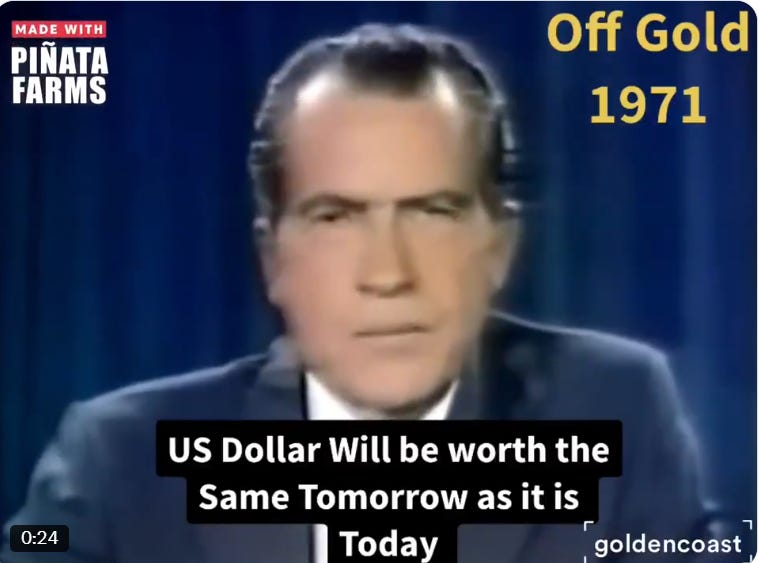
Aug 15, 1971: Nixon ends gold-backed money. 54 years since Nixon said, “We’re taking the dollar off gold – just temporarily.” 54 years later, the dollar’s lost over 90% of its purchasing power.
ddd
PRICE SHOCK THERAPY: Trump Tariffs Deliver a Gut Punch
The fresh shock of sticker prices at the grocery store isn’t some economic blip—it’s the opening act of a much uglier drama unleashed by Trump’s tariffs. Have you felt the slap at checkout as your veggie bill ballooned by 38.9% in July alone? Is your wallet begging for mercy while you cut potatoes and priorities?
WHO REALLY PAYS? It’s NOT the Exporters—It’s YOU
Let’s kill the spin: these new tariffs—spiking as high as 50% on global imports—were sold as a jab at foreign exporters. But ask yourself, have you met a single Brazilian or Thai supplier who’s shuddering? Or is it plain old Americans left swallowing the cost, one overpriced tomato at a time? Does anyone still believe this “America First” price hike is patriotic when all it does is rob your grocery savings?
WHEN PROTECTIONISM PROTECTS…YOUR BILL
So-called patriotism at the checkout comes at a ruinous price, hammering budgets across the board. These tariffs don’t just goose inflation, they leave it festering, leeching away prosperity that doesn’t bounce back. How many more paychecks have to vanish beneath these “sticky” new prices before the protection racket goes bust?
MADE IN AMERICA—IF YOU CAN AFFORD IT
Now let’s talk heavy metal: Ford. Facing a $3 billion tariff shakedown this year, the company is slashing its profit forecast while car buyers watch their American dream cars climb beyond reach. When “Made in Michigan” means paying $10,000 more than the Toyota across the street, who’s the real winner here? Is your next purchase still a Ford, or is America pricing itself off the lot?
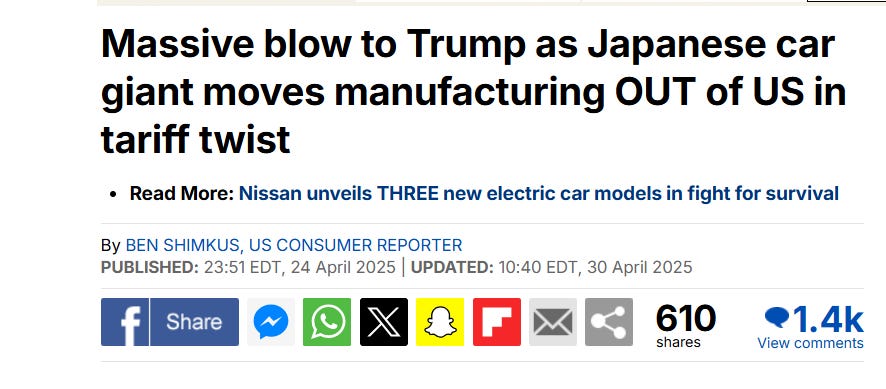
FACTORY FLEE: Subaru Packs Its Bags
Remember all those job-saving promises? Subaru just pulled the plug on its Indiana Legacy plant and is packing Outback production for a one-way ticket to Japan. If tariffs were built to defend American jobs, why are companies running for the exit? Has any worker felt safer since these policies rolled out, or are factories just vanishing in the rearview?
THE PLAYBOOK: Pass the Cost, Slash the Jobs
Corporations aren’t miracle workers—when faced with new costs, they either pass them on, lay you off, or jump ship for cheaper shores. Incentives dry up, hiring freezes set in, and Main Street becomes a ghost town. If this sounds eerily familiar, maybe it’s time to ask: Is anyone in Washington looking out for you, or is this just “survival of the fittest” for corporate America?
STICKY FINGERS—THE GOVERNMENT’S IN YOUR WALLET
Here’s the bottom line: U.S. job cuts in 2025 have smashed through 806,000, hitting levels not seen since 2020’s catastrophe. With tariffs fueling both lost jobs and runaway prices, are we stumbling into a stagflation trap of our own making? Who exactly is being protected—because it sure isn’t the American worker.
THE TRUE COST: Tariffs Bleed America Dry
If tariffs were medicine, 2025 proves the cure is worse than the disease. Households are losing billions, jobs are melting abroad, and iconic U.S. brands are in the crosshairs. So why accept a policy that promises to protect but instead pushes us to the edge?
Does “America First” Mean America Pays Most?
Make no mistake: protectionism isn’t painless. Beneath its banner, America absorbs the cost in lost jobs, price hikes, and the hollow echo of opportunity slipping away. When will we stop pretending tariff inflation is someone else’s problem, and demand policy that actually delivers for the American people?