
Federal Reserve policy has reached a crossroads—one paved by political hardball, economic anxiety, and, at last, the unambiguous ascendancy of precious metals. In the wake of Jerome Powell’s dovish speech at Jackson Hole in August 2025, the global financial community now anticipates September rate cuts as a foregone conclusion. The era of central bank independence is over; the Trump administration, through overt and covert pressure, has seized clear control of the Federal Reserve, transforming monetary policy from a technocratic exercise into an instrument of political will. For investors and citizens alike, this sea change has enormous implications—particularly in the astonishing performance of gold and its overlooked companion, silver.
Powell’s Capitulation: The September Rate Cuts
Powell’s Jackson Hole address was the equivalent of waving a surrender flag. Gone was any pretension of a hawkish stance or concern about credibility; instead, Powell painted a bleak portrait of the US economy, admitting GDP growth had fallen to just 1%, half of last year’s rate under Biden. He conceded that inflation sits not only above the Fed’s target, but is “moving in the wrong direction”—higher, not lower. Most importantly, Powell openly compared conditions now to those under Biden, underscoring that “the economy today is weaker than it was a year ago.” This is stagflation: low growth, high inflation, and policy paralysis.
Yet beneath this economic “sobriety,” a new dynamic played out. Trump, having agitated for rate cuts, succeeded in strong-arming Powell and the FOMC—via relentless public criticism, back-channel threats, and, in a crowning move, firing Fed Governor Lisa Cook on August 25, 2025. Political loyalty now matters more than sound economic judgment. The Fed, once a bulwark against executive branch encroachment, is now an appendage of the presidency. Capitol Hill whispers of arm-twisting and “getting their minds right” are no longer metaphorical—they are the new reality.
Precious Metals: Bull Market in Silence
Against this political and monetary backdrop, gold has taken flight. In 2025, gold is up an electrifying 28%—outpacing virtually every asset class and leaving the much-hyped Bitcoin in the dust, which is up just 21% on the year. But the true stars are the miners: the GDX (gold miners ETF) has surged 77.5%, and the GDXJ (junior miners) 78.5%—returns that quadruple the S&P 500’s modest gains. Yet mainstream financial media offers barely a nod; CNBC and Bloomberg focus on crypto and tech, missing the stealth bull run in metals that practitioners like Peter Schiff have trumpeted for months.
Gold’s ascent is a predictable response to runaway inflation and the deliberate debasement of the US dollar. Rate cuts—and the impending return of Quantitative Easing—reduce the opportunity cost of holding gold, boost demand (especially from foreign central banks fleeing dollar exposure), and undermine faith in currency stability. As the US dollar index plunges toward 97, confidence in the Fed’s inflation-fighting resolve craters, and investor flight to gold accelerates.
Silver: The Coiled Spring
If gold is the anchor, silver is the racehorse poised at the gate. Historically, the gold-to-silver ratio averages between 40:1 and 50:1; today, it hovers near 87:1. This means silver is—by all historical standards—cheap compared to gold, signaling a gaping opportunity for investors. The ratio has never stayed at these extremes for long; when it reverts, silver invariably surges much faster than gold. Silver’s dual demand—in monetary and industrial settings—compounds this potential. Electrification trends, solar panels, electric vehicles: all intensify demand for silver, while supply remains constrained.
When the Fed unleashes rate cuts and inflationary winds batter purchasing power, both metals benefit, but silver often outpaces gold by leaps and bounds as the valuation gap rapidly closes. Recent history confirms that, after multi-year periods of high ratios, silver’s upward corrections are swift and dramatic. The coiled spring effect is in play.
The Political Takeover: Why It Matters
The Trump regime’s capture of the Fed—punctuated by Lisa Cook’s ouster—has transformed interest rate policy into an extension of campaign strategy and headline management. Decisions are no longer rooted in the dual mandate of price stability and full employment, but in the need for short-term stimulus, asset inflation, and dollar debasement—the classic recipe for metals outperformance. The implications stretch beyond markets; they undermine confidence in American institutional independence and encourage capital flight abroad, fueling foreign stock and metal rallies.
Gold rises in environments where the US dollar weakens, especially during periods of rate cuts, high inflation, and political uncertainty, because these conditions erode confidence in the currency and increase gold’s appeal as a safe haven and alternative store of value.
Dollar Weakness and Gold Demand
Gold is priced in dollars on global markets, so when the dollar weakens, gold becomes less expensive for foreign buyers, driving higher demand and pushing prices up. Global investors seek to hedge against currency devaluation and inflation, making gold a preferred asset in times when the real value of the dollar is declining.
Impact of Fed Rate Cuts
Federal Reserve rate cuts reduce the opportunity cost of holding non-yielding assets like gold, boosting its investment allure. Lower rates make dollar-denominated assets less attractive, enhancing gold’s appeal even further—especially when inflation remains stubbornly high, as witnessed in 2025.
Inflation Hedge
Persistent inflation, especially “cost-push” inflation driven by tariffs or global disruptions, erodes purchasing power and undermines fiat currency value. Investors turn to gold because it historically preserves purchasing power, leading to record demand from both individuals and central banks.
Geopolitical and Economic Uncertainty
Periods of political interference in monetary policy, global conflicts, or economic instability amplify gold’s role as a safe haven. When central banks are pressured to tolerate higher inflation or implement loose monetary policy, as seen under Trump’s influence over the Fed in 2025, the dollar’s reliability falls and gold surges to new highs as investors seek to preserve wealth.
In summary, a weaker dollar, declining real interest rates, and inflationary policy directly boost gold prices, making it highly attractive in environments where confidence in traditional currency and monetary stability is eroding
The Verdict: Silver Is On Sale
For ordinary investors, the conclusion is revolutionary yet simple. Buy the asset that is historically undervalued. While gold’s 28% surge confirms its safe-haven status, silver’s underperformance relative to gold marks it as the best bargain in the market. The gold-to-silver ratio predicts an imminent catch-up—potentially explosive gains as the ratio reverts to mean, driven by simultaneous monetary and industrial tailwinds.
In this new monetary order, the wisdom is clear: buy silver, buy gold, and prepare for a historic correction in value. The old rules—of central bank independence, dollar strength, and inflation containment—are gone.
The new rule is survival, and precious metals are its clearest path.
Now take this in proper context:
Just in the past two days
-
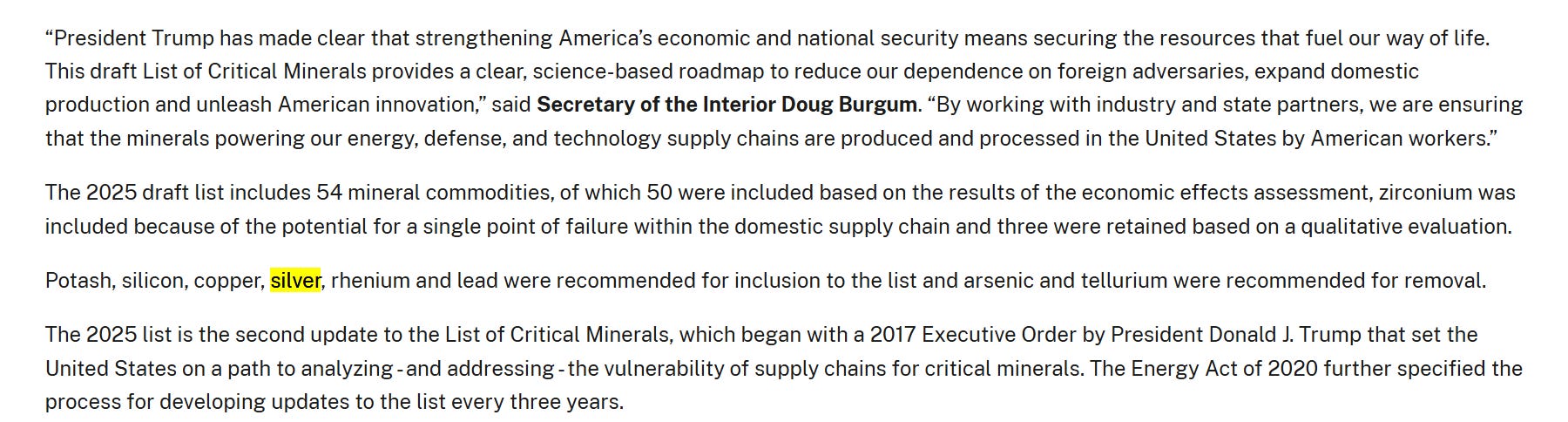
The US Department of Interior has just sent out a report (link below ) adding Silver to the list of “endangered species”
-
DOI added Silver to the DOI’s critical mineral list (see link)
-
source – https://www.doi.gov/pressreleases/department-interior-releases-draft-2025-list-critical-minerals

-
Remember the Facts
-
Gold is the leverage play on the pending dollar collapse (fueled by rate cuts which will usher in the largest wave of unbacked money printing US has ever experienced to keep US economy propped up)
-
Silver is the leverage play on gold (the 89 to 1 GSR will narrow to historical mean approaching 45 to 1 doubling price of Silver)
-
Silver is on the Brink of Extinction
-
Invest accordingly
-
How to play this
For investors seeking maximum leverage to the coming silver supply crunch, a handful of miners stand out as the most compelling opportunities—each extremely undervalued and perfectly positioned for explosive growth.
-
Aya Gold & Silver (OTC: AYASF | TSE: AYA) operates Morocco’s renowned Zgounder mine, one of the world’s highest-grade and fastest-growing primary silver projects.
-
Andean Precious Metals (OTC: ANPMF | TSE: APM) runs the San Bartolomé operation in Bolivia, a prolific, low-cost producer sitting atop vast reserves and expansion opportunities.
-
Kuya Silver (OTC: KUYAF | TSE: KUYA) is advancing its flagship Bethania mine in Peru, targeting high-grade silver mineralization in a country synonymous with silver riches.
-
Summa Silver (OTC: SSVRF | TSE: SSVR) just merged with Silver47, creating a junior powerhouse advancing resources totaling nearly 150 million ounces across world-class districts in Nevada, New Mexico, and Alaska.
All four offer unique entry points as silver’s next supercycle begins, providing both near-term production and blue-sky exploration upside.
-
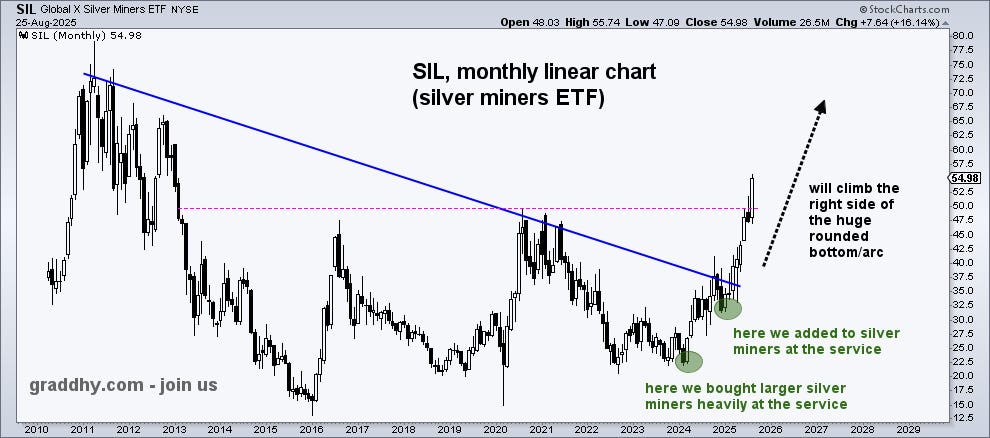
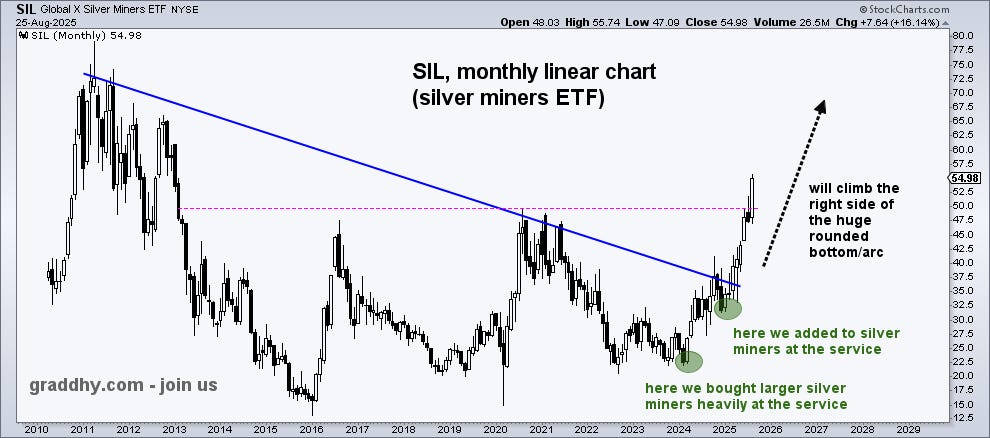
Graddhy states, “The silver miners ETF SIL is now breaking out. Been saying this huge opportunity is coming, and it is now here.” And it has had a big move since then (38%), as expected. With many silver miners moving 100% or more. Note that it did follow the black, unchanged, arrow. Some are now posting the pink breakout, but that is not the big breakout, the big breakout was the blue breakout.”
end of segment
-
our opinions are not our sponsors opinions
-
editorial department is separate from promotions department
-
not financial advice