
Foreword:
Gold and silver surge whenever the Federal Reserve starts cutting rates, easing policy, or printing money because lower interest rates and monetary expansion reduce the opportunity cost of holding non-yielding assets like precious metals. Rate cuts typically weaken the U.S. dollar and fuel expectations of rising inflation, making gold and silver more attractive as stores of value and inflation hedges. Additionally, economic uncertainty and easing measures trigger a wave of safe-haven demand, as investors pile into metals to protect purchasing power and wealth when confidence in fiat currencies erodes
Presenting the Problem – The Economy is VERY VERY VERY BAD and Main street is Feeling the Pain.
The Great Unraveling: Numbers Don’t Lie—But Washington Does
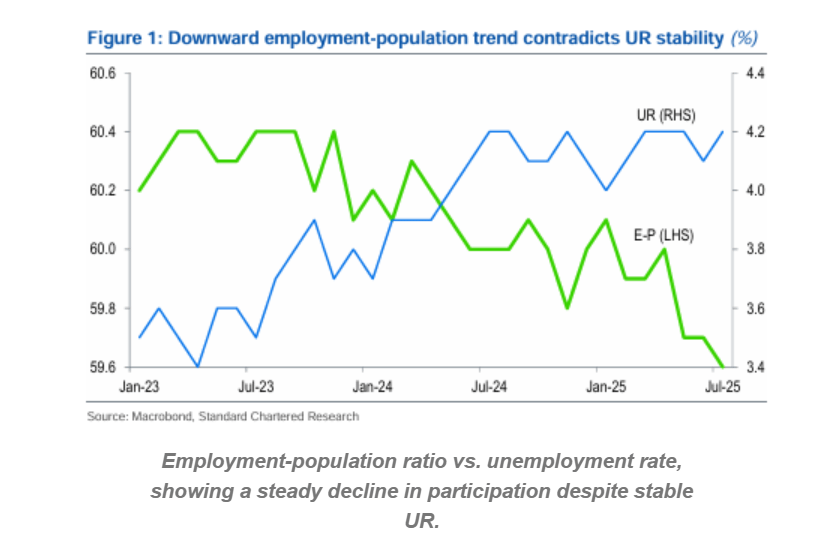
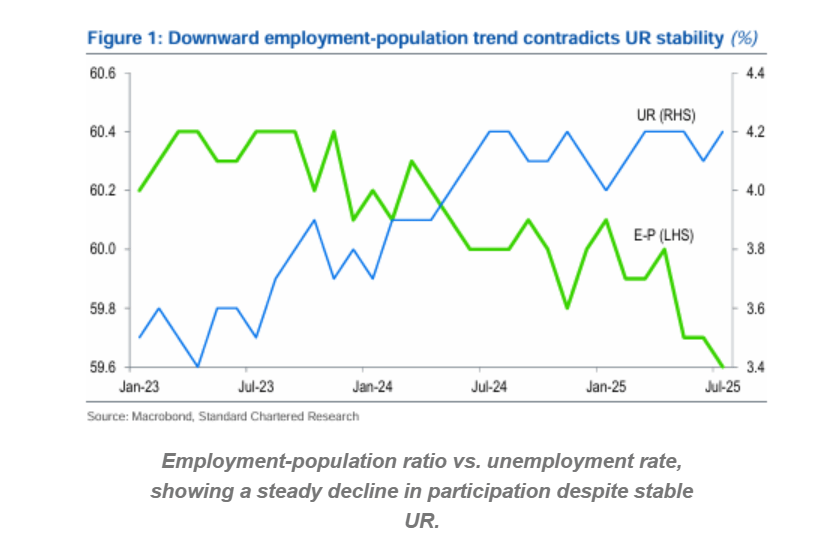
The latest avalanche of numbers smashes the narrative of resilience: US employers slashed nearly 86,000 jobs in August alone, up a staggering 39% from July and the worst August since the 2020 crash—driving year-to-date cuts toward a million. Simultaneously, job openings cratered to just 7.2 million, their second-lowest since the pandemic, while a growing army of the unemployed now exceeds available jobs for the first time in years.
New job creation has collapsed; private payrolls managed a paltry 54,000 jobs last month, undershooting forecasts as both hiring and hope dry up across America’s heartland. Meanwhile, the “birth-death” fudge factor is masking deeper disaster—officials are still cooking statistics to overstate job growth by up to 70,000 jobs a month.
Corporate Fear, Tariffs, and a Climate of Uncertainty
The collapse isn’t just in the numbers; it’s visible on every shop floor and boardroom. Tariff whiplash, surging costs, and Washington’s shambolic trade wars have left businesses terrified to hire, choosing layoffs and hiring freezes as their only defense against what they see coming next. Even historic giants like Paramount and Kroger are swinging the axe as demand falters and economic fog thickens.
The Bottom Line
America is living through a stealth depression—masked by policy spin and statistical gamesmanship, but spreading fast as layoffs rip through industries and jobs vaporize. Behind the numbers: a tidal wave of fear, failed policy, and a system buckling under its own fictions
Gold has Figured this out
Gold. The Perfect form of money
Gold Is Telling the Future: Why Precious Metals Are Outpacing Stocks
Markets are in the midst of a historic moment. The S&P 500 is enjoying one of its strongest bull runs in decades—surging +1,650 points in under five months. On the surface, equities look unstoppable. But a quieter revolution is unfolding in parallel: gold is crushing stocks.
So far this year, gold’s return stands at +37% year-to-date, nearly four times the S&P 500’s gain. What’s even more striking is that this outperformance isn’t a short-term anomaly. When you zoom out, gold’s momentum has been building for years.
Since the start of 2023, gold prices have nearly doubled, compared to a ~67% advance in the S&P 500. Even with the much-hyped AI revolution, the most transformative breakthrough since the internet, stocks are lagging gold. This is not what the textbooks say should happen—and that’s the story investors need to understand.
GDX and GDXJ: A Stunning Year
The gold miner ETFs are echoing physical gold’s historic ascent. In 2025, the VanEck Gold Miners ETF (GDX) has soared over 92% year-to-date, reflecting intense capital flows toward producers as investors seek leverage to the metal’s rally. Even more remarkable, the VanEck Junior Gold Miners ETF (GDXJ) is up about 96% YTD, outperforming large-cap miners as exploration, development, and small-cap producers become prized by speculators and funds alike. This sector-wide surge shows how investors are amplifying their gold exposure through miners as confidence in fiat assets erodes.
A Rewriting of Market History
Traditionally, gold has been classified as a “safe haven” asset—behaving like bonds, performing best during times of market stress, recessions, or geopolitical uncertainty. The historical relationship was simple: equities up, gold flat; equities down, gold up.
But since 2020, that relationship has begun to change. In fact, in 2024 the correlation coefficient between the S&P 500 and gold hit 0.91—a record high. That means both assets were moving almost in lockstep.
In other words: gold is no longer just defensive—it’s offensive. Investors are treating it less like an insurance policy and more like a growth asset, reflecting a massive shift in macroeconomic fundamentals.
Why This Shift Is Happening
There are two key forces driving gold’s transformation:
-
Deficit Spending & Inflation Expectations
The U.S. is running annual deficits approaching $2 trillion. That requires the issuance of massive quantities of new government debt. As Treasury supply balloons, bond prices fall and investors lose confidence in sovereign debt as a safe haven. Meanwhile, inflation expectations remain elevated, further diminishing the appeal of fixed-income securities. -
Central Bank Behavior
Recognizing these dynamics earlier than most, central banks have gone on their largest gold-buying spree in modern history. For the first time since 1996, central banks now hold more gold than U.S. Treasuries. This is not a coincidence—it is a defensive positioning against dollar debasement and a fragmenting global monetary order.
The result is that gold has now eclipsed government bonds as the ultimate reserve asset. And as the IMF, BRICS nations, and emerging markets diversify away from the dollar, this trend is set to accelerate.
Why Inflation is “Stealth Theft”
A critical backdrop here is the role of inflation. Unlike an explicit tax, which is openly levied, inflation functions as a hidden tax on savers and workers. As new money is printed and injected into circulation, each dollar loses purchasing power. That transfer of value—from households to governments—occurs quietly, without debate or consent.
As economist Thomas Sowell put it, inflation means “the money people have saved is robbed of part of its purchasing power, quietly transferred to the government that issues new money.”
This erosion of trust in currency stability is one of the biggest reasons gold demand is accelerating—not just from central banks, but also from retail investors, institutions, and sovereign wealth funds seeking protection from fiscal and monetary excess.
The Stock-to-Flow Advantage
Another way to understand gold’s appeal is through its stock-to-flow ratio (S/F)—a concept borrowed from commodity analysis.
-
The “stock” is the total amount of gold already above ground, estimated at around 200,000 tonnes (≈6.4 billion troy ounces).
-
The “flow” is the annual new supply mined each year, about 3,000 tonnes.
That gives gold an S/F ratio of roughly 67, meaning it would take 67 years of new production to replicate the existing supply.
This is extraordinarily high—much higher than most commodities and rivaled only by Bitcoin. The critical point is that gold’s scarcity is extremely durable. Only about 1% of new inventory is added each year.
Contrast this with a hypothetical rare metal with 100,000 units in existence and only 1,000 mined annually (an S/F of 100). If new technology suddenly increased flow to 10,000 annually, the ratio would collapse to 10—instantly making the asset far less scarce and valuable.
Gold avoids this problem: its geological scarcity and slow supply growth give it unprecedented predictability. This is the bedrock of its status as “sound money.”
What This Means for Investors
For decades, the investment mantra was simple: gold in times of crisis, stocks in times of prosperity. But the 2020s have upended that logic. We are now in a world where both are rising together—which is extraordinarily rare.
The implications are profound:
-
Bonds are losing their safe-haven status. The combination of inflation, deficits, and high issuance is crushing their appeal.
-
Gold is ascending as the global neutral reserve. Central banks vote with their balance sheets, and they are choosing gold.
-
Scarcity will matter more than growth. In a world drowning in paper money, assets with hard caps and slow supply growth will command premium valuations.
In short: gold is telling the future. And the future looks like a global pivot away from debt-based fiat assets and toward scarce, time-tested stores of value.
Final Word
We are watching history play out in real time. Gold’s outperformance is not just about price—it’s about trust, scarcity, and the shifting architecture of the global financial system. While equities remain buoyed by technological optimism, gold’s ascent reflects something deeper: a growing recognition that in an age of fiscal recklessness, monetary debasement, and geopolitical uncertainty, true wealth preservation comes from what cannot be printed.
For investors, the message is clear: ignore gold at your own risk.