
Global Gold Earthquake: Freeport’s Force Majeure Collides With China’s Gold Power Grab
The declaration of force majeure by Freeport-McMoRan at the Grasberg mine in Indonesia marks a pivotal turning point for the world gold market just as gold’s strategic importance is exploding worldwide. Grasberg, one of the single largest sources of both gold and copper, was abruptly sidelined after a catastrophic mud rush destroyed vital infrastructure, claimed lives, and left several miners missing. Freeport swiftly suspended nearly all production, and the latest guidance points to a long, slow recovery: the rest of 2025 and much of 2026 will see virtually no output, with normal flow not returning until at least 2027.
Era of Scarcity: Gold Supply Slams Shut
This force majeure comes against a remarkable backdrop of monetary transition. Global fiat currencies are in crisis, with paper money losing value fast as inflation rages and central banks push endless debt creation. Gold is stepping forward again as the world’s trusted store of value. What makes the Grasberg shutdown seismic isn’t just its size—it’s the timing. With central bank gold demand already near record highs, cutting the flow from one of the world’s top mines only intensifies supply fears, pushing savvy investors and nations to chase ever-scarcer ounces.
China’s Golden Revolution: From Vaults to Shanghai
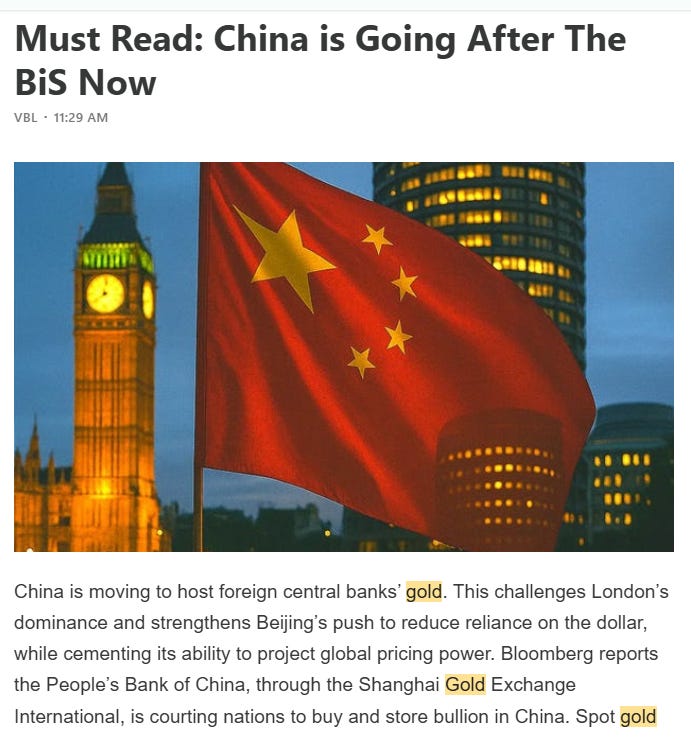
Against this supply squeeze, China is boldly redrawing the global gold map. The People’s Bank of China and the Shanghai Gold Exchange International are recruiting foreign central banks to store gold in their ever-expanding vault network—Beijing, Hong Kong, even as far as Saudi Arabia. At the same time, China is launching new yuan-denominated contracts on both the Shanghai Gold Exchange and Shanghai Metal Exchange, allowing central banks and sovereign funds to hold and price gold without ever touching Western markets.
Unlike the London and New York exchanges—where physical gold is more theory than practice—China’s model demands metal on hand. Hong Kong now rivals London and Switzerland as a bullion hub, rolling out transparent storage, settlement, and even waiving fees to attract global business.
Endgame for London and New York? China Upends the Old Order
London’s historic strength has always been the vast “pool” of gold held there on behalf of others—enabling the Bank for International Settlements (BIS) and central banks to lease, hedge, and engage in backdoor monetary policy. But as China’s new SGEI global vaults fill with foreign gold—and with nations looking to diversify out of the dollar—the supply available for these old tricks evaporates, threatening to undermine a century of Western financial dominance.
Two Earthquakes, One Bull Market: BRICS and US Gold Investors Cheer
The dual impact of Grasberg’s supply crisis and China’s unstoppable gold push is profoundly bullish for gold and silver. BRICS nations, Saudi Arabia, and a growing list of emerging market central banks are eager to price and store bullion far from Washington and London. Simultaneously, US gold investors watching Western fiscal chaos are finding even more reason to trust physical metal as anchor and insurance.
In summary: Freeport’s mine disaster slams the supply door shut just as China is swinging open a vault door for the world’s reserve managers. Both trends converge to amplify gold’s price and strategic importance at a moment when the old fiat order is visibly cracking. The global center of financial gravity is shifting—and this perfect storm is just beginning to unfold