
The Digital Gold Revolution: How China and Wall Street Are Rewiring Global Collateral
China’s Golden Bridge: The Dawn of a New Collateral Era
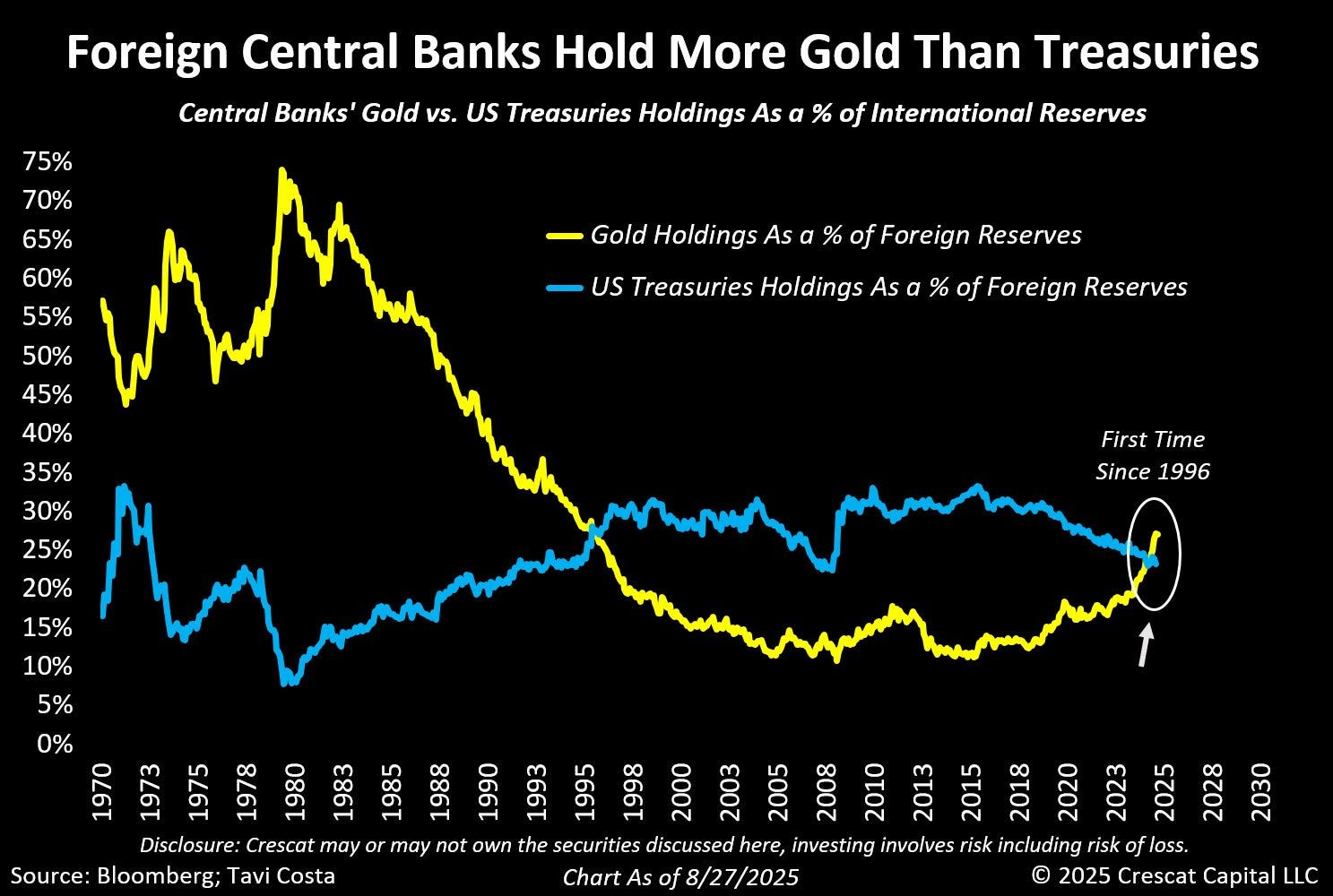
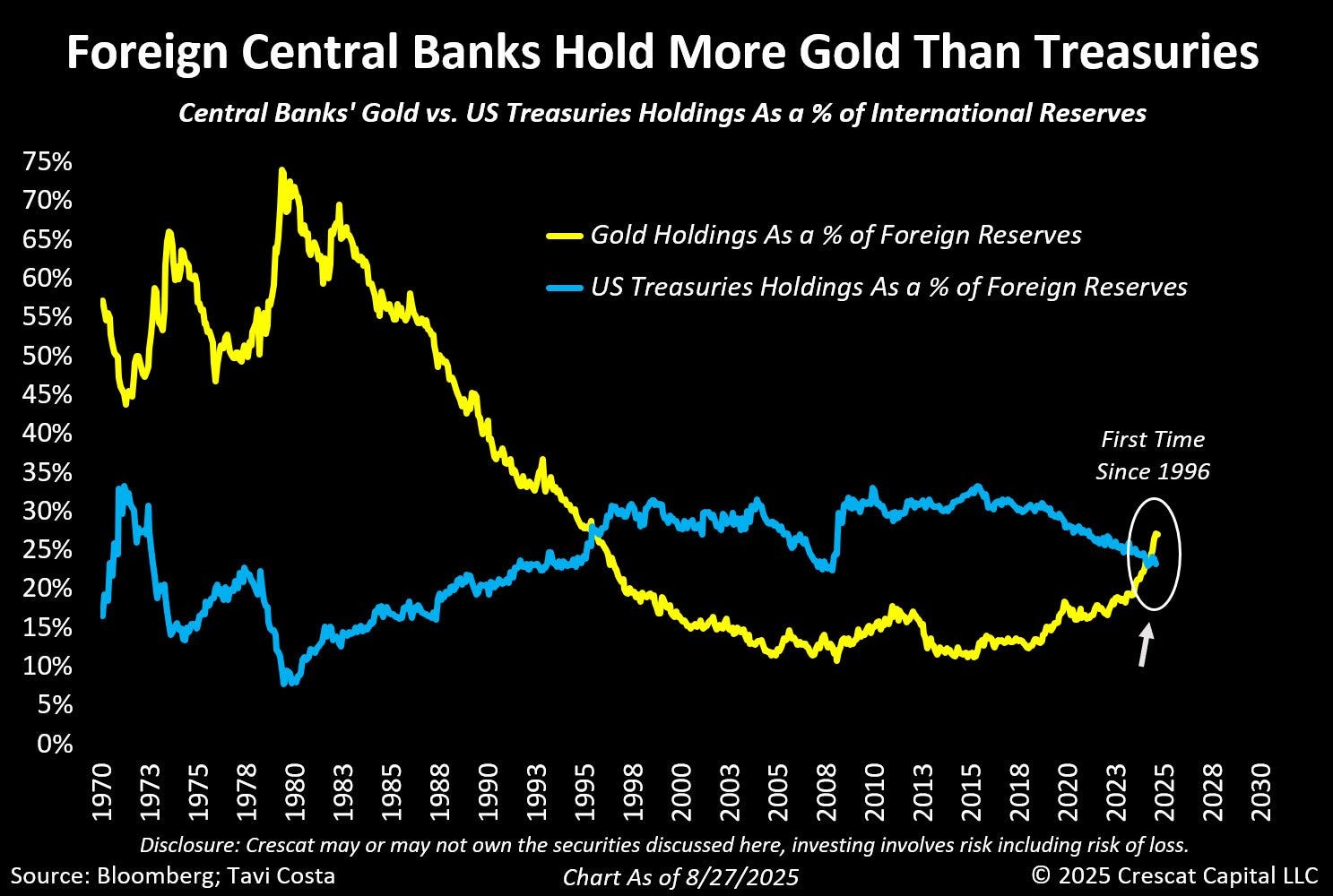
For over fifty years, the global financial system was anchored by U.S. Treasuries, viewed as the world’s most trusted collateral. Every international loan, repo, and swap rested on the “risk-free” status of American debt. But tectonic shifts are now underway in the world’s monetary architecture—and at the epicenter stands China, quietly reconstructing the global backbone around something far older and more enduring: gold.
China, joined by allies including the UAE, Singapore, Dubai, and Saudi Arabia—with India and others waiting in the wings—has begun constructing a revolutionary network of multi-jurisdictional gold vaults. This is not merely about hoarding bullion. Each of these vaults acts as a settlement node, powering international trade denominated in yuan, dirham, ruble, and more, but all ultimately anchored by physical, allocated gold held safely outside the reach of the West. This new “Bridge” infrastructure is engineered to rebalance the scales and build a multipolar collateral system in which gold becomes the universal denominator—accepted everywhere, trusted by all, and impossible for any single power to manipulate or seize.
Panda Bonds: The Yuan’s Ascent and Global De-Dollarization
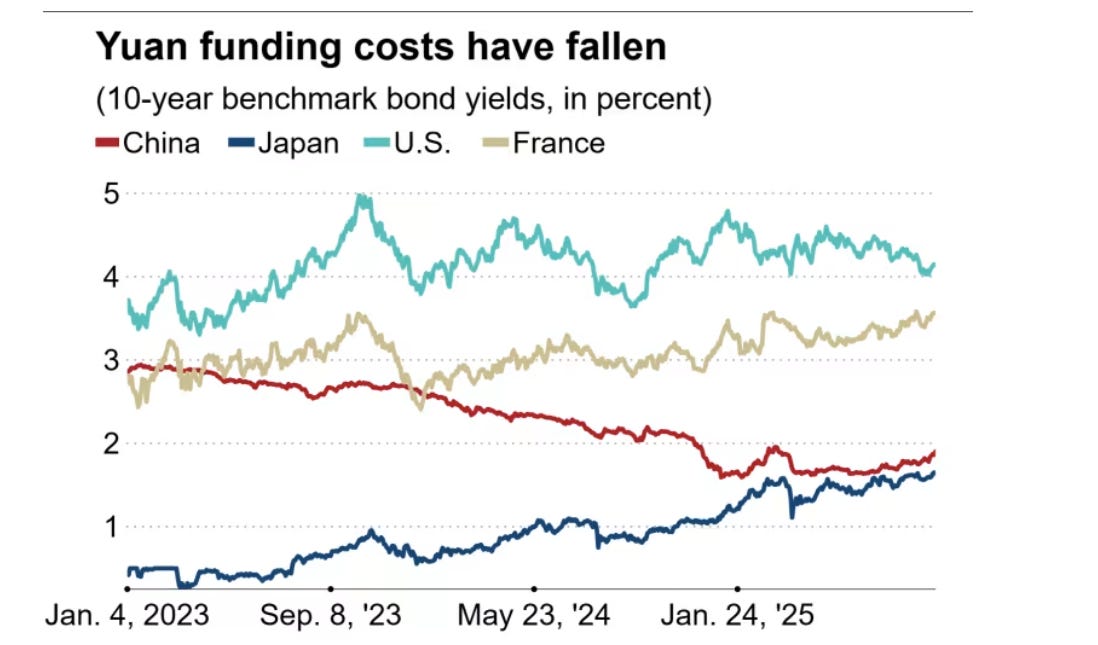
Enter the Panda bond—China’s answer to the world’s dependence on dollar debt. These yuan-denominated securities, sold within China’s domestic market but open to foreign governments and institutions, are rapidly gaining appeal. Designed as Beijing’s key tool for extending both financial influence and political cooperation, Panda bonds are especially seductive to nations seeking to diversify away from the U.S. and escape the volatility, sanctions, and weaponization of dollar reserves.
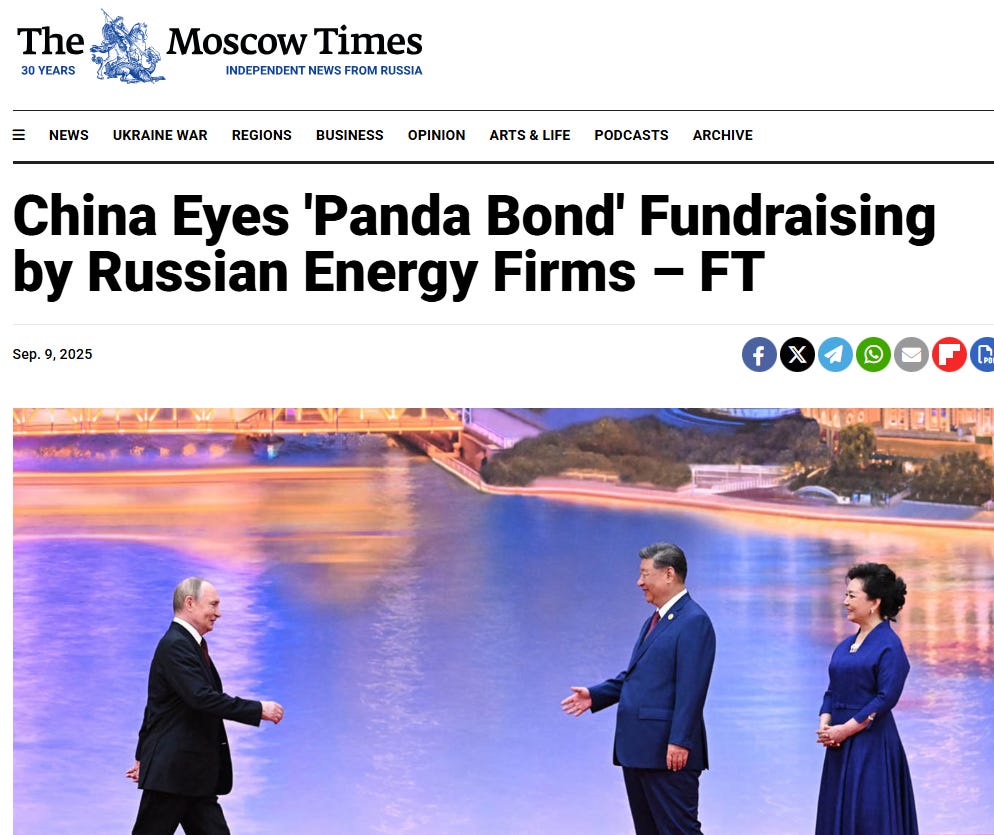
Recent surges in Panda bond issuance—from Hungary, Pakistan, Kazakhstan, and Russian energy giants to global infrastructure finance institutions—speak to a growing international hunger for a funding mechanism outside U.S. legal and political reach. China’s regulatory reforms have allowed proceeds from these bonds to flow more freely across borders, and their linkage to a physical gold infrastructure gives borrowers and buyers alike a new foundation of trust. In this emerging system, every partner holds capital “skin in the game,” shares a stake in transparent vaulting, and helps underwrite a gold-backed network that is structurally resistant to financial or political shocks.
The End of U.S. Bond Dominance: Treasuries Lose Their Shine
Why is this happening now? Several trends have come together to undermine the once-unquestionable supremacy of U.S. Treasuries.
Exploding debt issuance is flooding the market and eroding confidence; weaponized sanctions have transformed reserves into tools of geopolitics; climbing bond yields are vaporizing the perceived stability of U.S. debt; and deep deficits are making “risk-free” assets look anything but.
Collateral must be as close to apolitical as possible. Treasuries, historically viewed as neutral, are now damaged by both politics and credit risks. When the very concept of high-quality liquid assets (HQLA) is called into question, central banks and major investors are forced to search for a stable replacement—one that cannot be frozen, defaulted, or devalued by decree. Gold, vaulted beyond any single jurisdiction, is stepping back into this void.
Gold 2.0: Tokenization, Transparency, and Global Trust
But this is not the gold standard of the past. Today’s gold is reborn: every 400-ounce bar is “tokenized,” given a digital twin on a permissioned ledger, and made instantly transferable between banks and sovereign counterparties. Physical settlement ensures price integrity and eliminates the kind of opaque leverage that once kept gold prices artificially low.
China’s gold-vault infrastructure ensures that collateral can move across the Eurasian corridor at digital speed, creating organic yield for participants engaged in real-world trade, repo, and liquidity flows—not the shadowy mechanics of Wall Street futures markets. For the first time, gold becomes both a productive asset and the unassailable base for global settlement, deliverability, and trust.
The Historic Reallocation: Morgan Stanley’s Watershed Moment
The implications have not escaped Wall Street. In a remarkable about-face, even the staid investment powerhouse Morgan Stanley—never known for its bullishness on gold—has broken with convention. Their new message: bonds are no longer the backbone of safety. The old 60/40 playbook (60% equities, 40% bonds) is obsolete. They now advocate a split of 60% equities, 20% bonds, and a robust 20% gold allocation, instructing clients to rotate half their bond exposure into gold for risk hedging and portfolio stability.
Chief Investment strategists at Morgan Stanley have declared gold the new “anti-fragile” asset—a genuine hedge in ways Treasuries can no longer claim. It is a stunning admission: Wall Street now shares the same risk philosophy as China’s Bridge network, reinforcing the ascendancy of gold-backed safety as the foundation for the new financial order.
The Numbers: Trillions Set to Flow
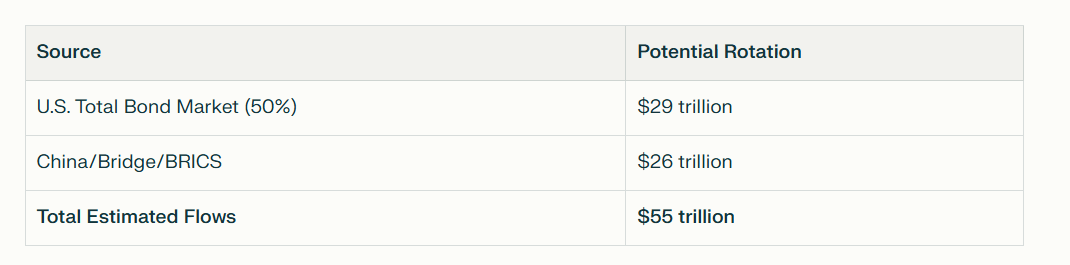
Just how large is this tectonic shift? The U.S. bond market, including Treasuries, corporates, and municipals, now totals over $58 trillion. If Morgan Stanley’s model goes mainstream and half of that capital rotates into gold, the result is a theoretical $29 trillion surge in new gold buying power. If we then assume that China, the Bridge system, and BRICS-related flows could match this figure—a further $26 + trillion in gold-based collateralization—the scale of capital in transition is simply unprecedented
Such a staggering movement of capital would overwhelm anything the gold market has ever experienced, pointing to a profound upward revaluation. Gold stands on the brink of transforming from “dead money” into the most productive—and foundational—global asset in the modern era.
The New World Order: Gold as Both Money and Productive Asset
This is not a return to the constraints of an old-fashioned gold standard, nor is it a speculative fad. It is the birth of Gold 2.0—programmable, distributed, yield-bearing, and utterly global in its reach. Gold will circulate as collateral with real yield, as tokenized vault assets, and as the trusted denominator in sovereign trade. Instead of being suppressed to protect bonds, gold is now strengthened to support balance sheets—a reversal with colossal implications.
Every financial institution, every sovereign, every corporate treasurer must now reckon with a new regime—one in which decentralization, transparency, and multipolar trust are at a premium. In a world fractured by politics and debt, only gold remains truly neutral.
Wall Street and Beijing may be rivals elsewhere, but on gold, they agree: the future is no longer built on politicized paper, but on the enduring, digital, and distributed power of vaulted metal. The global flight to gold has begun, and with it, the currency and collateral systems of the future