
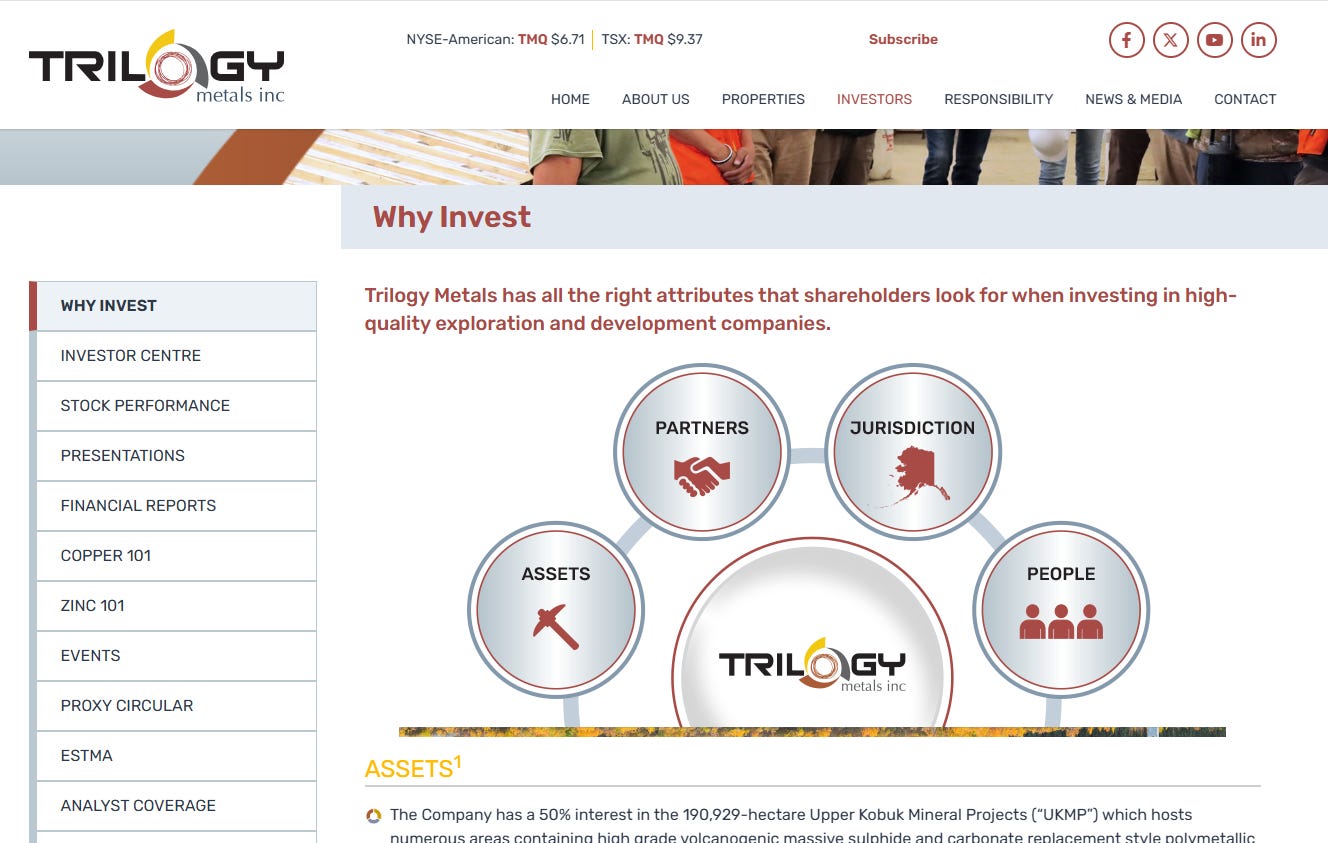
Snapshot of Why Invest in Trilogy?
What’s Missing from this? THERE IS NO SILVER, ZIP, ZILCH, NADA
by Jon Forrest Little
Editors Note:
Every time a major story is published here, a predictable cycle begins: within days, so-called influencers and analysts across Twitter and YouTube will recycle my original research without giving credit or reference.
Whether it’s envy or the hope that sponsors will migrate to their channels, (or to keep them from migrating to my channel) it’s become almost comedic how reliably this happens—article goes live, then the wannabe experts copy it verbatim, never offering a hat tip. The world’s only silver news continues to break stories first; the clockwork imitation is just part of the formula these days.
If anyone wants a list of the habitual offenders I can provide it to you via email. Find me at xlradar@gmail.com . Why would I send this info to you? perhaps you would contact them and tell them to knock it off.
The Trump Administration’s “Critical Minerals” Equity Game: Silver Nowhere in Sight … yet a FEAST FOR INSIDER TRADES
Equity Stakes, Policy Errors, and Silver’s Stunning Exclusion
Yesterday’s announcement that President Trump’s administration has snapped up equity stakes in Intel, MP Materials, Lithium Americas, Trilogy Metals, and US Steel is nothing short of historic—and uniquely nonsensical. While Washington trumpets these moves as vital to “strategic supply chains,” the reality is an assertion so bizarre it verges on satire: after months of political bluster surrounding “critical minerals,” not one of the government’s new holdings is even a silver miner, despite silver’s prominent place on the Department of Interior’s updated 2025 list of vital resources.
A “Critical” Farce: Not an Ounce of Silver
It’s difficult to overstate the absurdity. The government now owns a generous slice of Intel (a chipmaker), MP Materials (rare earths), Lithium Americas (lithium), Trilogy Metals (copper-focused, not even in production), and a so-called “golden share” in US Steel. The connection to silver—the metal now officially named essential for national security, clean technology, and defense? Absolutely zero. Trilogy, the only pick within even shouting distance of precious metals, is an advanced-stage copper explorer at best, with any hypothetical silver production little more than thrift-store smelter credits.
Trilogy’s own “Why Invest” page makes things plain: the company’s focus is the Arctic and Bornite Projects in Alaska, home to some of North America’s highest-grade copper. Silver, if present, is buried deep in technical reports as a rounding error in copper-equivalent calculations, not as a sought-after resource. Its partnerships, economic models, and company milestones all revolve around copper—with zinc, lead, and gold thrown in as seasoning, and silver barely getting a mention.
Where Are America’s Real Silver Miners?
Meanwhile, genuine U.S. silver production powerhouses have been left out in the cold. Hecla Mining, with over 16 million ounces of annual silver output and iconic operations like Greens Creek and Lucky Friday, represents the backbone of America’s supply. Coeur Mining isn’t far behind, producing well over 11 million ounces a year. These mines embody precisely the kind of domestic resilience the government claims to value—yet not a dime of government support or public championing comes their way.
If Washington’s “critical mineral” strategy actually aligned with supply chain realities, companies like Silver47 and Blackrock Silver—true junior explorers with large-scale silver ambitions—would be first in line for attention or investment. Instead, the spectacle here is akin to declaring a national oil emergency, only for the government to go long on a fast-casual burrito chain as a solution.
But even that analogy barely scratches the surface. For the Trump regime to purchase 10% of Trilogy Metals—a company nowhere near actual production—would be the equivalent of a national security crisis requiring advanced semiconductors, and instead of investing in Intel or another proven chip fabricator, buying a 10% stake in a startup that merely promises, “We’ll be manufacturing chips in five or six years—see, it’s right here in our PowerPoint.” The difference between funding miners who deliver ounces today and those who simply talk up “potential” is not just strategic error, it’s a sign of policy unseriousness bordering on farce.
The Spectacular Nothing Burger: A National Policy Illusion
For anyone serious about U.S. industrial security or the future of precious metals, the message is sobering. All the fanfare over government equity stakes—and none of it touches silver mining. The administration’s actions skip over America’s most significant, real-world silver producers and junior project pipeline in favor of headline-grabbing plays in companies with, at best, theoretical exposure to the metal. Calls to shore up domestic supply chains for critical minerals have become little more than photo ops, leaving the actual U.S. silver industry waving from the sidelines.
This isn’t just bad policy—it’s performance art. For investors, policymakers, and anyone following the precious metals space, the Trump regime’s “critical minerals” narrative deserves to be called what it is: a deeply unserious, dazzlingly misplaced nothing burger. Silver’s name is on the list, but neither the money nor the momentum is going anywhere near the metal or the miners who actually produce it.
Paper Promises, Silver Betrayals
If one had to hazard a guess as to why the Trump administration would make such an illogical and historically irrational decision—ignoring bona fide U.S. silver miners while jawboning about silver’s “critical” importance—the explanation is depressingly familiar. The United States has a long and storied tradition of hostility toward silver, stretching back well before the Coinage Act of 1964 under LBJ. The nation’s monetary history is littered with grand betrayals: the disappearance of the original Coinage Act in the 1790s, the so-called “Crime of 1873” that demonetized silver, and above all, the establishment of the Federal Reserve in 1913, which cemented Wall Street’s grip on the currency.
The playbook is as old as central banking itself. Government issues paper notes as substitutes for real silver and gold, infecting the “villagers” with debt money while suppressing the actual value of these metals through market interventions. The banking cartel—closely linked to industrial conglomerates that rely on cheap silver—has never wanted an honest price for silver or a public that holds it in size.
So the inclusion of silver in the “critical minerals” list and the public pageantry of investing in mining are best interpreted for what they are: empty political theater, headlines for campaign season, with no actual substance or honest intent to secure domestic silver supply. It’s a tactic as old as Washington itself: talk tough about metals, do nothing meaningful, and keep the real money flowing elsewhere.Inserted seamlessly into the analogy, the Trump regime’s decision to purchase 10% of Trilogy Metals—a company not even close to production—makes about as much sense as fighting an oil crisis by acquiring shares of Chipotle or McDonald’s. But it’s even more ludicrous than that: it parallels responding to a need for advanced semiconductors for defense or AI by investing not in proven chip manufacturers like Intel, but in a company that merely promises to build chips five or six years from now, with only a PowerPoint slide to show for it. This is the critical mineral playbook at work—favoring hand-waving potential over hard, immediate production.
It’s a page from the oldest book in American monetary history. The United States government has been uniquely antagonistic toward silver since at least the Coinage Act of 1964, if not the debasements and betrayals of previous centuries. Whether it was the “Crime of 1873” or the creation of the Federal Reserve in 1913, the playbook remains the same: swap real silver and gold for paper substitutes, suppress the value of silver in global markets, and weave banking cartels into the fabric of American industry. While politicians jawbone about lists and mining incentives, these headline-grabbing promises are—like so many before—little more than election season lies, serving up illusion instead of substance.
One more oddity:
Determining the silver mineral resource estimate in an exploration-stage company like Trilogy Metals is highly opaque, involving complex modeling, assumptions, and shifting technical parameters. Silver often appears as a minor byproduct, buried in copper-equivalent calculations, not reported as standalone reserves or resources. Technical reports may include some silver data, but it’s based on limited drilling, inferred grades, theoretical pit shells, and future metal prices. It’s very different from an established producer with reliable output. If there were a semiconductor crisis, this would be like investing in a startup promising chips in 5–7 years, not in Intel’s actual fabrication plants
Snarky Note:
In American politics, nothing is ever truly surprising. If the government backs a new mining project, don’t be shocked when Trump’s friends or family soon own the nearest hotels, gas stations, restaurants, or hardware stores selling picks and shovels. Whether it’s Jared Kushner or Barron Trump, the timing of business and political deals always seems perfectly choreographed.
Concluding thought
The Department of Interior’s decision to list silver as a critical mineral, then invest in an exploration-stage company with little connection to silver, defies basic logic. The reality is clear: established miners like Hecla and Coeur consistently extract massive quantities of silver—
-
Hecla Mining produced over 16 million ounces last year
-
and Coeur Mining over 11 million ounces in the last year
-
anchoring America’s supply chain?
-
Not really, USA is 91% import reliant on Silver and Mexico has declared NO NEW MINING ALLOWED.
-
RE (OTC: AAGAF) Silver47’s (merged with Summa Silver) combined resources at Alaska, Mogollon, and Tonopah total 236 million silver equivalent ounces
-
Blackrock Silver’s total mineral resource estimate surpasses 108 million silver ounces
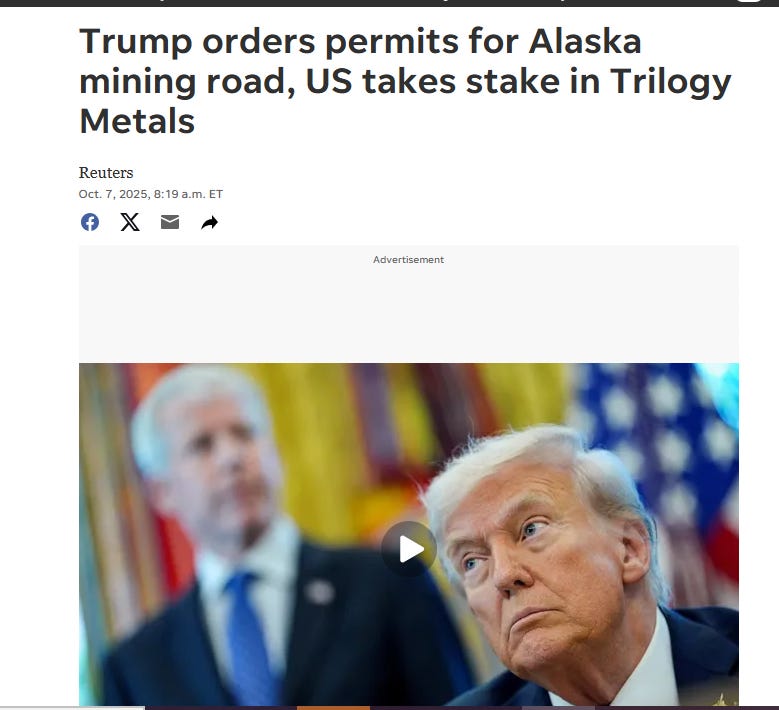
All of this makes the White House’s move to buy into Trilogy—a company whose silver, if any, is a minor byproduct—an absolute head-scratcher. In fact, given government’s track record, perhaps their absence from genuine silver investing is a blessing in disguise. Direct government involvement in the private sector is usually fraught with unintended consequences, market distortions, and opportunities for insider enrichment.
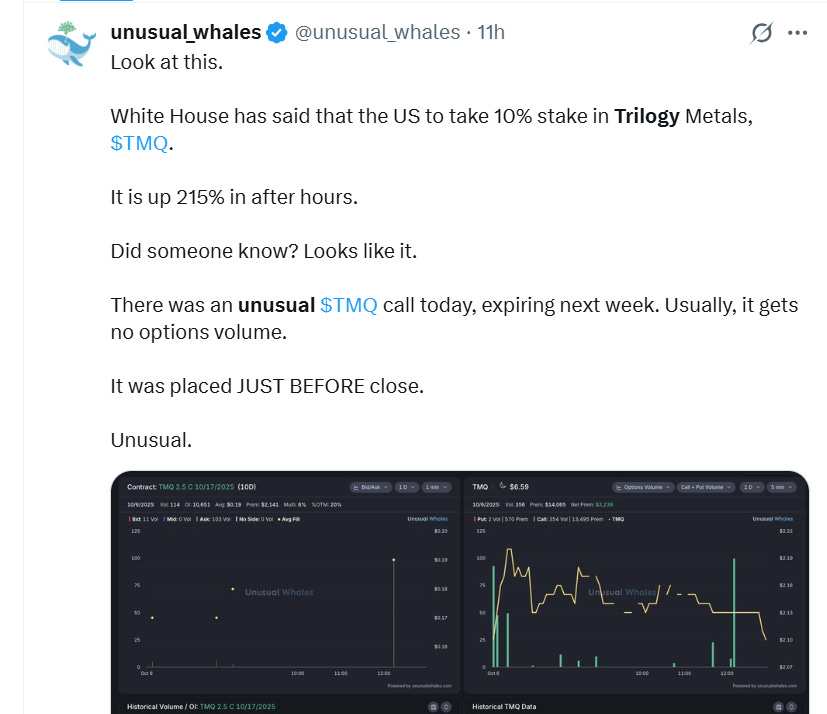
Just yesterday, Trilogy’s shares rocketed over 200 percent immediately after the news. It’s hard not to wonder how many well-connected government insiders or congressional members were loading up positions in advance, ready to profit when the headlines hit. This episode is a textbook case of market distortion and political favoritism—corruption writ large, practiced right in the open for all to see
end of segment
-
not financial advice
-
editorial department is separate from promotions department
-
our opinions are not our sponsors opinions
-
this newsletter and this writer has no issue with Trilogy metals. We do need to invest in exploration and advancing mineral resources towards production. My issue is with the absurd decision making methodology practiced by our sad King.