
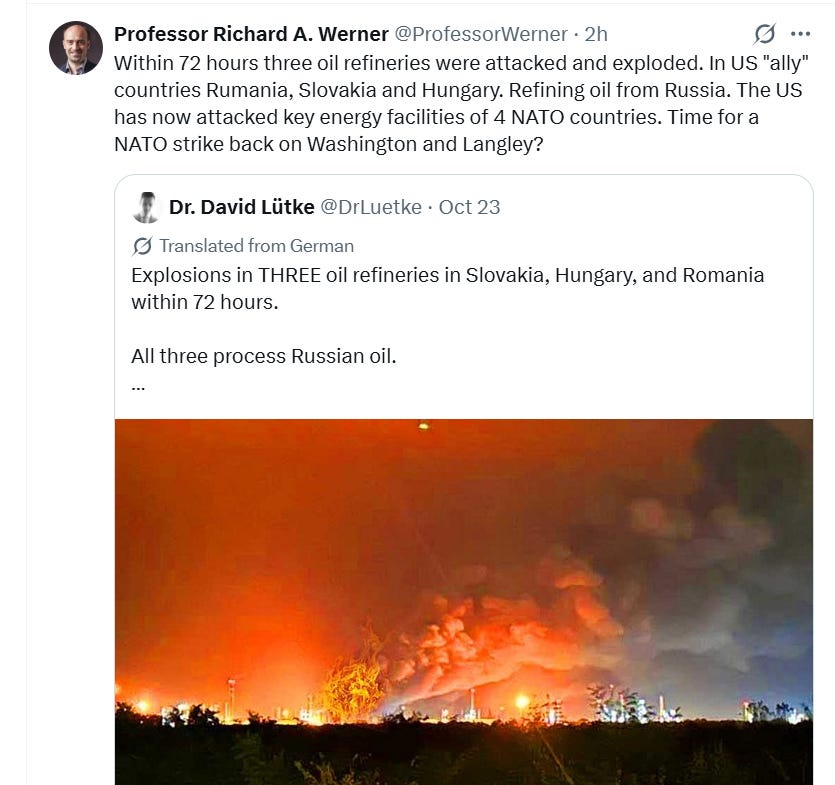
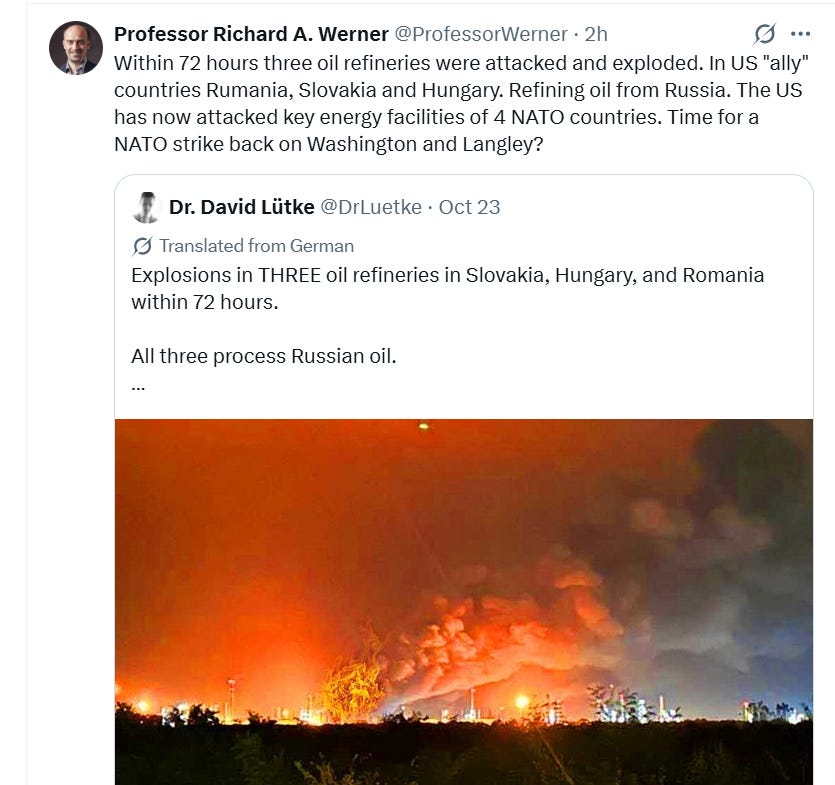
Explosions That Set the World Alight
Three refineries in Slovakia, Hungary, and Romania—all NATO members, all dependent on Russian crude—were gutted in synchronized attacks over seventy-two hours. Insiders say this wasn’t random: US intelligence and Ukraine’s operational abilities, turbocharged by the timing of President Trump’s new sanctions on Russian oil majors, point to a coordinated act of sabotage—the opening shot in an escalating global pattern of turmoil.
America’s Multi-Front War
This latest incident fits a broader campaign: Washington is locked in economic and kinetic conflict with Russia, China, India, Iran, Venezuela, and Colombia. Ten US airstrikes on vessels in Caribbean and Pacific waters killed dozens of Colombians, sparked a diplomatic uproar, and led Colombia to recall its ambassador. The White House responded with sanctions, slashing aid, and threatening tariffs.
Israel: Proxy Power with a Price Tag
Then there’s Israel—widely regarded as the world’s most active battlefield of proxy engagement. In the past decade, Israeli jets have launched hundreds of strikes against Gaza, Lebanon, Syria, and beyond on a near-monthly basis, almost all with American weapons, funding, or intelligence. Since the latest Gaza war began, at least $21.7 billion in US military aid has flowed to the Israeli Defense Forces (IDF), with even more earmarked for future years. American taxpayer money doesn’t just fund war machines: it underwrites Israel’s universal healthcare, robust social welfare, and discussions in Congress over pension benefits for any US citizen serving with the IDF—though broad pensions for all IDF members remain unpassed and controversial. Israel’s ability to operate with impunity—and its soldiers’ benefits—are courtesy of US agreements and largesse.
Ukraine: The Costliest War
The price of the Ukrainian front is even steeper. Since Russia’s invasion, the United States has allocated roughly $175-183 billion for military and economic aid, making it the largest donor by far. The bulk of this, over $130 billion, is military assistance: missiles, drones, armored vehicles, and munitions. The rest fuels Ukraine’s government, economy, and social stability, with American factories and defense contractors profiting from orders meant for Kyiv.
251 U.S. Wars Since 1991: The Empire of Intervention
Drawing back the lens, congressional records show the US has launched more than 251 military interventions around the world since 1991—a record revealed by Ben Norton and corroborated by academic researchers. From Afghanistan to Libya, Sudan to the Philippines, American boots, bombs, and dollars have shaped global conflict more than any other power.
Bear Market of Trust, Bull Market of Desperation
Ray Dalio famously warns that as empires become desperate to retain dominance, their acts grow frequent and reckless—a bear market of trust, where chaos replaces diplomacy. From sabotaged refineries to pension debates, the pattern is clear: America’s allies are uneasy, its adversaries increasingly aggressive, and its credibility as a trusted partner is fading fast.
Only Ounces Endure: Gold, Silver, and the Flight to Safety
As the world sniffs out the scent of turmoil—wars multiplying, alliances fraying—the final flight isn’t to the dollar, but to gold and silver. These metals have become the ultimate vote of no confidence, the last refuge in a world where even American promises can be embargoed overnight. In this new era of empire, only ounces endure.
end of segment
In Case You Missed it (earlier this week)
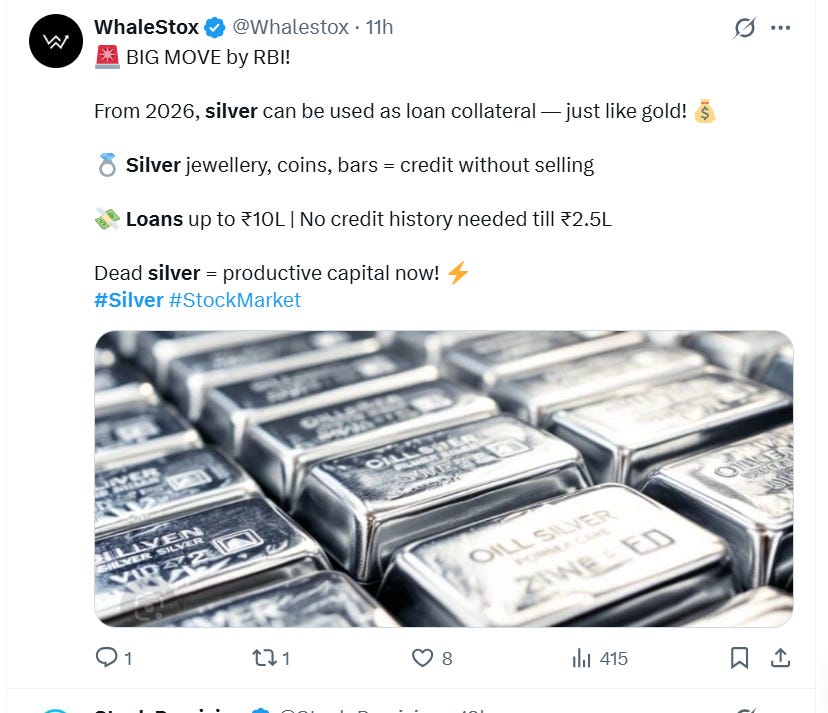
India Adopts Modern Bimetallic Standard: RBI Unlocks Silver Bullion as Banking Capital at 10:1 Gold-Silver Ratio
In a break with 150 years of tradition, India’s Reserve Bank recognizes silver as a monetary metal—catapulting bullion from industrial commodity to banking collateral just as supply shortages, LBMA woes, and record industrial demand threaten global inventories. A wave of silver imports and a stunning 10:1 gold-silver ratio signal vast revaluation ahead, transforming dead metal into productive capital and rewriting the rules for investors, banks, and nations worldwide.
India has just lit the fuse for a global silver revaluation. With the Reserve Bank of India’s landmark decision to allow silver bullion as loan collateral starting in 2026, the world’s most populous nation is effectively bringing silver back into the monetary system for the first time since the 19th century. This is not just a financial reform—it is the first step toward a modern bimetallic standard, where both gold and silver serve complementary roles in banking and financial architecture.
For decades, silver has been treated primarily as an industrial input for solar, electronics, and technology, stripped of its ancient monetary role. The financial world has dismissed it as a mere commodity, while gold has retained its privileged status as the core reserve asset. That perception changes now: India’s new policy redefines silver’s identity from commodity to capital, unlocking the potential of its estimated 25,000 to 30,000 tonnes of privately held bullion. What had been dormant wealth now becomes productive collateral, directly strengthening the nation’s banking balance sheets and opening formal credit access to millions—creating a new pillar of liquidity in the process.
This historic move is no accident. India’s aggressive silver import surge and accumulation in recent years now take on new meaning: the country has been strategically building reserves in anticipation of this very moment, laying the foundation for bimetallism while global exchanges such as the LBMA struggle under shortages and falling inventories. Encouraging the monetization of silver as collateral will channel trillions of rupees from private hoards into the financial system, further tightening global supply at a time when industrial demand for silver is exploding.
The implications for world markets are seismic. Silver’s shift from commodity to monetary metal is the greatest bull tailwind seen in generations. As physical supply tightens and exchange inventories dwindle, India’s new policy will not only fuel demand within its borders but act as an international signal—the bimetallic era is returning, and silver may be revalued toward the historic 10:1 gold-silver ratio that underpins this new standard. Silver’s status, liquidity, and price discovery have entered an entirely new era.
The RBI’s announcement may well become the moment silver ceased to be dismissed as cheap metal and regained its full stature as money. India has placed silver at the center of its financial architecture, bringing dead assets to life and rewriting the silver playbook for banks, investors, and nations worldwide
ICYMI , posted two days ago