
The Market Miracle That Isn’t
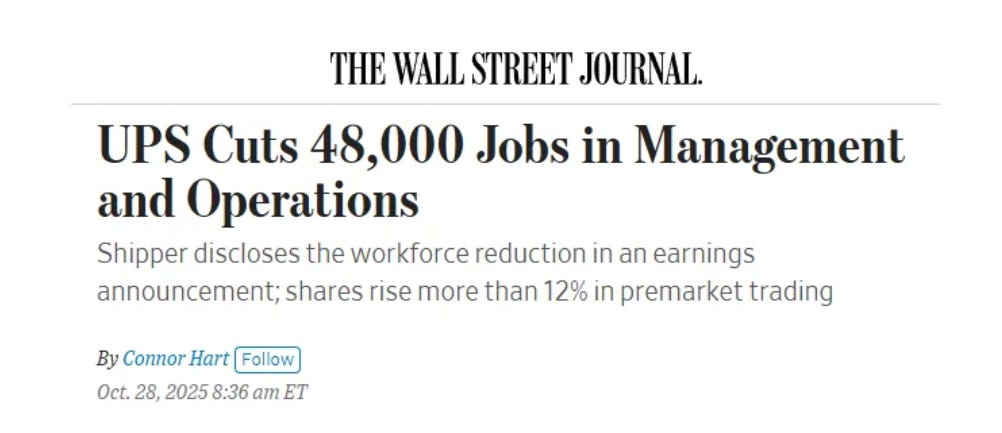
The illusion of a booming S&P 500 is unraveling in full view, exposing the rot beneath the surface of America’s so-called “prosperity.” While headlines trumpet market highs, millions are handed pink slips with cold, indifferent efficiency. Amazon slashes 30,000 jobs, UPS cuts 48,000, and the parade of layoffs sweeps mercilessly across industries once deemed untouchable. The titans of American industry—General Motors, Target, Meta, Google, Intel—are no longer symbols of strength but harbingers of decay, each iteration of their cuts a grim reminder that no one is safe. This is not a sector struggling; it is a systemic hemorrhage.
The Month the Pink Slips Fell Like Confetti
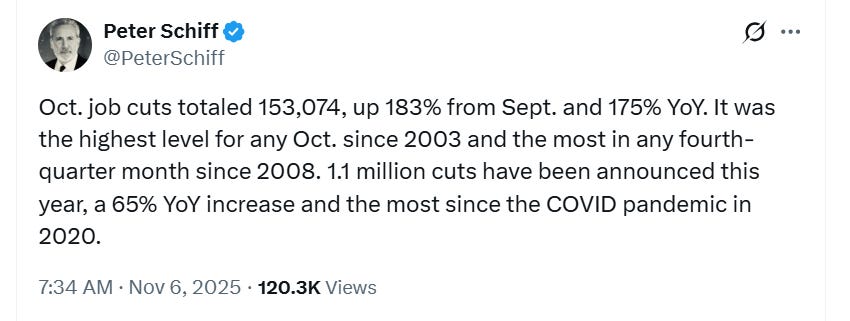
October 2025 delivered a grim milestone: over 153,000 layoffs announced in one month, the highest in two decades. This carnage isn’t confined to any one corner. It’s not just tech or “disruptive innovation” swallowing its own tail. Warehouses are shuttered, factories laid bare, Main Street retailers buckle under the strain. The backbone of the American economy is being sawed off at the knees under the guise of AI, automation, and “cost-cutting.” But cutting costs means cutting people—and the cost is a devastated middle class.
The Ghosts of Corporate America
Witness the vanishing of once-indomitable corporate giants. U.S. Steel, General Motors, Procter & Gamble have all but disappeared from the headlines—except to mark their decline. Retail relics like Sears, JC Penney, and Macy’s are ghosts wandering the aisles of our collective economic memory. Energy giants Exxon, Chevron, and ConocoPhillips have been eclipsed by volatile tech behemoths, and even Walmart and Target strain to hold onto relevance amid a consumer base that’s too strapped to spend.
Collapse in Real Time
The so-called “fast-casual revolution” has turned into a rout. Cava, Shake Shack, Chipotle, Jack in the Box, and Wendy’s—once the darlings of America’s dining scene—have each become casualties of collapsing consumer demand and an overstretched economy. Their stocks are down between 45% and 85%, reflecting not just operational missteps but the brutal math of a public too broke or too wary to dine out. These were the brands that promised affordable indulgence and middle-class convenience; now they serve as a barometer of exhaustion. When even cheap meals are unaffordable, it’s not just the restaurants that are in decline—it’s the entire idea of American prosperity.
On both Main Street and Wall Street, collapse writes its story with brutal clarity. DoorDash plummeted 17% due to reckless spending and mounting losses. Wendy’s, a staple of American fast food, fell nearly 45% this year, a casualty of vanishing customer traffic and bleak sales forecasts. Chipotle slashed sales projections 15%, citing “relentless macroeconomic pressures” that translate plainly to consumer wallets running thin. The narrative of a thriving economy? It’s a mirage.
The AI Five and the Hollow Core
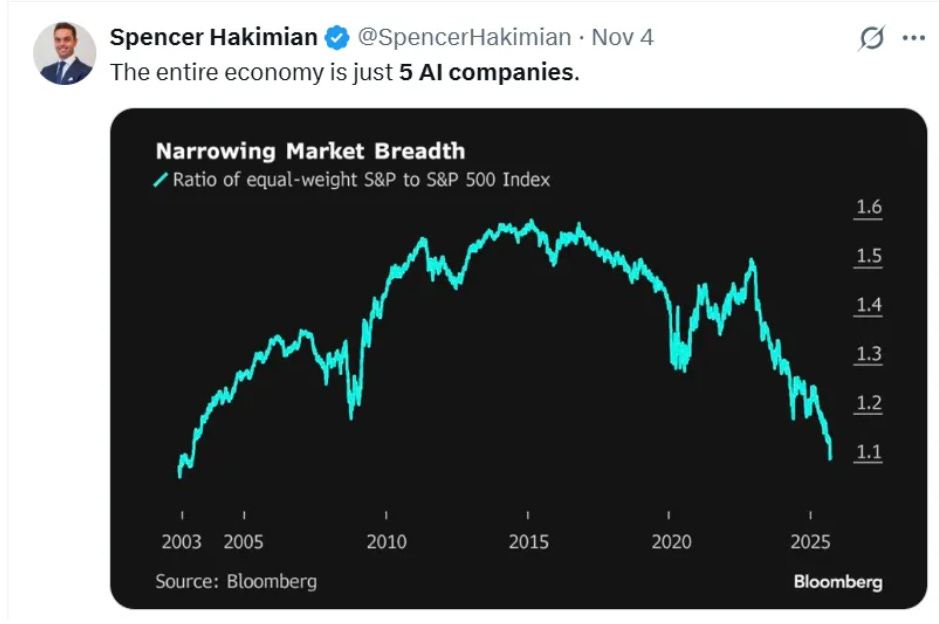
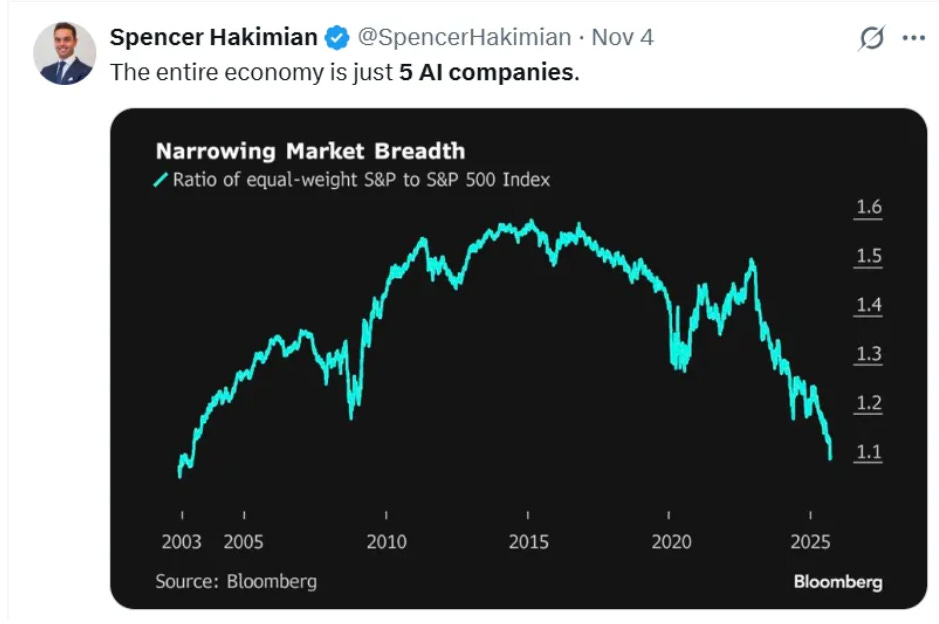
Behind this veneer of market strength lies a barren core propped up by five AI giants—NVIDIA, Microsoft, Apple, Amazon, Alphabet—while the rest of the economy bleeds. This is no broad-based prosperity; it’s a paper tiger. Stock buybacks and AI hype mask the reality of boarded-up storefronts and an evaporating middle class stripped of both jobs and hope.
Shutdowns, Spectacle, and State-Induced Chaos
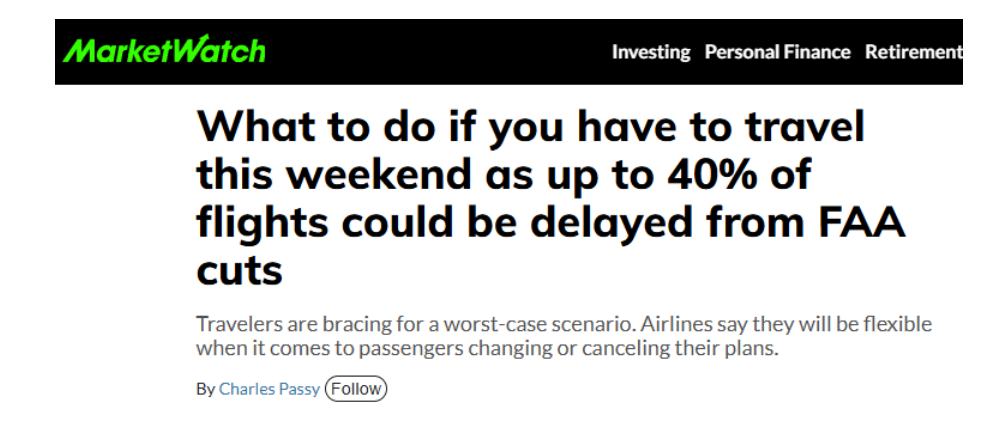
Washington’s answer? Paralysis and spectacle. Amid tens of thousands losing their livelihoods, the government flounders, indifferent or powerless to intervene. Instead of policies to revive the economy, we get shutdowns and manufactured crises timed for maximum disruption. The FAA slashes flights at 40 major airports right as millions prepare holiday travel, grinding the system to a halt. Air traffic controllers and TSA agents work unpaid and exhausted, hostages to a political theater that weaponizes public frustration under the guise of fiscal responsibility.
Crisis as Policy
Meanwhile, the government recycles tired crisis narratives to justify spending restrictions and control measures, all the while ignoring the real suffering of working people. The emergency “money pipes” open, but the funds rarely reach those who need them most. Instead, citizens endure travel chaos, airport chokepoints, and tightened financial reins while being placated with empty talk of stability and safety. The message is clear: compliance, not care.
The Distraction Doctrine

Foreign distractions multiply as Washington escalates military tensions—from Venezuela to Russia’s doorstep, Palestine to Mexico’s border. These aggressive postures parade as “national security,” a spectacle playing to a distracted public while the home front degrades into economic ruin. Domestic citizens become suspects—monitored, restricted, and marginalized in a society increasingly governed by mistrust and control.
A Nation Engineered to Fail
The government’s modus operandi has evolved into a relentless cycle of crisis creation and narrative management, designed to keep the populace off balance and focused everywhere but on their shattered economic realities. Mass unemployment climbs; industries crumble; social safety nets threadbare. Yet, the response is a theater of dysfunction—shutting down government, halting flights, escalating foreign military flashpoints—all while basic needs go unmet.
The War Within
The American people find themselves caught in a maelstrom of deliberate economic destruction and political distraction. The reality is stark: Washington isn’t working to solve the crisis—it is deepening it. With one hand the capitalist machine lays off workers by the hundreds of thousands, while with the other the state tightens controls and wages covert wars, domestic and foreign. What remains is a hollowed nation, propped up by speculative hype and political theater, destined for ruin under the weight of its own neglect.
Glitter, Decay, and the Mirage of Prosperity
No miracle lies behind the S&P 500’s shimmer—just desperation, deception, and decay. The glittering stock charts mask boarded storefronts and exhausted workers, while those in power turn crisis into control, pain into spectacle. The American dream? Reduced to a mirage, slipping through desperate fingers as the fantasy finally fragments in harsh daylight.
Gold and Silver to the Rescue
Chinese citizens, who own substantial gold, have enjoyed roughly a trillion-dollar net gain in household wealth this year thanks to gold’s steep price rise, while U.S. citizens—disproportionately invested in declining Treasuries—have faced losses.
This divergence highlights how rising gold values benefit Chinese households, while falling Treasury prices erode American wealth. With this advantage, countries like China and Russia have little incentive to return to a U.S.-centric, dollar-dominated financial system built on trust they no longer have
The U.S. critical mineral designation for silver sets the stage for a global scramble among major economies—China, Russia, India, the EU, Canada, Japan—to secure strategic supplies, potentially unleashing a stockpiling race that drives demand sky-high.
This comes just as silver faces its most bullish setup in decades: persistent structural supply deficits, inflexible byproduct-dependent production, and surging industrial demand from solar, military, aerospace, EV batteries, technology, and medical sectors.
On top of this, new government stockpiling programs add price-insensitive demand, potential trade restrictions tighten supply chains, monetary demand rises as faith in fiat erodes, and official validation from Washington ratifies silver’s strategic importance, amplifying urgency and upside potential in a shifting global landscape.
Invest Accordingly
Aya Gold & Silver (TSX: AYA, OTCQX: AYASF) has reached a transformative milestone in Morocco with the delivery of a landmark Preliminary Assessment (PA) for its Boumadine project.
-
Aya Gold & Silver Investor Update:
-
Boumadine Sets New Standard in Morocco
-
Estimate for first five years of mine:
-
328,000 to 400,000 ounces of gold equivalent PER YEAR
-
operating cost of approximately $1,021 per ounce
”Most of the revenues are derived from from gold at 61% of the revenue is gold, 21% is silver and about 18% is is lead and zinc. And I quite like this waterfall. I think it it really put the project in in in the light that we have $7 Billion of revenue and after tax-free cash flow of $2 billion. And again, I repeat, this is this is the the base case. So, a $2,800 per ounce of gold and and and $30 per ounce of silver. And the best case is is robust. Then the spot price is even better.” – Benoit La Salle (CEO: Aya Gold and Silver)
This marks the culmination of three years of intensive exploration and engineering—confirming Boumadine as a world-class asset and positioning Aya as one of the region’s premiere precious metals producers.
This video provides investors with a comprehensive look at key project highlights, economics, and the path forward.
Boumadine is emerging as one of the world’s premier precious metals development projects, underpinned by Aya Gold & Silver’s proven execution at Zgounder and now supported by a robust PA.
With a low-cost, high-margin production profile, significant resource growth potential, and a strategic Moroccan footprint, Aya represents compelling value and an exciting growth platform for investors as Boumadine advances toward production.