
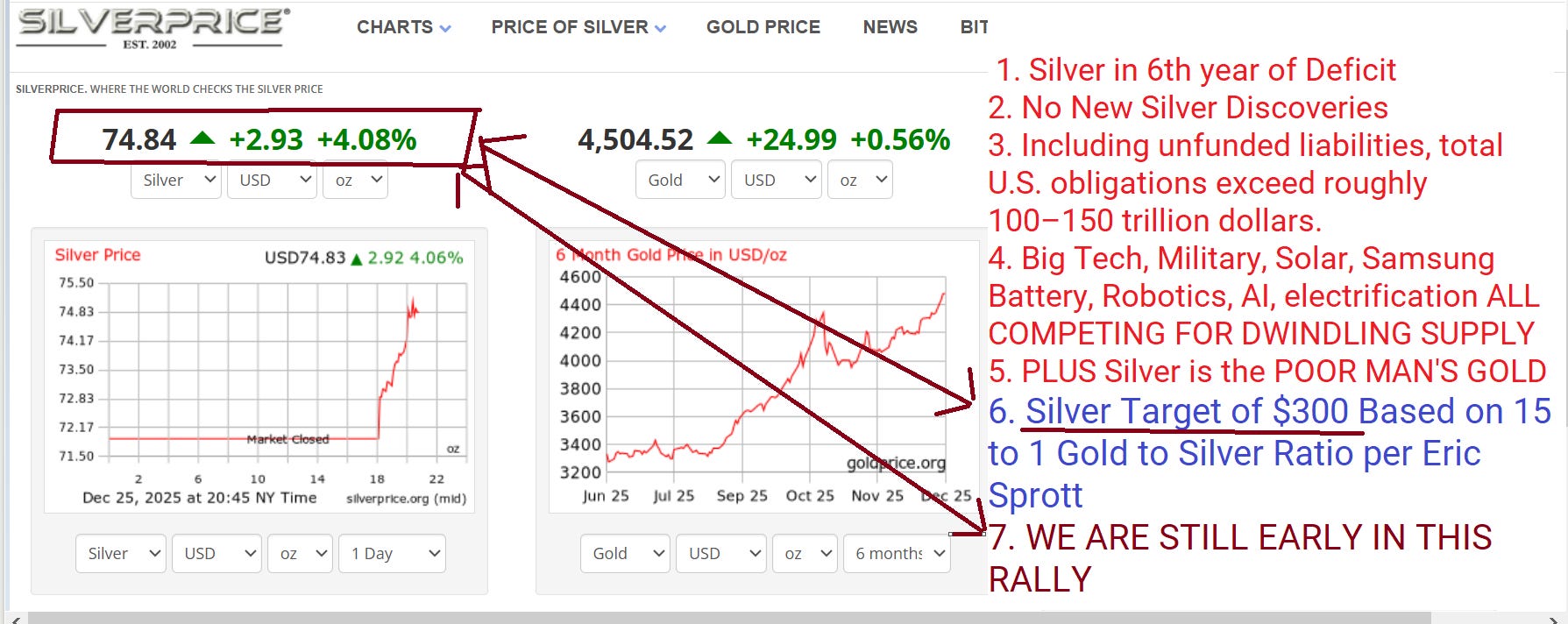
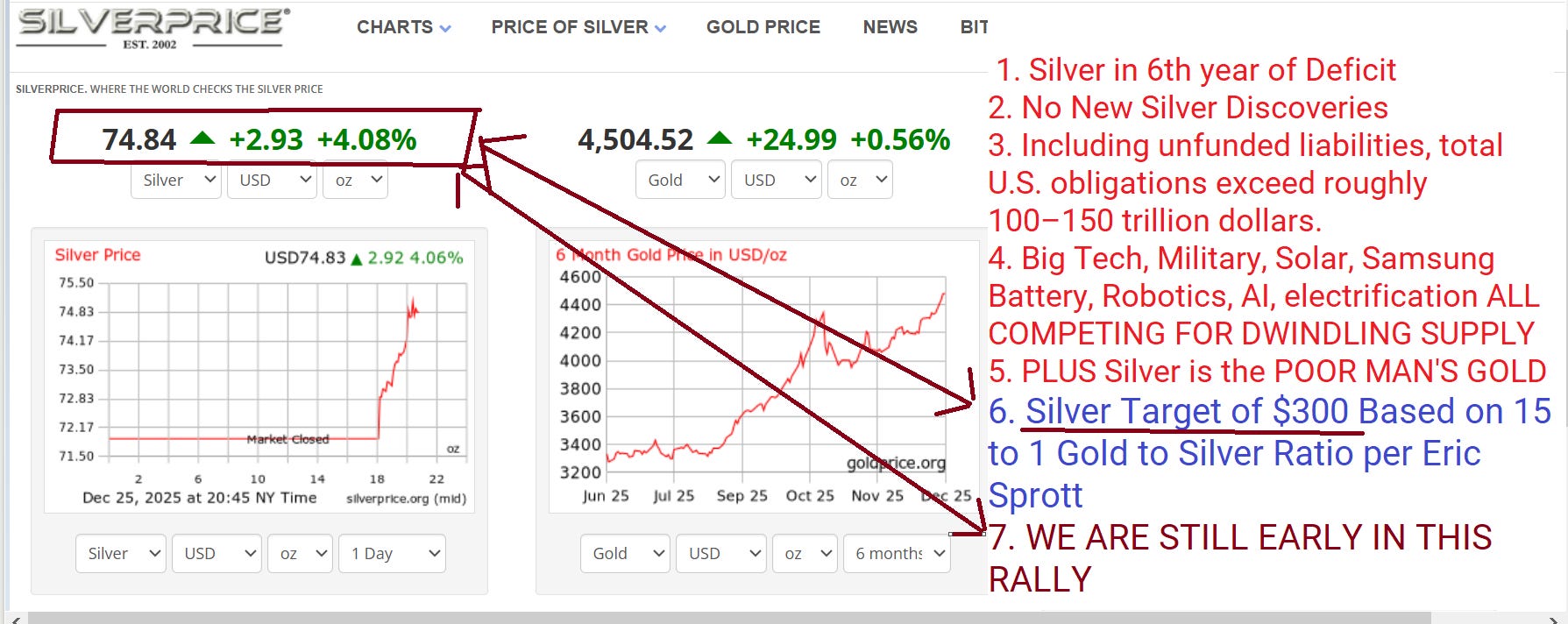
Silver is no longer a sleepy “precious metal” – it is the most contested raw material in the modern system, where money, energy, war, and machines are all converging on the same shrinking pile of physical ounces. Monetary and industrial demand are now fusing into one super‑cycle, and almost nobody in the West is positioned for what happens when the world figures out there simply is not enough silver to go around.
Monetary silver: the new collateral
Silver is quietly being re‑monetized while Western media still calls it “just another commodity.” Central banks, sovereign funds, and now Indian regulators are hard‑wiring silver into the plumbing of the financial system as collateral, savings, and strategic reserves.
-
The Reserve Bank of India will allow loans against silver jewelry and coins from April 2026, turning household silver into bankable collateral.
-
Indian pension rules have been revised so long‑horizon retirement money can flow into gold and silver ETFs, structurally anchoring silver as a store of value.
-
As BRICS countries accumulate gold and silver while Western governments pile on debt, silver is being peeled away from gold’s shadow and recognized as an independent monetary metal.
Industrial silver: the metal you can’t replace
In parallel, industrial users are devouring silver in ways that cannot be substituted without breaking entire technologies. Silver’s unmatched conductivity, reliability, and corrosion resistance mean it is locked into electronics, energy, and weapons systems at the design level.
-
Engineers specify silver where failure is not an option: radar, power electronics, high‑end circuit boards, and advanced communications.
-
Industrial uses are largely non‑recoverable at scale; once silver is locked into millions of cars, panels, chips, and missiles, it is effectively gone for decades.
-
As energy transition, electrification, and rearmament all accelerate, industrial demand is rising into a flat‑to‑declining mine supply profile.
Tech giants: wiring the cloud with silver
Big Tech’s data centers, AI clusters, and consumer devices all run on high‑performance electronics where silver quietly carries the digital world on its back. The more compute power and bandwidth humanity wants, the more silver disappears into server boards, high‑speed interconnects, and power modules.
-
Silver is built into critical contacts, solders, and high‑reliability components inside networking gear and cloud infrastructure.
-
AI hardware and next‑gen chips tighten tolerances, reinforcing the need for silver’s conductivity and signal integrity in premium designs.
-
Every generational leap in consumer electronics—5G, 6G, XR, high‑end wearables—quietly ratchets up the silver burn rate inside billions of devices.
Auto makers: the 9‑minute silver battery shock
The auto industry just got blindsided by a silver‑powered solid‑state battery that shreds the old EV equation. Samsung’s new design uses a thin silver‑carbon composite anode layer to deliver a full charge in about nine minutes, roughly double the driving range, and a 20‑year lifespan at far higher energy density than mainstream lithium‑ion.
-
The silver solid‑state cell can reach around 500 Wh/kg, nearly double typical EV batteries, making packs up to 40% lighter for similar energy.
-
Range in the 600‑mile neighborhood with ultra‑fast charging obliterates range anxiety and turns charging stops into coffee breaks instead of lunch breaks.
-
Analysts estimate that such designs can require on the order of a kilogram of silver per car, multiplying automotive silver demand if this technology scales.
Solar companies: no substitute, no mercy
Solar manufacturers are trapped in a brutal race: cut costs, add capacity, and hope silver prices don’t explode first. Photovoltaics already account for a large and rising share of global industrial silver demand, and there is simply no perfect substitute without sacrificing efficiency.
-
Silver paste in solar cells is critical to collecting and transporting current; alternatives like copper bring performance and reliability penalties.
-
As solar’s share of global power generation climbs, cumulative silver use for PV is projected to take well over 10% of total industrial demand and keep rising.
-
Every new gigawatt of installed solar locks away more silver on rooftops and in fields for 20–30 years, permanently tightening above‑ground inventories.
Central banks and sovereign funds: stealth silver insurance
Central banks openly talk about gold while quietly studying—and in some cases accumulating—silver as strategic backup to financial and geopolitical shocks. Sovereign wealth funds, seeing BRICS loading up on hard assets and tensions spreading from the Red Sea to the Taiwan Strait, are reassessing silver as portfolio insurance.
-
Policy circles increasingly frame silver alongside gold as a monetary hedge, especially in countries building alternative payment systems outside the dollar.
-
Sovereign portfolios can express this via ETFs, miners, and physical reserves, turning what used to be a “retail metal” into an institutional asset.
-
As official players move into a market historically dominated by individuals, their scale threatens to overwhelm thin physical inventories.
Individual investors and the Eastern middle class
Western retail remains half‑asleep, with FOMO barely flickering compared to the speculative frenzies seen in meme stocks and crypto. In the East, particularly India, silver is shifting from a cultural adornment to a formally recognized savings and credit instrument.
-
India will allow silver jewelry and coins as collateral for regulated bank and NBFC loans from April 2026, monetizing household silver at scale.
-
Indian pension funds can now allocate to gold and silver ETFs, embedding long‑term, non‑trading silver demand into retirement systems for over a billion people.
-
This is “buy and hold for decades” capital, not speculative day‑trading, meaning those ounces, once acquired, are essentially removed from the market.
Defense, aerospace, and robotics: war for conductivity
Modern weapons systems are in a literal arms race for silver. Silver‑zinc batteries still power torpedoes, missiles, and spacecraft because you cannot risk lithium packs that might ignite in a torpedo tube or guidance system.
-
Guidance, radar, communication, hypersonic missiles, satellites, and space stations all depend on silver in contacts, solders, thermal films, and primary batteries.
-
Silver‑zinc batteries are described by engineers as the only safe, high‑power option for certain torpedoes and cruise missiles, with no practical substitute.
-
High‑end robotics and automation systems rely on silver‑rich solders and contacts at critical joints, where failure means crashed drones, dead factory lines, or mission failure.
One shrinking pool of metal
Tech giants, automakers, solar firms, central banks, sovereign funds, retail investors, Eastern savers, defense contractors, and robotics manufacturers are all bidding for the same finite pile of physical silver. Mine supply is flat, industrial destruction is permanent on human timescales, and long‑horizon capital is locking up what remains.
At some point, price will not be about charts, but about who actually gets delivery—and who discovers, too late, that “just‑in‑time” doesn’t work when the metal is gone
Eric Sprott is Right
Eric Sprott is right because his $300 silver target and 15‑to‑1 gold‑silver ratio call are grounded in geology, history, and math, not hype.
He notes silver is mined at roughly 8‑to‑1 versus gold and historically (in times like these) traded near 15‑to‑1, yet the ratio blew out toward 100‑to‑1 during the era of extreme paper suppression.
With gold targets in the $4,500–$8,000 range and a return to a 15‑to‑1 ratio, Sprott calculates silver in the $300+ zone as allocation shifts and physical shortages collide.
Eric Sprott has actually lived this market from single‑digit silver into multiple bull and bear cycles, calling out manipulation and enduring decades of banking games, paper attacks, and COMEX distortions while still accumulating metal.
That longevity gives his conviction real weight. When it comes to taking delivery, his own bullion platform, SprottMoney, is widely regarded as one of the most trusted places to buy and store physical gold and silver, offering global mint products and vaulting solutions.
We accept his thesis that the real move is still ahead, it makes sense to align with the dealer bearing his name at sprottmoney.com

-
our opinions are not our sponsors
-
the editorial department is separate from the promotions department
-
not financial advice
-
buy silver
-
it is heading to $300 soon