
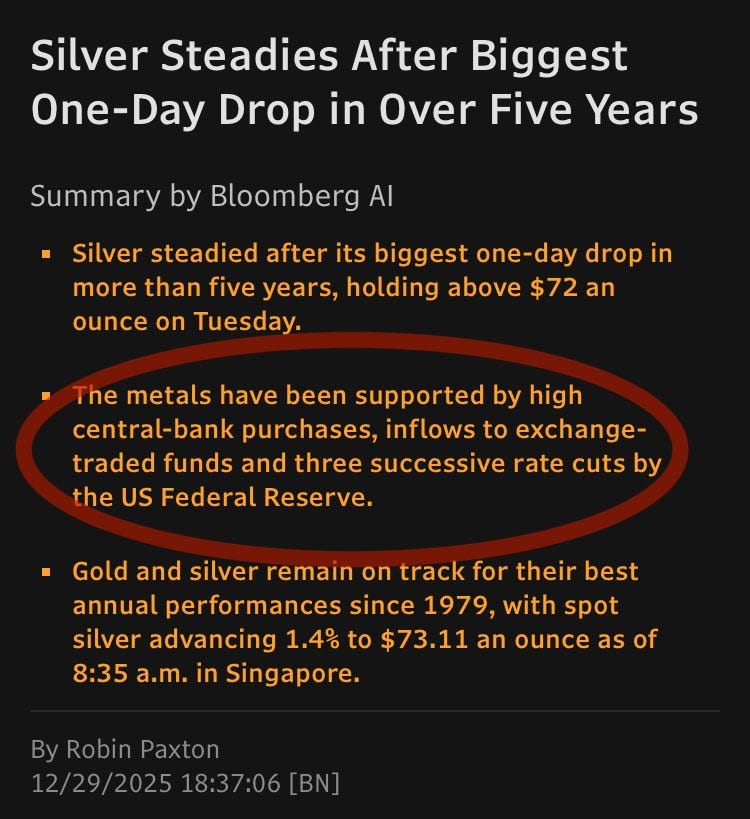
Bloomberg Admits Central Banks are Now Buying Silver
Recall what Gold did once Central Banks and Institutional Money Piled in
Now understand how “Poor Mans Gold” will Blow by Gold relatively
THE SILVER REBELLION
How the East Broke the Paper Empire
The calm you see isn’t stability — it’s the sound of an old order quietly coming apart.
Midnight in the Paper Empire
Somewhere between the graveyard shift in Shanghai and the opening bell in London, the silver market snapped. The terminals still flashed prices, but underneath, something far more important had changed: belief.
For half a century, COMEX and the LBMA posed as the high temples of “price discovery,” churning out paper claims on silver at a ratio that would make a counterfeiter blush. They sold leverage, not metal; faith, not bars.
So what happens when the world finally calls their bluff?
Ask yourself
Q: Since Shanghai is over $80 per ounce why wouldn’t any whale just take all Western Silver at $72 over to China
Anyone would convert $72 to $80 for an immediate 11% gain
So Why aren’t we seeing this?
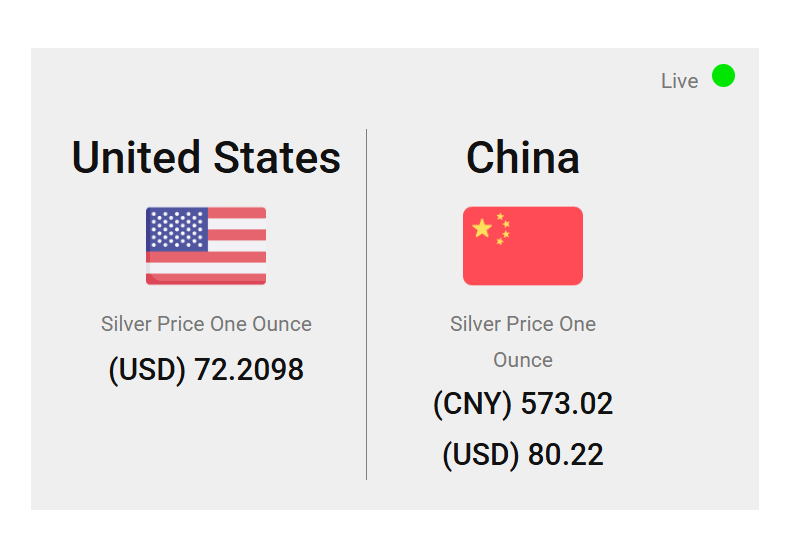
This Proves that LBMA / COMEX doesn’t have the Silver … otherwise someone would have
They Don’t HAVE the Silver!!!
LBMA and Comex are Has Been INSTITUTIONS
China controls Silver
Because China controls refining
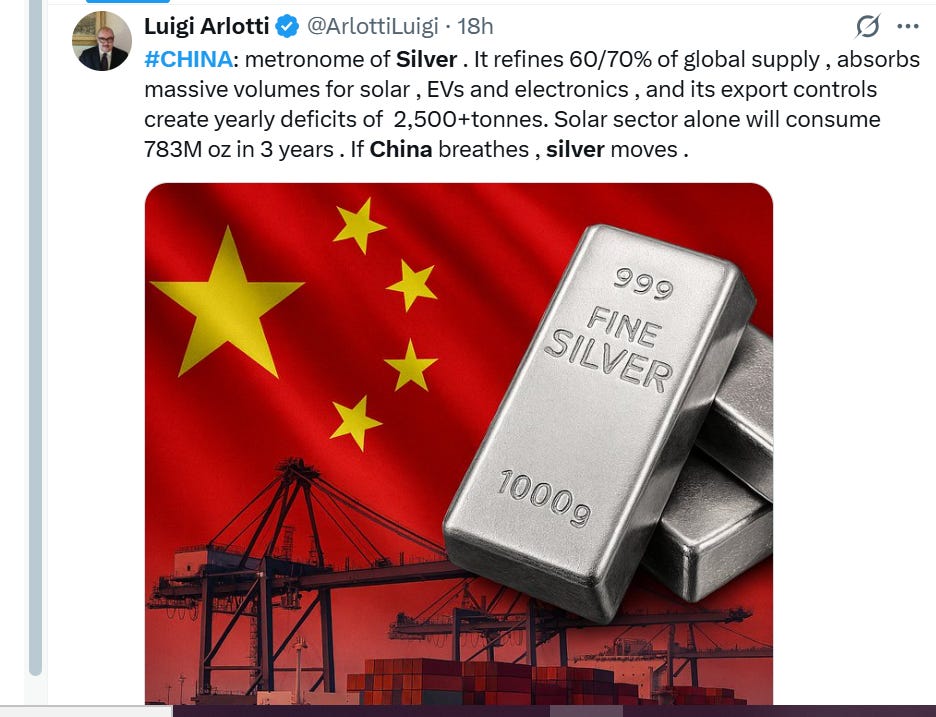
China poured capital into massive smelting and refining capacity, now controlling most global refined silver, making its processing hubs indispensable chokepoints for industrial supply chains and future pricing power
”China effectively controls silver because it controls the refining stage, where raw mine output becomes usable metal. Over the last two decades, Beijing funneled state-directed capital into gigantic smelting and refining complexes, especially integrated base‑metal hubs that also produce silver as a byproduct. These facilities now handle a dominant share of global refined silver, so industrial users ultimately depend on Chinese processors even when ore is mined elsewhere. That concentration gives China a strategic chokepoint over supply chains and significant leverage over future silver pricing and availability” – Jon Forrest Little
China Built the Chokepoints. Then Turned the Valve.
While Wall Street gamed basis trades, China quietly spent a decade turning itself into the central nervous system of global refined silver. Chinese smelters and refineries now handle the majority of the world’s silver output, making their industrial hubs indispensable to Big Tech, military, aerospace, solar, EVs, and AI infrastructure.
Now Beijing has shifted silver into the same strategic basket as rare earths and tungsten — a resource to weaponize, not donate.
Starting January 1, 2026, new export controls and licensing rules will effectively put 60–70% of globally traded refined supply behind a Chinese permission slip.
If one country can decide whether your factory runs or dies, who really sets the price?
A Deficit You Can’t Paper Over
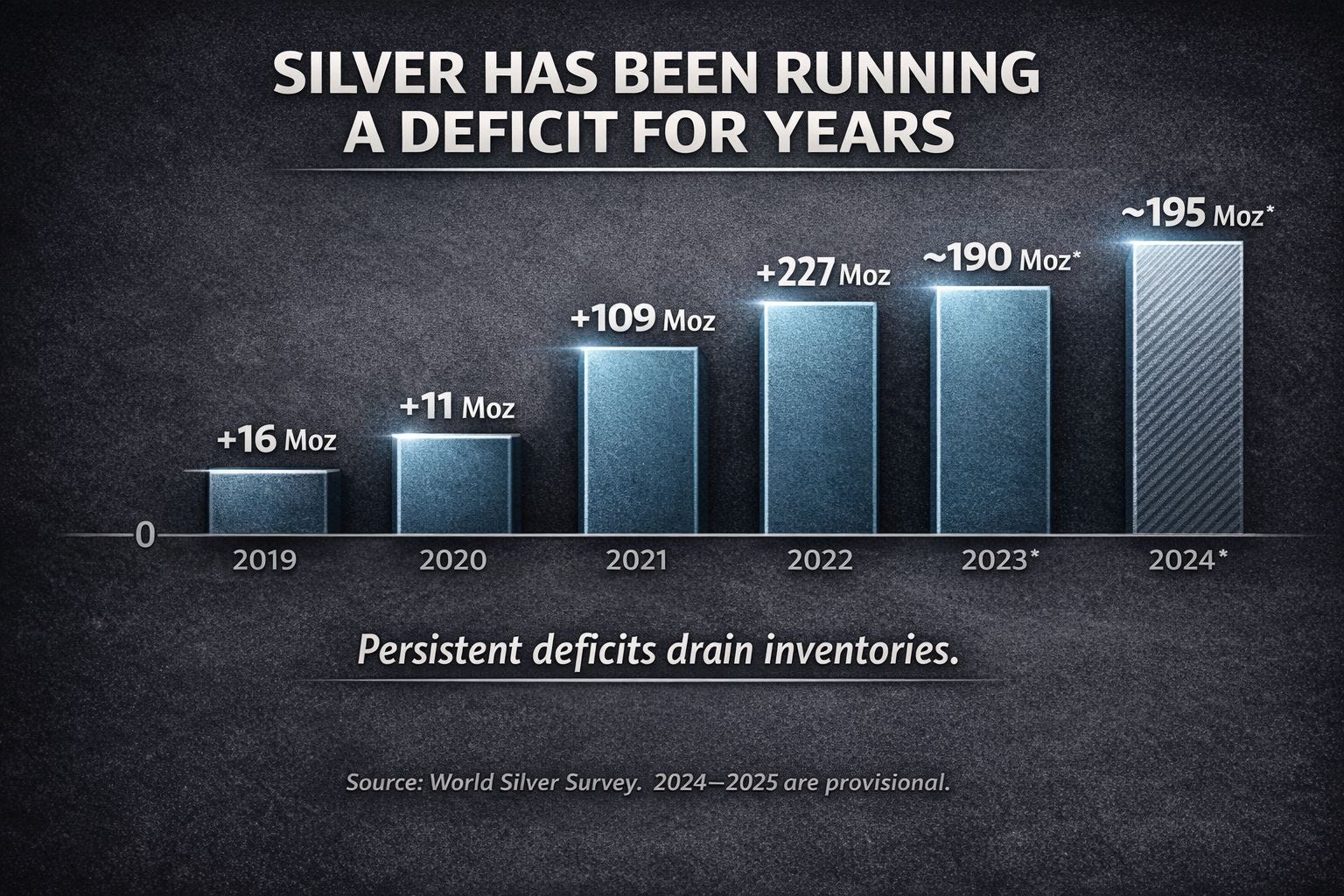
The “everything’s fine” narrative dies the minute you look at the balance sheet. The silver market has been stuck in a structural deficit for years, with recent shortfalls running around 200–230 million ounces annually as demand outstrips mine supply.
Those missing ounces aren’t for jewelry; they’re being swallowed by the growth engines of the entire global economy — solar, data centers, EVs, defense systems, 5G, robotics, and AI hardware — in what analysts now call an unprecedented cumulative deficit approaching nearly 800 million ounces.
When your “oversupplied” metal has effectively burned through almost an entire year of global production, how long can the illusion of abundance survive?
CME’s Margin Panic: When Control Starts to Slip
Enter the Chicago Mercantile Exchange, stage left, with its favorite tool of control: margin. Silver has exploded this year, with prices ripping to record highs north of 80 dollars before profit‑taking hits, while gold also notched historic gains.
Now, CME has hiked margins twice in short order, slamming silver traders with outsized increases while tightening screws across the metals complex as volatility erupts.
The official line is “risk management”; the unofficial translation is simple: the old guard is terrified of losing the narrative as paper prices start to reflect physical scarcity.
If they’re willing to bleed their own casino with brutal margin hikes, what are they really afraid of — volatility, or discovery?
When Arbitrage Fails, Truth Shows Up
Here’s where the story turns from “messy market” to “systemic tell.” London’s LBMA loves to posture as a deep, liquid pool of metal — yet Shanghai silver has been trading at fat premiums to Western benchmarks, often up around 10%, and the supposed arbitrage isn’t being closed.
In a healthy market, metal would sprint from cheap West to expensive East until that gap disappears. When it doesn’t, it means one of two things: either the metal isn’t where the paper says it is, or it cannot be moved without breaking something in the banking and leasing machinery that has kept this game alive.
If free money is sitting on the table and nobody can pick it up, is the problem really price — or is it the terrifying truth about physical settlement?
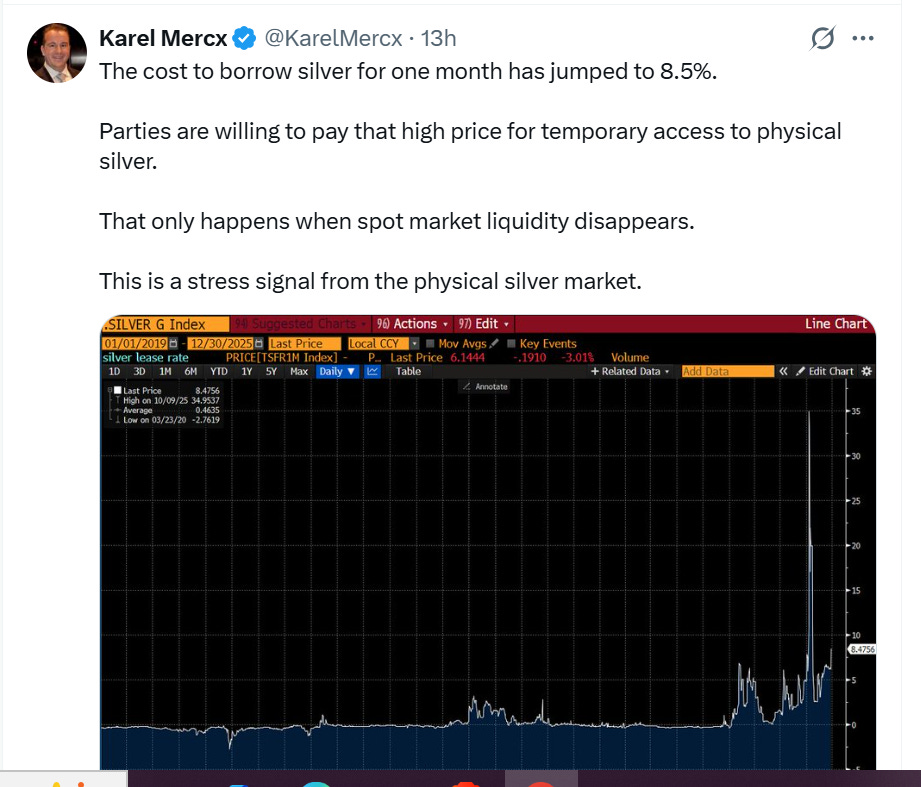
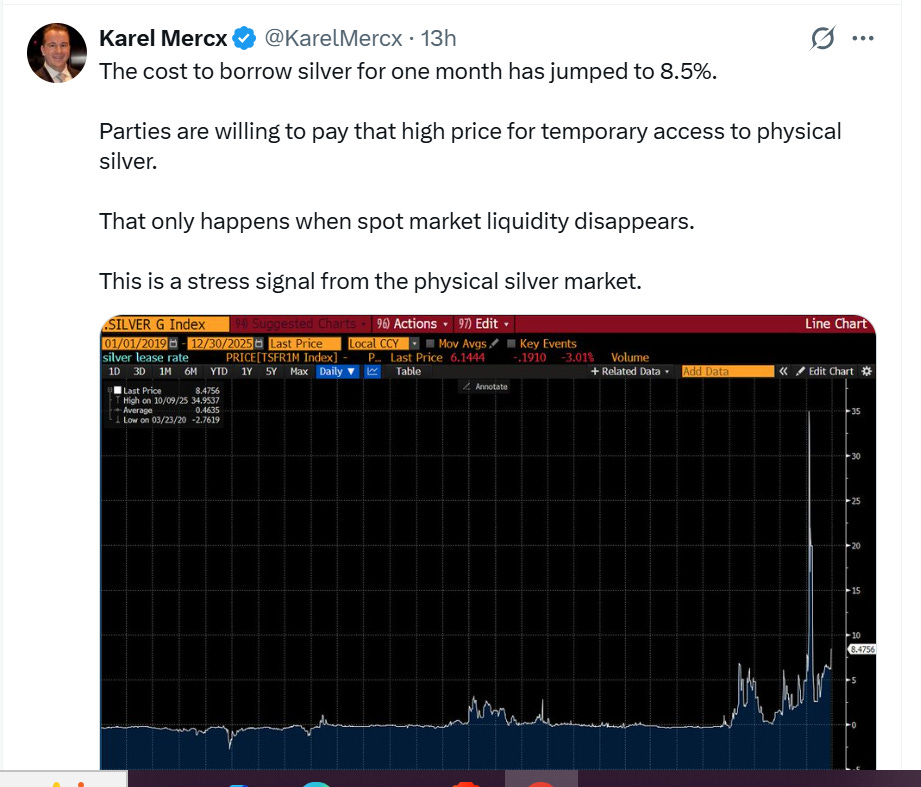
The Market’s SOS: Negative Swaps and 8.5% Borrow
Deep in the plumbing, the signals are screaming. Analysts now point to surging silver lease rates and deeply negative swap structures as evidence that physical supply is vanishing from easy reach, even as prices lurch higher.
When parties are willing to pay eye‑watering annualized rates — 8%‑plus just to borrow silver for short stretches — it’s not about juicing returns; it’s about survival in a spot market where real liquidity is disappearing. A market that has to bribe metal out of hiding at any cost is not healthy — it’s in triage.
If the only way to get silver is to overpay for temporary access, how long before “benchmark” prices lose all meaning?
More Gold Than Tradable Silver
Here’s the twist that blows up 50 years of monetary dogma: there is now more gold sitting idle in vaults than silver available to trade on earth-scale markets. Analysts peg above‑ground gold at roughly 200,000‑plus metric tons, while freely tradable silver is a fraction of that — often cited near 55,000 metric tons once you strip out locked‑in industrial inventory and long‑term holdings.
Silver was always sold as “poor man’s gold.” Today, poor man’s gold is scarcer, more indispensable, and more system‑critical than its glamorous cousin. When central banks and sovereign funds start pivoting from just stacking gold to quietly eyeing silver as a co‑strategic reserve, the old hierarchy flips.
If the scarcer, more useful metal has been mispriced for decades — what happens when the world finally updates the scoreboard?
This Is How Financial Centers Die
Global financial centers do not collapse in a single headline. They decay through a series of small, “technical” failures: an undelivered bar here, a delayed shipment there, a quiet force majeure no one wants to talk about. COMEX and LBMA won’t fall by admission; they’ll fade into irrelevance as the physical East refuses to play by paper West rules.
China’s export controls turn its refining hubs into strategic throttles, structural deficits keep draining inventories, margin hikes reveal panic, and arbitrage gaps that refuse to close expose a brutal truth: availability, not a screen quote, is becoming the real signal.
If “price discovery” lives where metal actually moves, are New York and London still in charge — No. They already lost the war and just not read the surrender terms?
Silver: From Afterthought to Weapon
The irony is almost poetic. The metal Wall Street mocked as an industrial sidekick is now the one resource capable of cracking their monetary stagecraft. With China pulling export levers, structural deficits grinding on, and physical stress bleeding through every layer of the market’s plumbing, silver has crossed a line: from commodity to weapon, from hedge to leverage point.
When the next delivery fails, it won’t just be a contract problem. It will be a credibility event — for exchanges, for bullion banks, for the entire idea that digital claims can stand in for cold, heavy metal in a world that suddenly needs every ounce.
So the real question isn’t whether silver wins. It’s this: when the curtain finally falls on the paper empire, which side of the trade will you be holding?
end of segment
-
our opinions are not our sponsors
-
editorial is separate from promotions
-
not financial advice