
Amid all the metal wars between the United States and China, export controls, whitelists, and geopolitical theatrics, the loudest signal today is brutally simple: silver is already a three‑digit metal in India.
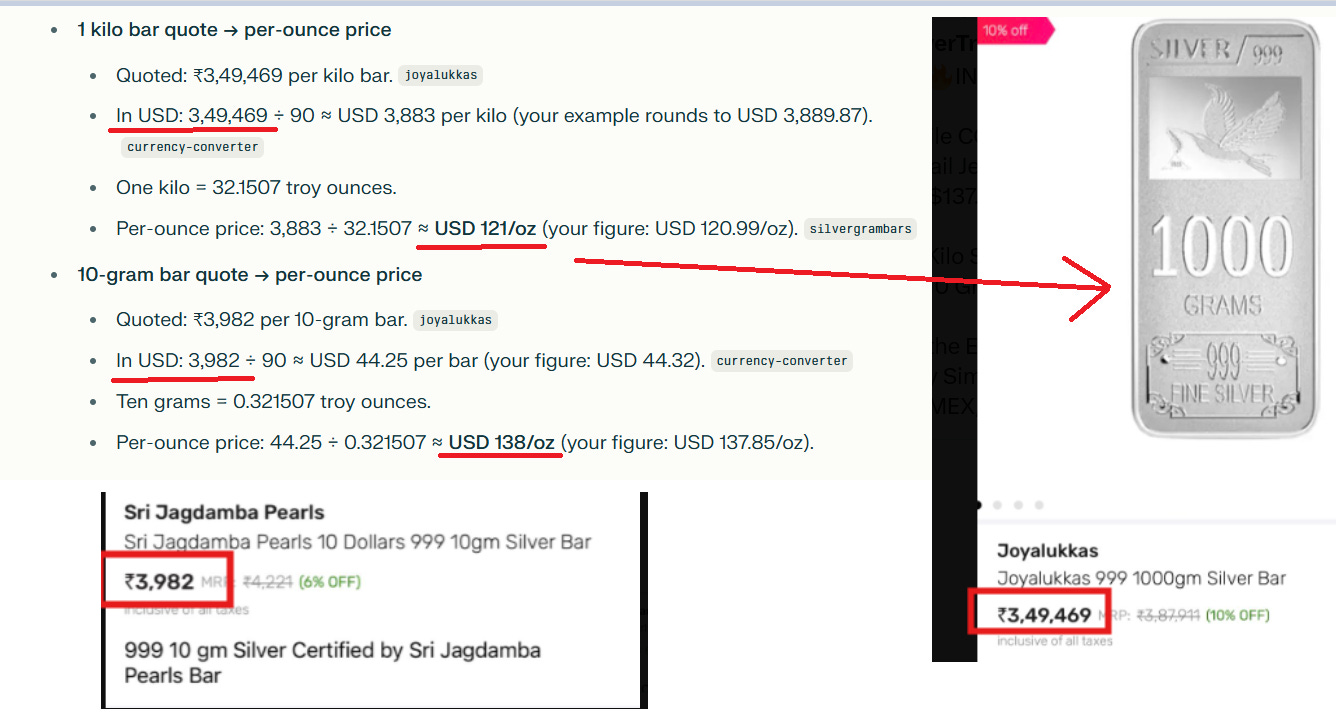
China is reclassifying silver as a strategic resource, locking 60–70 percent of tradable refined supply behind an export‑licensing wall, while only 44 firms are authorized to ship it abroad through 2027. Yet the most important development is not a policy memo in Beijing, it is the lived reality on the streets of Mumbai, Delhi, and Chennai, where retail buyers are paying roughly USD 137 per ounce for small‑denomination Joyalukkas silver—nearly double Western COMEX prices. That is the real tell. One superpower is tightening the spigot; another giant, India, is proving what silver is actually worth when 1.4 billion people and a modern banking system treat it as money instead of a disposable input
Setting up some context with 5 key points
-
Silver is entering a structural crisis, not a “cycle.”
-
Industrial demand has already won the war for ounces.
-
Silver’s monetary role is about to triple – that is a regime change
-
A small market with enormous leverage to chaos is built for violent upside.
-
The 2026 environment is precisely the kind of chaos silver was built for.
This Is Not a Cycle, It’s a Structural Crisis
Silver is not in a routine commodity swing; it is in a mechanically guaranteed squeeze, because demand exceeds supply by more than 300 million ounces per year with no credible plan to close that gap. This is not a forecast, it is an arithmetic shortfall, which means the market must cannibalize above‑ground inventories every single year just to keep functioning. That is how physical markets behave when they are structurally short: visible stocks bleed out, delivery times stretch, and every price dip simply accelerates metal moving from weak hands into strong vaults. In this setup, much higher prices are not speculation; they are the only possible clearing mechanism for a market running a permanent deficit.
Industrial Demand Already Won the War for Ounces
Silver’s industrial demand is embedded in the non‑optional infrastructure of the 21st century: solar and grid‑scale energy, robotics and automation, AI data centers, advanced weapons, satellites, space platforms, and ultra‑high‑end circuitry. These sectors cannot simply decide to use less silver without sacrificing performance, security, or uptime; they are price takers locked into silver’s unique properties. This means these industries will keep growing and will pay what it costs to secure feedstock, because the cost of not having silver is economic and strategic failure. The consequence for investors is brutally clear: industrial users lock in a growing baseload on the physical market, tightening throughput and leaving ever fewer ounces available for monetary demand at anything close to today’s prices.
Silver’s Monetary Role Is Tripling – That’s a Regime Change
Silver is transitioning from roughly 16 percent monetary and investment demand to more than half of total demand, a 300 percent expansion in its monetary function. This is not a subtle tweak; it is silver rejoining gold as a core store of value in a world that no longer trusts unbacked promises and paper abstractions. When a metal crosses that threshold, the character of its market changes: it stops clearing on industrial cycles and starts clearing on liquidity panics, policy mistakes, and confidence shocks in the currency system. The result is a permanent bid from investors, sovereigns, and households who are no longer trading silver but allocating to it as monetary insurance, and in that environment every ounce must serve two masters—industry and money—with the only rationing mechanism being a far higher price.
A Tiny Market Sitting Under a Mountain of Claims
Silver is a relatively small, thinly traded market buried under a colossal stack of financial claims, derivatives, and institutional portfolios that still treat it as a rounding error. That mismatch is exactly why silver behaves explosively during periods of monetary stress: a modest reallocation of capital into a physically constrained market produces outsize price moves by design. This is how constrained markets with tight float and rising monetary demand always respond to crisis—they gap higher, overshoot, and force shorts, hedgers, and underweight institutions to chase ounces into a shrinking pool of available metal. In that scramble, what is happening is not “volatility” in the abstract; it is a transfer of wealth from those holding paper assumptions to those already holding metal.
2026 Is the Exact Environment Silver Was Built For
Silver’s appeal rests on one brutal fact: it thrives when the monetary system is under visible, undeniable strain. The world heading into 2026 is defined by record sovereign and corporate debt, eroding trust in fiat, weaponized financial plumbing, and a global race to lock down hard collateral in energy, defense, and technology. In that backdrop, a metal with a hard structural deficit, non‑substitutable industrial uses, and a rapidly expanding monetary role is not a “speculation”; it is the pressure valve built into the system. This is how markets behave at turning points: the asset that was mocked for a decade suddenly becomes the asset everyone needs at any price, and in this cycle, that asset is silver
Yes it is true the world has changed dramatically since Biden regime seized Russian assets a few short years ago. This started dedollarization. Now with US looting oil tankers more dedollarization. China controls the silver as over 75% of refining occurs in China. US and China are the largest industrial users of Silver and both of these countries are at war. Yes, US government plans on refining silver as there is a merger reportedly a joint venture between the so called Department of War and Silver smelter in Venezuela. Less than 24 hours after U.S. pressure on Venezuela escalated, Washington quietly backed an $8 billion, defense-linked silver smelter complex positioned to process up to $1 trillion in regional precious metals. This isn’t invasion—it’s hardwiring control of physical flow, refining, and new piece of the puzzle surrounding silver price discovery.
Still, the biggest news is India (Even though China has received most of the Silver headlines recently)
India Just Turned Silver Back Into Money
India, a nation of roughly 1.4 billion people and hundreds of millions of bank‑dependent workers and small businesses, is not just buying more silver; it is in the process of turning silver into money again through its banking system. At the same time, the spread between Eastern physical prices and Western paper benchmarks has blown out to levels that can no longer be dismissed as “premiums” or “temporary dislocations” – this is the market screaming that physical silver is underpriced on COMEX and LBMA.
RBI’s Rule: The Moment Silver Rejoins the Banking System
Beginning in April 2026, India’s new “Lending Against Gold and Silver Collateral” regime allows regulated lenders to accept silver ornaments and coins as collateral for loans, effectively placing silver alongside gold as recognized banking collateral for the first time in the modern era. Individuals can pledge substantial amounts of physical silver – up to 10 kilograms in certain categories – to obtain credit without ever selling their metal, which is the very definition of re‑monetization: a non‑yielding asset becomes a backbone of formal credit creation. In practical terms, this unlocks a colossal pool of household silver, accumulated over generations, and ties it directly into the plumbing of India’s financial system, turning what used to be inert savings into productive capital while keeping the metal itself off the market.
India’s Street Price Is Already Three‑Digit Silver
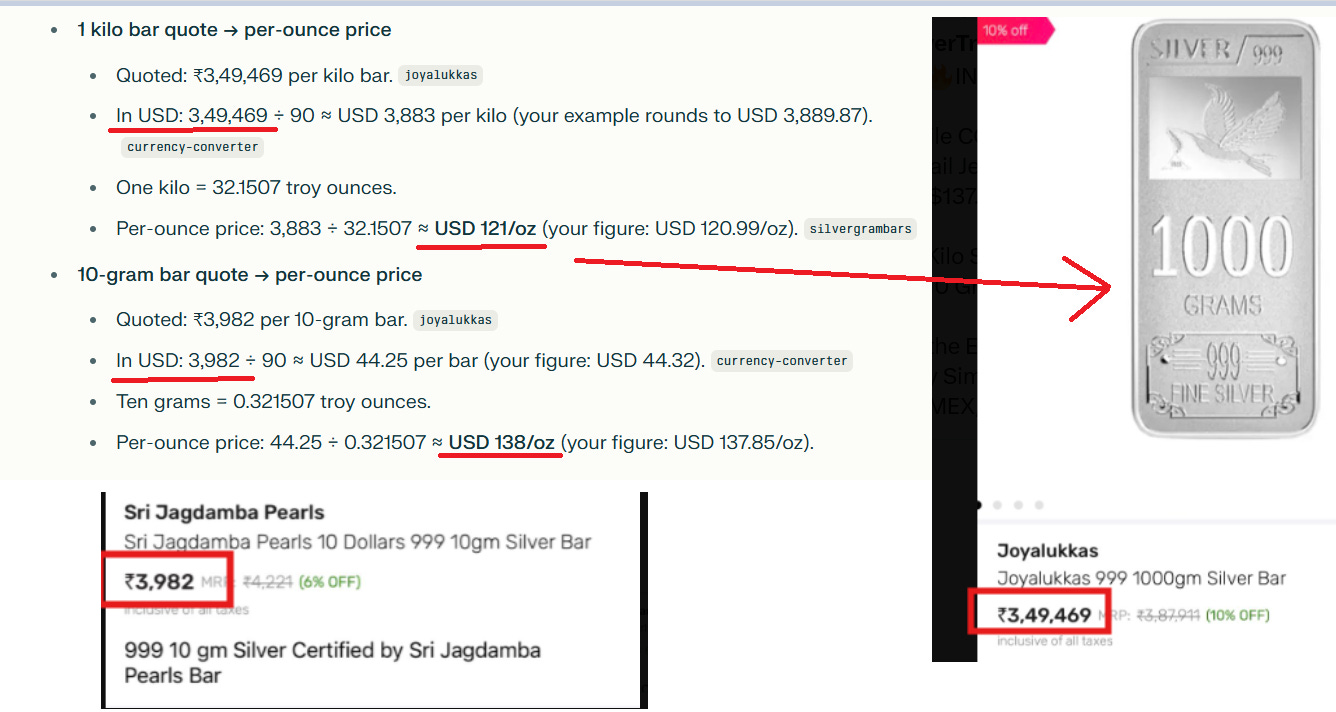
Now overlay that structural shift with what Indian prices are actually telling you today. Retail jeweler and bullion dealer Joyalukkas is quoting kilo silver bars at ₹3,49,469, which converts to roughly USD 3,880–3,890 per kilo at current exchange rates – around USD 121 per troy ounce. Smaller 10‑gram bars are selling for ₹3,982 each, or about USD 44.30 per bar, which works out to roughly USD 138 per ounce once converted from grams to troy ounces. In other words, the same dealer, in the same market, is effectively valuing silver at approximately USD 120/oz for wholesale‑style kilo bars and close to USD 140/oz for small‑denomination retail pieces, with the higher figure representing the true “street price” where regular Indians can actually acquire physical metal.
Paper Silver Lives in a Different Universe
Contrast that with Western paper markets. COMEX silver futures in early January 2026 have been chopping around the mid‑70s per ounce, with episodes of aggressive, highly correlated selling that drive contract prices lower even as real‑world physical demand stays firm. The result is a staggering arbitrage: India, one of the two great gravitational centers of global precious‑metals demand, is already transacting physical silver at 60–90 percent above the official paper price that Western media and banks still treat as the “real” price. That is not a healthy, efficient market; that is a broken signaling mechanism in which a thin, leveraged futures arena pretends to dictate value to a world that is increasingly ignoring it and paying what it takes to secure metal.
The Dogmatic Verdict: COMEX Is the Outlier, Not India
When a country of India’s size writes silver into its collateral code and tells hundreds of millions of potential borrowers that their silver can back formal loans, it is not a minor tweak – it is a regime change. Silver in India is no longer just an industrial input or a sentimental asset; it is bankable wealth, treated by the system as a monetary reserve at the household level, and priced accordingly at triple‑digit dollar figures per ounce in the retail channel. The East is now valuing silver as a scarce monetary metal, while the West insists on valuing it as an overabundant industrial byproduct, and that philosophical gap is now encoded in hard numbers: ~USD 75 on a COMEX screen versus USD 120–140 where real bars actually change hands. The dogmatic conclusion is unavoidable: the problem is not that Indian silver is “too expensive”; the problem is that Western paper silver is still absurdly cheap relative to the monetary role that 1.4 billion Indians, backed by their own central bank’s rulebook, are in the process of assigning to it. In a world where a major sovereign market has already moved to a de facto three‑digit silver standard for physical, the idea that COMEX can indefinitely enforce a low‑double‑digit narrative is fantasy; those holding paper own a price illusion, and those holding metal own the benchmark
Here is how to play all of this
Buy this Dip ASAP
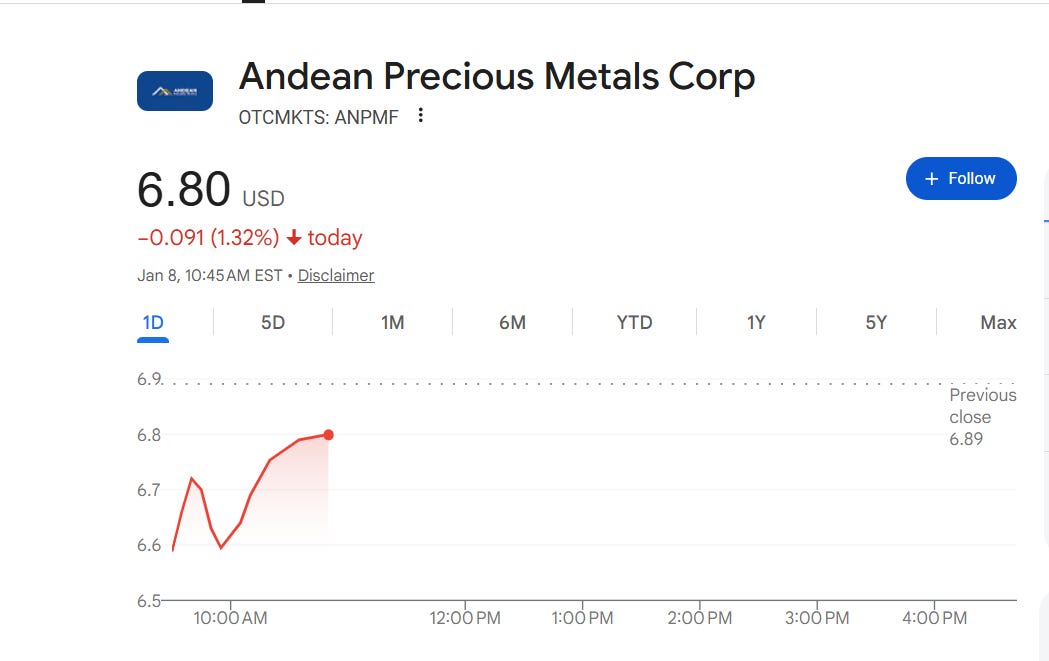
Andean Precious Metals (OTC: ANPMF) stands out as one of the best silver stocks in the market right now.
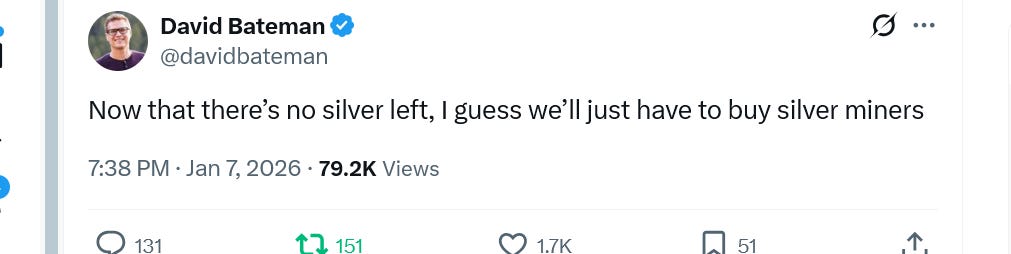
Operating the San Bartolomé plant in Bolivia, the country’s dominant silver processing hub, it sources ore from over 20,000 artisanal miners rather than owning high‑risk, expropriation‑prone deposits itself. Bolivia has already nationalized its major silver deposits, which paradoxically insulates Andean from future resource‑grab risk while locking in its role as the indispensable mid‑stream processor. Its sliding‑scale payment model—paying miners more when silver is higher and less when silver is lower—crushes downside margin risk while preserving massive upside torque, making it a cash‑flow machine in a silver bull market
-
our opinions are not our sponsors opinions
-
The editorial department is separate from the promotions department
-
not financial advice