
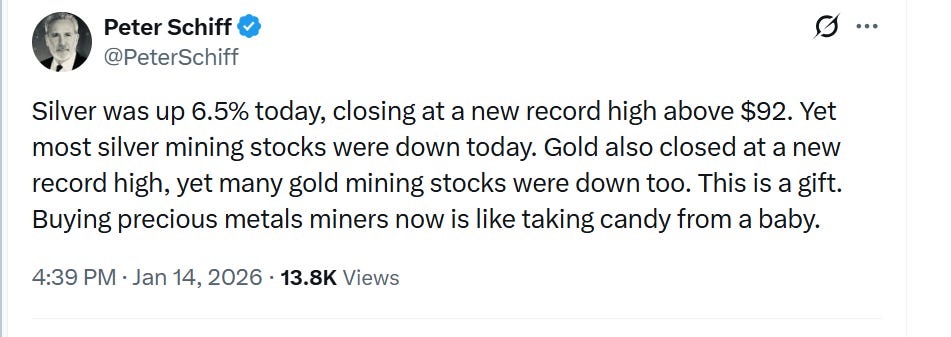
Silver exploded 6.5% higher today, blasting through a fresh all‑time high above $93 an ounce, while gold also tagged a new record high of its own. And yet, on the very same day, most silver and gold mining stocks finished in the red. That is not a warning sign; it is a gift wrapped in market confusion. Buying precious‑metals miners into this kind of divergence is like taking candy from a baby.
The Metal Wars And A Broken Signal
The world is in the middle of full‑blown metal wars, with the United States and China weaponizing trade flows, export controls, and financial plumbing. The two largest industrial users of silver are simultaneously in open strategic confrontation, even as one of them, China, reclassifies silver as a strategic resource and locks a majority of refined supply behind export licensing walls. On the street level in India, the other great gravitational center of precious‑metals demand, physical buyers are already paying triple‑digit prices for small silver pieces while Western paper markets still pretend mid‑double‑digit quotes represent reality. The signal is loud: physical silver is far scarcer, and far more monetary, than legacy benchmarks are willing to admit.
This is what a broken pricing mechanism looks like at the top of a credit and geopolitical cycle. Futures and derivative markets are still trading yesterday’s narrative, while real‑world buyers in Mumbai, Shanghai, and São Paulo are scrambling to secure metal at almost any price. Against that backdrop, a one‑day selloff in quality miners on the very day the metals punch into new record territory is not a “cooling off”; it is the tape offering you leverage on the real story at a discount.
The Sweet Spot: Three Silver Miners In The Blast Zone
Aya Gold & Silver (OTC: AYASF) is the emerging flagship of this new silver regime. Its Zgounder mine in Morocco just posted record 2025 production of about 4.83 million ounces of silver, nearly triple 2024, capped by a monster Q4 with 1.37 million ounces and a record 545,491‑ounce December as the expanded plant ran above nameplate capacity. With Boumadine advancing behind it and a supportive mining jurisdiction, Aya is quietly transforming into a multi‑asset primary silver producer feeding a market where physical is already clearing at three‑digit prices in the East.
Andean Precious Metals (OTC: ANPMF) offers a very different but equally powerful angle: it operates the San Bartolomé plant in Bolivia, the country’s dominant silver oxide processing hub, sourcing ore from a vast network of artisanal and cooperative miners instead of relying on a single nationalization‑risk deposit. Its sliding‑scale payment model means feed costs flex with metal prices, crushing downside margin risk while preserving enormous upside torque when silver rips higher, and Bolivia’s prior nationalizations actually entrench Andean as the indispensable mid‑stream processor for the district’s remaining silver inventory.
Kuya Silver (OTC: KUYAF) is the high‑beta newcomer ramping into this squeeze. The company has brought the historic Bethania mine in Peru back into production, reporting record concentrate sales in 2025 as throughput, grades, and recoveries improved quarter after quarter. In Q3‑2025, Bethania generated roughly 16,983 ounces of silver (over 21,000 oz silver‑equivalent) with recoveries above 91% and about 79% of revenue coming from silver, and management is targeting higher tonnage and further optimization through 2026 as new infrastructure and drilling unlock more of the vein system.
The key takeaway in the Kuya Silver story is that the company is only just getting started. Kuya is advancing its deposit from a discovery phase into full production—and is on track to increase its quarterly silver output by 20x before the end of this year.
Silver and gold just printed record highs; Aya Gold & Silver, Andean Precious Metals, and Kuya all sit on real production, real plants, and real ounces — and yet two of these traded lower on the day. Aya was up 2% ….Nevertheless, Peter Schiff is right, This is precisely the kind of dislocation that has historically set up life‑changing moves when metals bull markets reach their second and third legs.
Structural Crisis Meets Non‑Optional Demand
Silver is not in a cute little “cycle”; it is in a structural crisis defined by a persistent supply deficit and non‑optional industrial demand. The core growth engines of the new economy — AI data centers, robotics, advanced manufacturing, aerospace, defense systems, and the electrification of absolutely everything — are hard‑wired to silver because they have no real alternative. Silver is the world’s best electrical and thermal conductor, and in solar its unique mix of conductivity and reflectivity makes it irreplaceable in high‑efficiency cells without sacrificing performance.
Industrial users cannot simply “decide” to use less silver without also deciding to accept slower chips, less reliable grids, weaker weapons, and less power output per dollar of capex. As national energy transitions, AI build‑outs, and rearmament programs accelerate into the late 2020s, these sectors will keep locking in a growing baseload of silver demand at almost any reasonable price, permanently removing more metal from the circulating pool each year.
Silver As Money Again: India’s Regime Change
At the same time, silver is being dragged back into its ancient role as money, especially in the East. India, a nation of roughly 1.4 billion people with hundreds of millions relying on bank loans, has moved silver from the jewelry box into the heart of its financial plumbing. Under the new “Lending Against Gold and Silver Collateral” framework, effective April 2026, banks can accept silver ornaments and coins as formal collateral — in some cases up to 10 kilograms — allowing households and small businesses to unlock credit without selling their metal. That is textbook re‑monetization: a non‑yielding asset suddenly backs credit creation while staying firmly in private hands.
When a giant like India writes silver into its collateral code, it is telling the world that silver is no longer just an industrial input or sentimental heirloom; it is bankable wealth at the household level. Combine that with a huge, growing middle class and decades of Western outsourcing that have turned India into a global services hub, and you have a colossal, structurally increasing monetary bid for silver layered directly on top of the industrial squeeze.
Why Today’s Miners’ Dip Is A Gift
Now map all of that onto today’s tape. Silver and gold hit fresh all‑time highs. The structural deficit is worsening. Industrial load from AI, robotics, military, aerospace, and the electrification of everything is compounding. China is tightening export controls. India is re‑monetizing silver and already paying triple‑digit prices on the street. And yet, the very businesses that dig, mill, smelt, and process this metal — from Aya to Andean to Kuya and their peers — sold off on the day of the breakout.
That is what a mispriced turning point looks like. Futures markets and passive flows grab the headline move in spot prices first, while equity investors hesitate, sell winners to “de‑risk,” or obsess over short‑term volatility instead of long‑term cash‑flow torque. For anyone thinking in cycles of years rather than intraday candles, that gap is the opportunity: miners are how you turn a $10 move in silver or gold into multi‑bagger equity gains when earnings, reserves, and net asset values are repriced to a new metal regime.
When the world is running a permanent deficit in the metal, when physical prices in key Eastern markets are already in the triple digits, and when silver’s role as both industrial backbone and monetary pressure valve is expanding simultaneously, weakness in quality precious‑metals miners on a record‑high day for the metals is not a warning. It is the market handing you leverage on a silver and gold repricing that has only just begun.
Today’s red in the miners, against all‑time‑high silver and gold, is a gift. In this environment, buying precious‑metals mining stocks now really is like taking candy from a baby — except the “candy” is hard‑asset leverage to a monetary and industrial reset the system can no longer avoid.
end of segment
-
our opinions are not our sponsors opinions
-
the promotions department is separate from the editorial department
-
not financial advice