
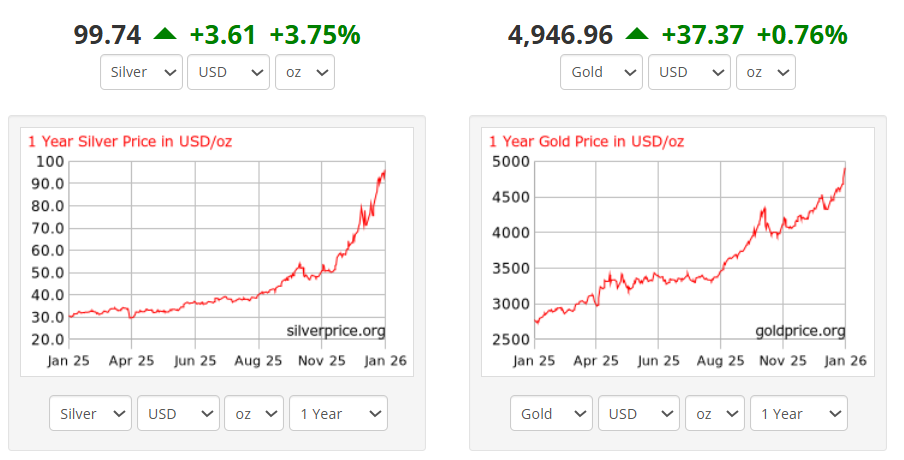
SILVER is about to BUST THROUGH 100 DOLLARS AN OUNCE.
That is not a price; it is a verdict. Years of gaslighting by Wall Street, years of paper games in London and New York, just collided with the physical reality of the most strategically necessary metal on Earth.
In the real world, silver is the wiring, skin, and nervous system of modern power.
Military and aerospace systems rely on silver in guidance electronics, satellite communications, heat sinks, night-vision optics, and laser platforms because nothing carries current or sheds heat as efficiently under extreme stress.
Solar panels consume a growing share of global silver, with photovoltaic cells using highly conductive silver pastes and coatings to move electrons with minimal loss, a role driven by silver’s top-ranked electrical conductivity and roughly 95% light reflectivity.
5G infrastructure and high-frequency electronics lean on silver in antennas, RF components, and dense circuit boards where low resistance and high thermal conductivity are non‑negotiable.
Robotics and advanced automation embed silver throughout sensors, actuators, and control boards because it keeps signals clean and components cool in compact, high‑power packages.
Even next‑generation energy systems—from EV and grid batteries to power distribution hardware—use silver to boost energy density, reliability, and thermal stability as loads rise and tolerances shrink.
China and India are now setting the tempo of this new silver age. China’s dominance in solar manufacturing and the manufacturing arm of our electrification economy have turned silver into a structural pillar of its energy strategy.
India — racing to expand its clean‑power capacity and support a rapidly growing middle class — is hoarding silver ahead of new RBI rules that will allow the metal to be used as collateral. With an estimated 250–400 million middle‑class citizens, many employed in U.S. corporate back offices and electronics manufacturing, India is joining China in driving industrial silver demand to record levels and anchoring long‑term consumption growth. – Jon Forrest Little
The center of gravity has shifted East; the West no longer dictates the physical market.
Against this backdrop, the COMEX and LBMA paper edifice looks fragile and absurd. Even mainstream analyses now concede hundreds of derivative claims for each ounce of eligible silver, with estimates north of 300 paper ounces per real ounce in recent years.
A record 65 million ounces of silver stood for delivery last month.
This month — typically a non‑delivery period on COMEX — silver is on pace to surpass that record total.
Coverage ratios on Western exchanges have worsened as inventories drained and open interest swelled, leaving hundreds of millions of ounces in short positions stacked atop a shrinking pool of deliverable metal. The result was inevitable: when industrial users and sovereign buyers finally insisted on bars, not promises, paper lies met physical truth—and silver exploded into three digits.
If you own silver, you already understand what just happened. Suppression failed. Shortage won. You now get to say, without apology: “I was there when silver hit three digits for the first time in human history.”
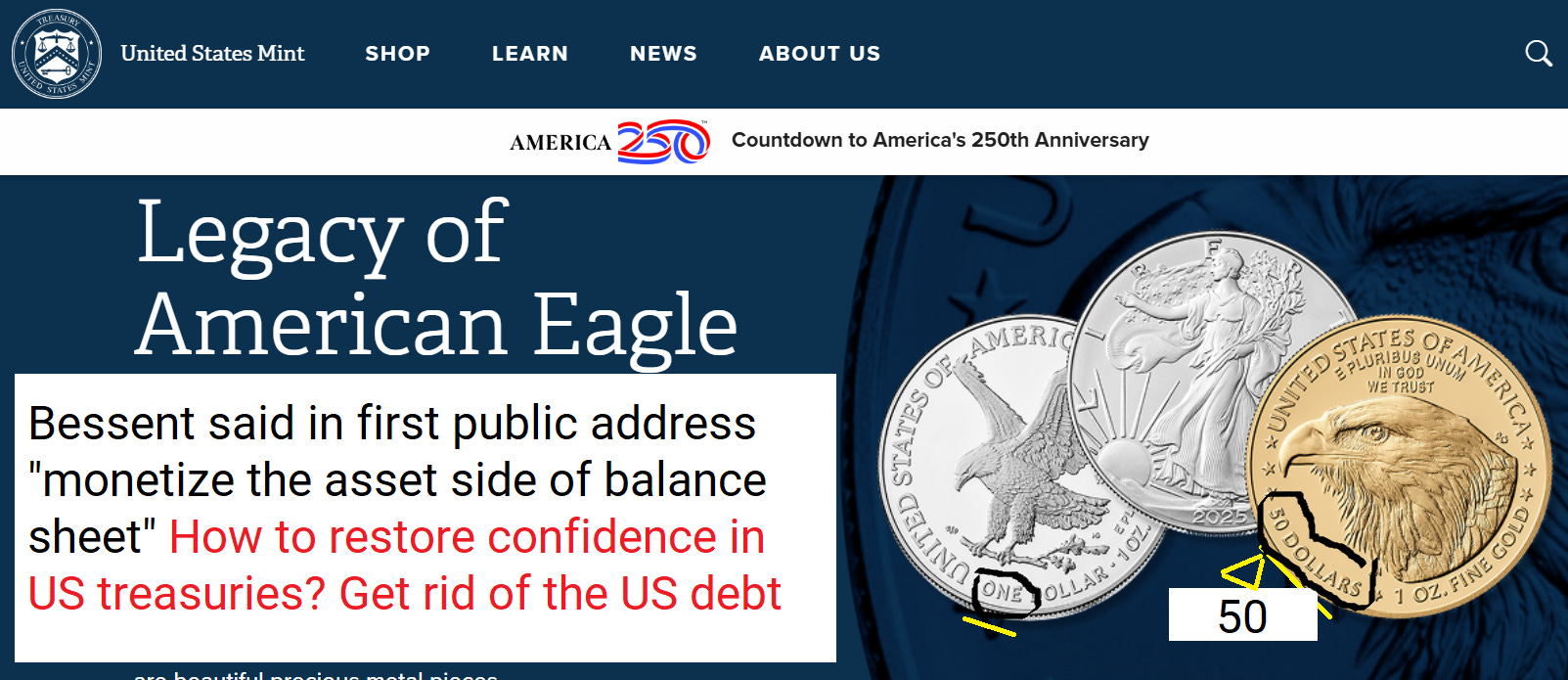
start your research here: https://www.usmint.gov/coins/coin-programs/american-eagle-coins/
-
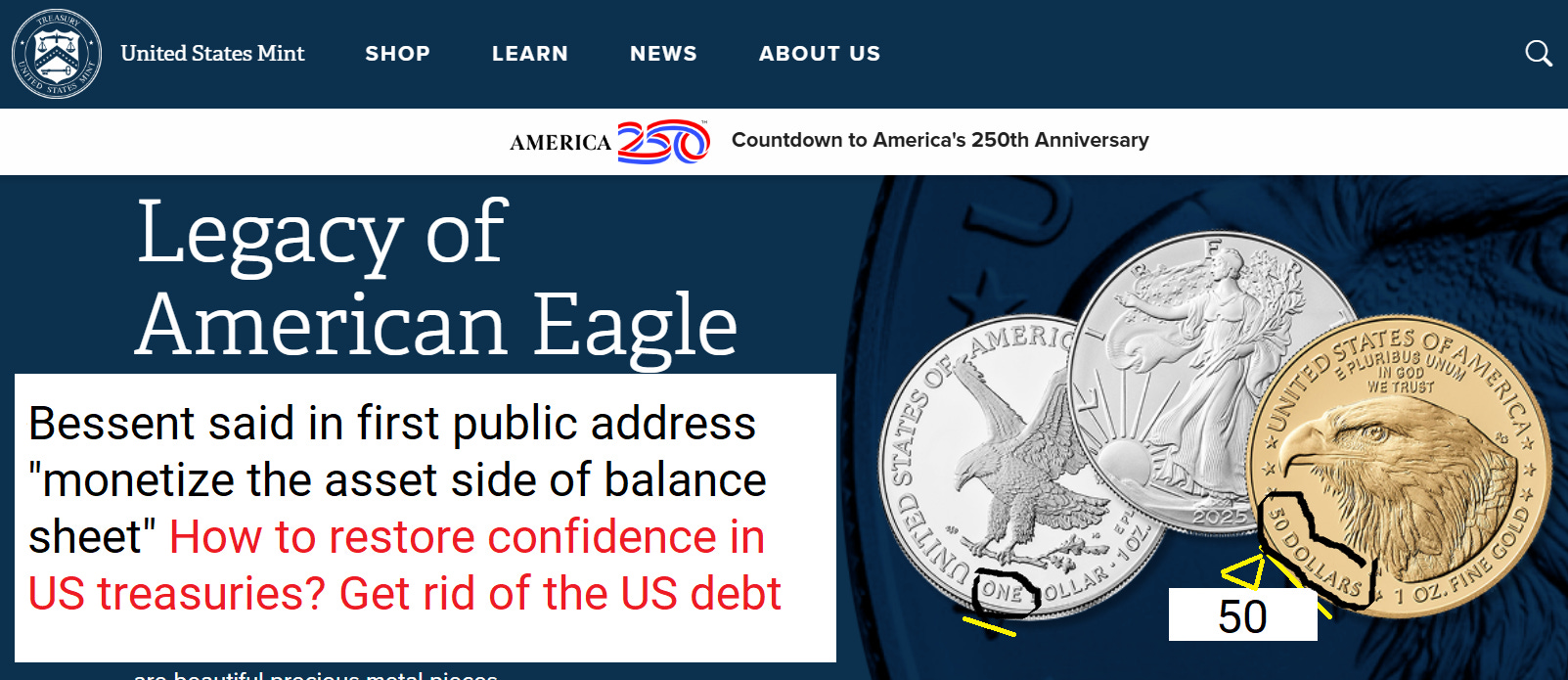
On the U.S. Mint’s “American Eagle Coins” page, two silver coins appear beside a gold coin — the silver marked $1, the gold $50. That 50:1 ratio may symbolize a deeper policy message about how Washington perceives relative value between its metals and its money.
-
Scott Bessent, now tasked with “monetizing the asset side of the balance sheet,” confronts a $39 trillion federal debt and waning global demand for Treasuries.
-
How do you increase demand for US treasuries? Make US balance sheet attractive, pretty basic logic right?
-
The U.S. holds 261.5 million troy ounces of gold (≈8,130 metric tons).
-
To extinguish national debt using only that gold implies a valuation near $147,000 per ounce — a figure that reframes what “sound money” could mean.
-
Eliminating half of 39 trillion dollars (19.5 trillion) with 261.5 million ounces implies a gold price near $73,500 per ounce, assuming all U.S. official gold is used for that purpose
-
China now owns more gold than U.S. Treasuries, a historic first signaling an accelerating pivot from dollar reserves.
-
Recently, major nations like Sweden and Denmark — along with their largest pension funds — have divested U.S. Treasuries, marking a once‑in‑a‑generation erosion of confidence in the dollar.
-
Against this backdrop, Trump’s renewed Western Hemisphere ambitions — stretching across Cuba, Colombia, Mexico, Venezuela, Greenland, and even Canada — expose the geopolitical dimension of financial control.
-
In this context, a U.S. gold revaluation could emerge as the strategic lever to erase debt, restore Treasury demand, and reinforce America’s dominance over the hemisphere’s economic architecture.
-
It is doubtful the fiat overlords would allow such a drastic refinancing of debt using precious metals but look at the year precious metals have had against fiat instruments, perhaps this kind of momentum turns into political capital
Life changing Wealth
Current valuations suggest that silver miners are still being priced as if the underlying metal were trading at roughly $40 per ounce. In contrast, our analysis indicates that silver is on track to reach a minimum of $200 per ounce within the year, implying significant undervaluation across the sector.
Three Silver Miners Approaching Inflection Point
Earlier this week, we recommended an opportunistic accumulation of Andean Precious Metals (OTC: ANPMF) following a sharp 11% dip triggered by a market misinterpretation of a corporate release.
We emphatically informed our readers the smart play was to buy that dip for immediate returns on investment, here was that post.
As we reported, their rebound has been remarkably swift — nearly the entire decline erased in less than two trading sessions, even as bullion banks launched one of their most coordinated assaults in recent memory to create additional headwinds.
Moreover, we are recommending a diversified $100,000 allocation across the three highlighted silver producers below (offering asymmetric upside potential.) Based on sector positioning and production leverage to rising silver prices, at least one of these equities has the potential to deliver a 10X, 20X or even 100X order-of-magnitude return, while the remaining positions still stand to benefit substantially from tightening supply dynamics that will persist for the next decade.
Aya Gold & Silver (OTC: AYASF) is the emerging flagship of this new silver regime. Its Zgounder mine in Morocco just posted record 2025 production of about 4.83 million ounces of silver, nearly triple 2024, capped by a monster Q4 with 1.37 million ounces and a record 545,491‑ounce December as the expanded plant ran above nameplate capacity. With Boumadine advancing behind it and a supportive mining jurisdiction, Aya is quietly transforming into a multi‑asset primary silver producer feeding a market where physical is already clearing at three‑digit prices in the East.
Andean Precious Metals (OTC: ANPMF) offers a very different but equally powerful angle: it operates the San Bartolomé plant in Bolivia, the country’s dominant silver oxide processing hub, sourcing ore from a vast network of artisanal and cooperative miners instead of relying on a single nationalization‑risk deposit. Its sliding‑scale payment model means feed costs flex with metal prices, crushing downside margin risk while preserving enormous upside torque when silver rips higher, and Bolivia’s prior nationalizations actually entrench Andean as the indispensable mid‑stream processor for the district’s remaining silver inventory.
Kuya Silver (OTC: KUYAF) is the high‑beta newcomer ramping into this squeeze. The company has brought the historic Bethania mine in Peru back into production, reporting record concentrate sales in 2025 as throughput, grades, and recoveries improved quarter after quarter. In Q3‑2025, Bethania generated roughly 16,983 ounces of silver (over 21,000 oz silver‑equivalent) with recoveries above 91% and about 79% of revenue coming from silver, and management is targeting higher tonnage and further optimization through 2026 as new infrastructure and drilling unlock more of the vein system.
The key takeaway in the Kuya Silver story is that the company is only just getting started. Kuya is advancing its deposit from a discovery phase into full production—and is on track to increase its quarterly silver output by 20x before the end of this year.
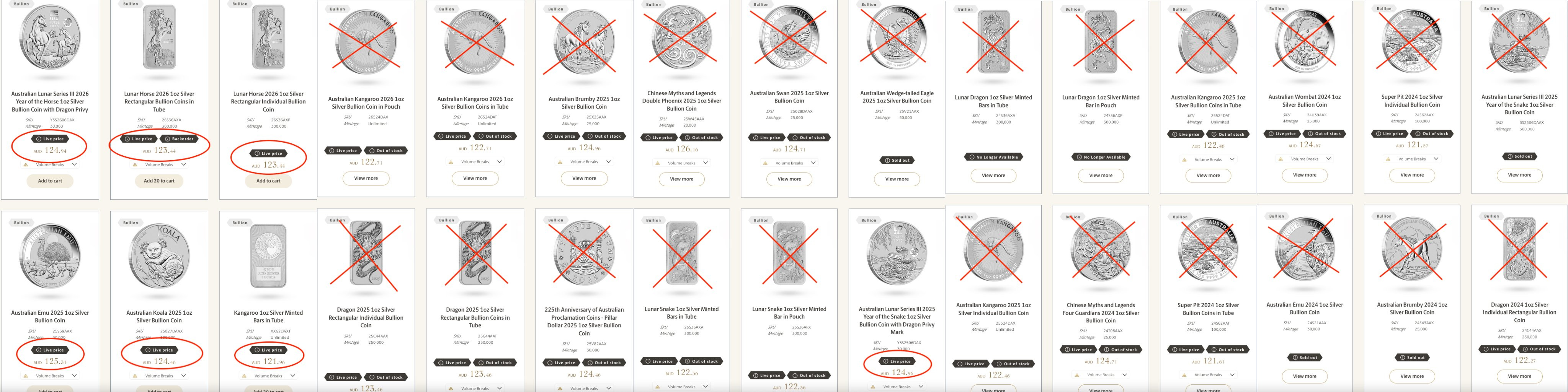
This is what a Silver shortage looks like
end of segment
-
our opinions are not our sponsors
-
the editorial department is separate from the promotions department
-
not financial advice