
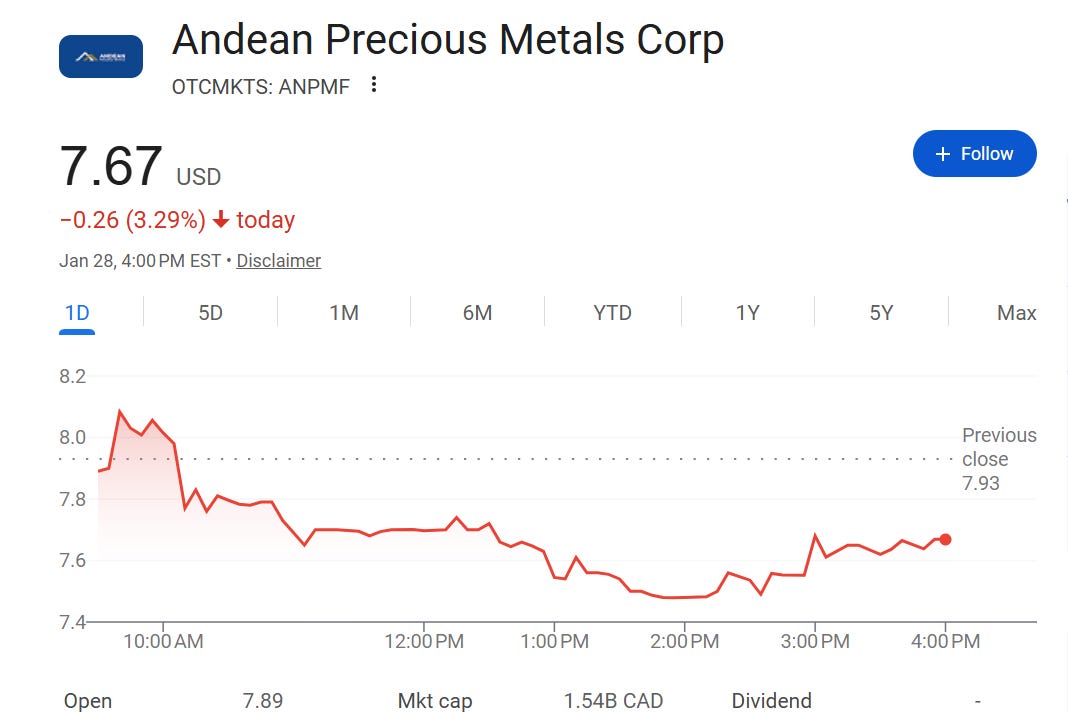
Wow. Rarely in my career have I seen such a wild distortion as this one, where the Market clearly has no clue and manages to confuse two of the most basic concepts in finance: a primary offering and a secondary offering.
Mr. Market has never been famous for nuance, but this time he can’t even clear the bar of basic vocabulary. The latest “dip” in Andean Precious Metals isn’t about fundamentals, jurisdictional risk, or balance‑sheet stress. It’s about investors and algos seeing the word “offering” and instantly assuming the worst: dilution, dilution, dilution.
Let’s be blunt: a secondary offering is not a primary offering.
In a primary, the company issues new shares, increases the share count, and dilutes every existing holder’s slice of the pie. In a secondary, existing shareholders sell stock to new buyers. No new shares are created, no extra claims are layered onto the business, and your percentage ownership of the company’s assets and cash flows is unchanged. The only thing that truly changes is who owns the stock and how much paper is available to trade on any given day.
In Andean’s case, a large insider selling stock at a set price is a textbook secondary transaction.
The company is not printing new paper, not stuffing the market with fresh supply, and not raising capital because it doesn’t need to. Float and liquidity improve, spreads should tighten over time, and the shareholder base becomes broader and more institutional. Yet the market, reflex‑driven and headline‑addicted, is trading this as if Andean just did a desperate, dilutive cash grab.
For investors who can distinguish between “more shares exist” and “different people own the same shares,” this is not a crisis; it is a gift. This dip will come roaring back just like the last time this happened.
Mechanical selling pressure and sloppy narrative are temporarily knocking down a business whose risk profile and upside potential remain intact. While the crowd flinches at a misunderstood filing, disciplined buyers have the chance to accumulate one of the most compelling silver vehicles on the board—at a discount handed to them by confusion, not by deteriorating reality.
BUY THIS DIP
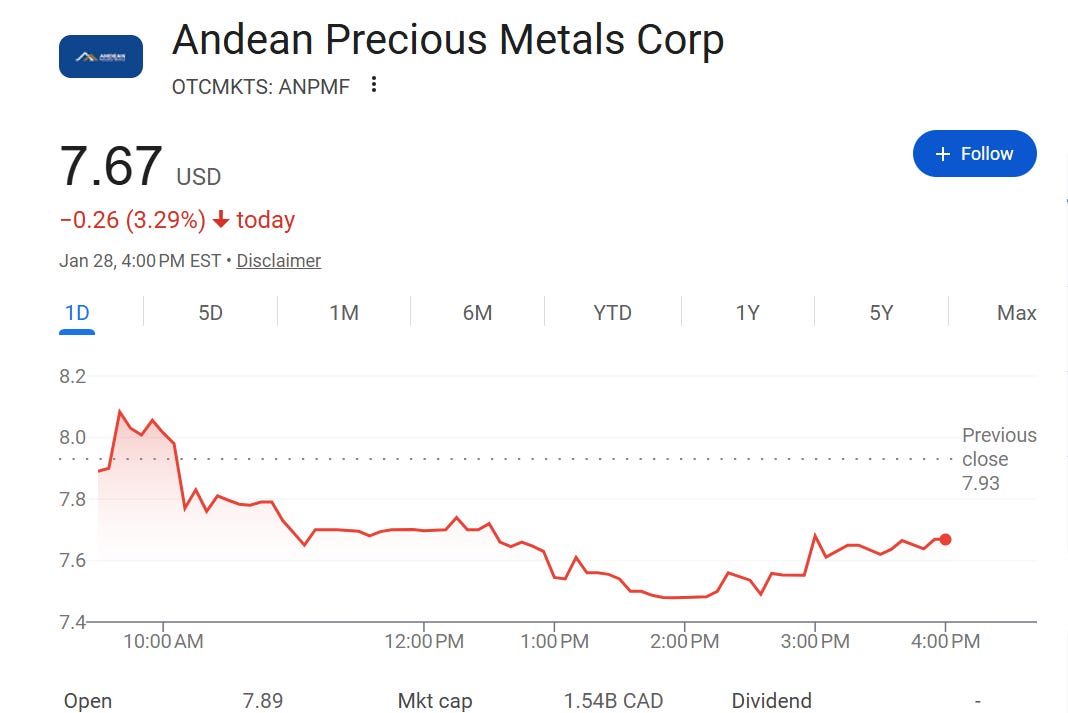
The market, as usual, can’t be bothered to read past the headline: it hears “secondary offering” and reflexively panics, confusing a simple shareholder liquidity event with a dilutive primary capital raise. This lack of attention to basic mechanics is frustrating—for the credentialed—but it creates a juicy opportunity to buy the dip.
You’re not chasing a fad; you’re buying into one of the most unique silver production stories on the planet, where Andean Precious Metals operates Bolivia’s largest oxide processing plant at San Bartolomé in Potosí, tolling ore from more than 20,000 artisanal and cooperative miners on a sliding‑scale basis. That setup keeps fixed labor costs light, aligns incentives with rising silver prices, and avoids the traditional volatility of salaried workforces, making the business arguably one of the least dilution‑prone, most risk‑adjusted exposures in the entire silver universe.
Since the market is having trouble sorting out basic terms, let me emphasize this again and again if necessary
A secondary offering simply transfers existing shares from one owner to another, so it does not create new shares and cannot dilute anyone’s percentage ownership; only a primary offering issues new stock and dilutes existing holders by increasing the total share count.
Why is this a misread? Because the market hears ‘offering,’ stops thinking, and never bothers to notice the crucial adjective that comes right before it.
When investors see the word “offering,” they often assume dilution, but in a secondary, the company’s share count, market cap mechanics, and per‑share claim on the assets are unchanged; what changes is float, liquidity, and who owns the stock, not how much of the business each share represents.
Andean Precious Metals offers an unusually low‑risk silver exposure because it operates more like a tolling business than a traditional high‑CAPEX miner, monetizing third‑party ore through its San Bartolomé plant in Potosí rather than taking large balance‑sheet bets on new mines.
Bolivia nationalized its major mines in 1952, making the state the custodian of the country’s mineral wealth and forcing modern operators to align closely with national interests instead of behaving like classic foreign concessionaires.
Within that framework, Andean sources feed from over 20,000 artisanal and cooperative miners on sliding‑scale terms, so miners effectively share price risk with the company by earning less when spot falls and more when spot rises, instead of Andean bearing fixed labor liabilities for a large in‑house workforce.
The company also controls Bolivia’s largest silver‑oxide processing facility at San Bartolomé, a 1.8‑million‑tonne‑per‑year plant that has produced roughly 5 million silver‑equivalent ounces annually since 2008, giving it unmatched processing scale in one of the world’s most prolific silver districts
below is the news release the market misread
https://www.newsfilecorp.com/release/281893/Andean-Precious-Metals-Announces-Closing-of-C95.6-Million-Bought-Public-Secondary-Offering-of-Common-Shares-by-PMB-Partners
end of segment
-
our opinions are not our sponsors opinions
-
the editorial department is separate from the promotions department
-
not financial advice