
In this video Mr. Clive Thompson does a superb job of explaining all the confusion revolving around CME / Comex
He also released a video today discussing how disruptive the situation is in Mexico currently. He validates many of our talking points surrounding Mexico’s Jurisdictional risk.
Silver’s surge to about $87 dollars an ounce has turned COMEX into the center of a high‑stakes showdown, especially for short sellers facing tight physical supply.
The basic COMEX silver contract
A standard COMEX silver futures contract is a promise to buy or sell 5,000 troy ounces of silver in a specific delivery month, such as March 2026. The silver must be at least 999 fine and from brands approved by the exchange, and the contract is quoted in U.S. dollars per troy ounce.
At a price near 87 dollars per ounce, one March contract represents about 435,000 dollars worth of silver (5,000 × 87). Most traders are not moving bars around; they are trading these standardized promises and usually close or roll their positions before delivery.
Longs and shorts: who’s who
Every futures trade has two sides:
-
Longs are the buyers. They profit if silver rises, because they locked in a lower price today. Longs include speculators betting on higher prices and industrial users (like refiners or manufacturers) that may want the metal delivered in March.
-
Shorts are the sellers. They profit if silver falls, because they sold at a higher price and can later buy back cheaper. Shorts often include bullion banks exploiting contango (selling higher‑priced future months and rolling), and miners or refiners hedging expected production.
If a long is still holding after the key cut‑off dates and gets assigned, they must pay for and accept 5,000 ounces per contract. The short on the other side must deliver approved silver, typically via a warehouse warrant from a CME‑approved depository.
How delivery and key dates work
The delivery calendar is what turns paper bets into real metal obligations:
-
Before first notice day, brokers force out most longs who do not intend to take delivery, either by closing or rolling their March positions forward.
-
On first notice day, shorts gain the right to file delivery notices. When a short files that notice, the clearinghouse assigns it to a remaining long, who then must be prepared to pay for and receive the metal.
-
From the first delivery day through the last business day of March, shorts can choose when to issue notices. Once a notice is issued, the warrant changes hands and payment is made, usually the next business day.
Crucially, the short chooses the timing of notice; the long does not get to say, “I want my silver next Tuesday.” That is why any long who doesn’t want truckloads of silver must be out before those dates, while any long still in is implicitly saying, “I’m ready to own metal.”
Margin: small deposit, big leverage
No one puts up the full 435,000 dollars per contract. Instead, both longs and shorts must deposit a margin, a fraction of the contract value held as a performance bond by the clearinghouse.
-
Initial margin is what you need to open a position.
-
Maintenance margin is the minimum to stay in the trade; if your account value drops below it, you face a margin call.
Since January 2026, CME has set precious‑metals margins as a percentage of contract value rather than fixed dollars. For COMEX 5,000‑ounce silver futures, CME has ratcheted those percentages higher as volatility exploded:
-
Mid‑January: percentage‑of‑value margin model introduced for gold, silver, platinum, and palladium.
-
Late January to early February: several hikes pushed silver margin from about 9–11 percent to 15 percent.
-
February 6: margin raised again from 15 percent to 18 percent for standard silver futures, effective after that day’s close.
At today’s 87‑dollar price, an 18 percent margin means around 78,000 dollars per contract must be posted — more than three times the roughly 22,000‑dollar ballpark from just a few months ago. As prices rise, a percentage‑based margin automatically demands more cash, making the squeeze tighter for leveraged traders.
Why the shorts are in a perilous trap
Margin pressure hits both sides, but the structure of this market makes the short side uniquely dangerous right now.
-
Inventory is historically tight.
COMEX registered silver — the category that is actually deliverable against futures — is about 88 million ounces, while total exchange inventory is a bit over 366 million ounces, with the rest in “eligible” but not formally pledged to delivery. Registered stocks have fallen sharply from higher levels seen just months ago, reflecting sustained drawdowns by buyers taking metal out. -
Open interest represents far more silver than is registered.
Recent data show open interest equivalent to roughly 240 million ounces, meaning there are paper claims for nearly three times the amount of registered, deliverable silver. Even if many contracts are closed or rolled before March, the coverage ratio (registered metal divided by open‑interest ounces) sits near 0.14 — historically lean. -
Margin hikes are forcing a game of musical chairs.
With an 18 percent margin on a rising price, shorts must devote increasing amounts of cash just to keep their positions open. Well‑capitalized bullion banks and producers that actually hold metal can manage this, but naked shorts — those who sold futures without owning silver — are trapped between two bad choices:-
Rush into the market to buy back contracts, driving the price even higher, or
-
Try to source physical metal in a market where registered supply is thin and being drawn down.
-
-
Price action signals short‑side stress.
After the February 6 margin hike and a violent correction from above 120 dollars down toward the 70s, silver has rebounded back toward the high‑80s. That kind of V‑shaped rebound, in the face of higher margin, is a classic sign that forced short covering, not carefree selling, is dominating the tape.
For a high‑school‑level picture, imagine 88 concert tickets locked in a safe, but 240 people hold contracts promising they can demand a ticket at a fixed price in March. As March approaches:
-
Anyone who doesn’t really want to go will sell their contract and step aside.
-
But if too many decide to attend, the people who promised tickets (the shorts) must either:
-
Find more tickets in the real world, or
-
Offer more and more money to convince holders to sell their claims.
-
That is the short squeeze scenario facing COMEX silver. The well‑hedged shorts who already own metal can deliver and walk away with cash. But naked shorts are staring at the possibility of having to buy back contracts or find physical silver in a market where registered stocks are thin, margins are rising, and the price is already climbing.
Put simply: every uptick in silver tightens the financial noose around short sellers, and the limited pool of registered ounces means there are fewer and fewer chairs left when the music stops.
Update
Mr. Clive Thompson delivers a stark warning about what he calls “a crisis in Mexico,” laying out a landscape of roadblocks, militarized security, protection rackets, protection payments—and, most devastating of all, a silver mining sector where it will now be next to impossible to recruit engineers, geologists, and other critical staff amidst constant disruption. In this video Mr. Thompson also recommends that investors do research on which silver mining companies have “exposure to Mexico”
Editors Note: There is all sorts of speculation going on
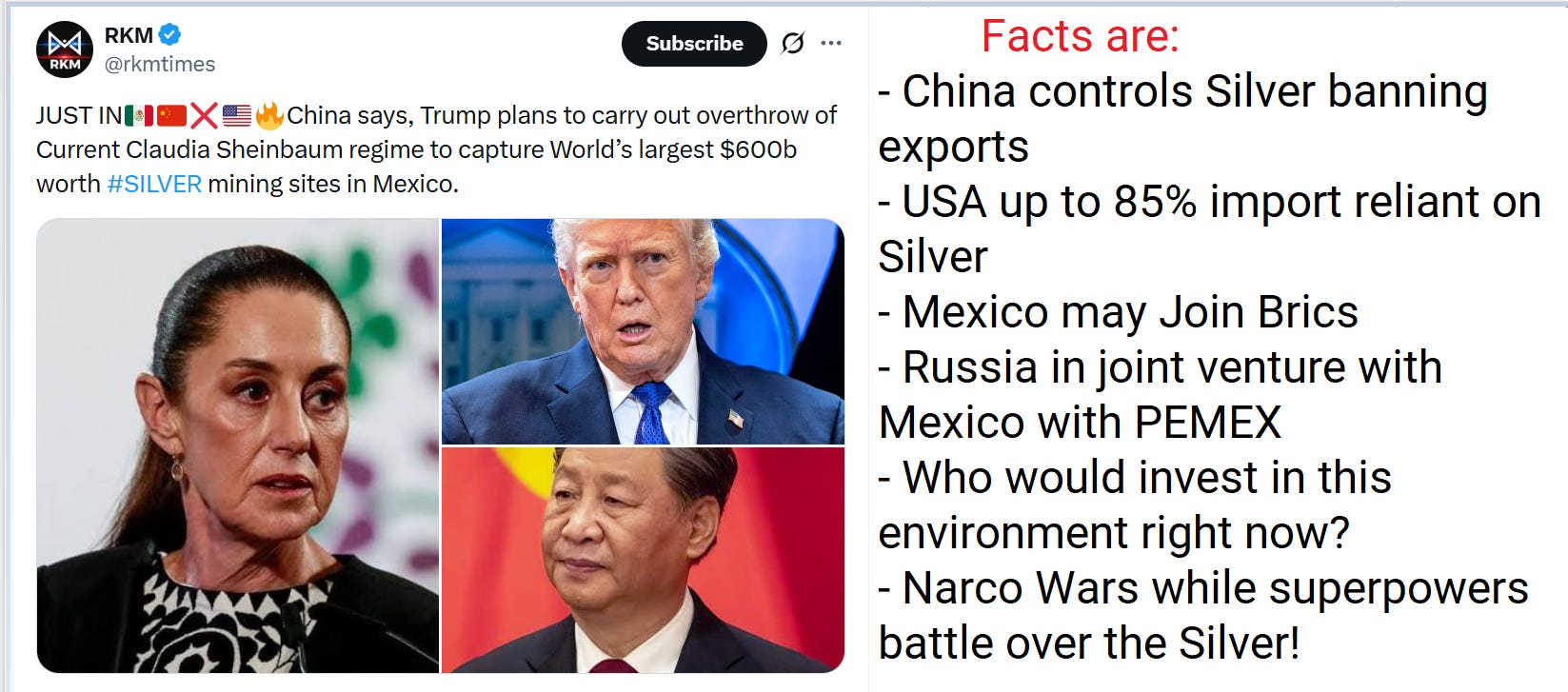
Speculation around Mexico’s narco wars is spiraling into a full‑blown geopolitical thriller. Reports and rumors claim cartel gunmen are rotating through Ukraine for drone‑warfare training, even as fact‑checkers find no hard proof that Western anti‑tank systems sent to Kyiv have been systematically diverted to cartels. Other investigations show Israeli‑origin firearms and a massive “iron river” of U.S. weapons feeding cartel arsenals, giving the conflict a proxy‑war flavor.
Layered on top is China’s accusation that Washington—and specifically Trump—wants regime change in Mexico to lock down what pundits frame as a multi‑hundred‑billion‑dollar silver endowment, alongside earlier regime‑change talk for Cuba, Venezuela, Iran, even Greenland. The same administration faces constant scandal noise, from Epstein files to NGO and “peace”‑industry grift narratives, which fuels online claims of a compromised cabinet chasing minerals. Mexico, fresh from attending the BRICS summit in Rio as an observer, is visibly hedging toward China, Russia, India and others—signal enough that its silver won’t be surrendered without a fight
Mexico has crossed the line from chronic instability into an outright security crisis that is now structurally constraining silver supply, exactly the scenario U.S. strategists feared when they elevated silver to “critical mineral” status last year. With the killing of cartel kingpin Nemesio “El Mencho” Oseguera Cervantes and the ensuing narco‑blockades across key western and northern states, Mexico’s civil war between cartels and the state is no longer a background risk for silver—it is the main event.
From US Critical Mineral To Live‑Fire Test
In 2025, U.S. authorities moved silver onto the draft critical minerals list for the first time, explicitly warning that a disruption of Mexican exports could cross the GDP loss threshold for national security. The logic was simple: the U.S. is roughly 70–80% import‑reliant for silver, and more than half of those imports come from Mexico, which dominates the U.S. inbound flow of unwrought and semi‑manufactured silver. Silver’s role in solar, electronics, semiconductors, autos, and defense systems turned it from a “nice‑to‑have hedge” into a strategic input, and Mexico was identified—on paper—as the single most important vulnerability.
That scenario has now stopped being theoretical.
Cartel Warfare Moves Directly Into The Silver Chain
The January 23 abduction of ten workers linked to Vizsla Silver’s operations near Concordia, Sinaloa—geologists, engineers, security, and admin staff pulled out of a gated compound—was the first clear signal that mine personnel had become high‑value leverage in the narco war. Five of those workers have since been found murdered; five remain missing, and the entire Mexican silver industry has moved onto a higher security footing. Companies have responded with:
-
Hardened sites and travel protocols, including escorts, safe‑house compounds, and staggered movements.
-
De facto protection payments to cartels and “community” groups disguised as social programs and benefit agreements.
-
A shift away from shipping refined doré or bars—prime targets for hijacking—toward moving bulk ore that looks like dirt in standard trucks.
Even before this week’s escalation, lawlessness was already driving up operating costs, hollowing out skilled labor in hot zones as families demanded engineers and geos come home, and choking insurance capacity for high‑value bullion transport. Cargo thefts of concentrates and attempted seizures of metal in transit had become common enough that some producers were quietly using armored convoys and rerouting flows, sacrificing margins to keep metal moving.
El Mencho’s Death Turns Crisis Acute
The killing of El Mencho in a major Mexican military operation has detonated a power vacuum and unleashed coordinated retaliation across at least a dozen states. Cartel gunmen have torched buses and trucks, erected burning roadblocks, and effectively shut key highways and urban arteries in Jalisco and beyond—the very corridors used to move silver ore and metal to smelters, ports, and the U.S. border. Hotels in tourist hubs like Puerto Vallarta locked down guests under shelter‑in‑place conditions, public transport was suspended, and airports saw chaos and cancellations as routes in and out of affected cities were threatened.
For silver, this is not just noise around the edges; it is a direct hit to logistics:
-
Roadblocks and convoy freezes have halted regular metal movements out of multiple producing regions.
-
Some categories of transport insurance, especially for high‑value bullion, have become either uneconomical or unavailable, rendering pure bars effectively unshippable from the worst‑hit zones.
-
U.S. tourists and mining expats have been ordered to shelter in place, with non‑essential travel suspended, further complicating site staffing and rotations.
This is precisely the kind of export disruption scenario the USGS modeled when it assessed silver as system‑critical to U.S. GDP.
Structural Squeeze: From CME Vaults To Mining Equities
On the market side, the combination of chronic jurisdiction risk and this acute security shock is starving the exchange system of Mexican metal. CME/COMEX registered stocks have been trending lower as users pull out physical, but fresh inflows from Mexico—historically a key replenishment source—have dwindled. With roadblocks up and normal freight frozen, the pipeline of deliverable silver into March and subsequent contracts looks increasingly fragile.
To keep metal flowing at all, some miners are:
-
Shipping unrefined ore instead of bars, accepting higher downstream costs to reduce hijack risk.
-
Cutting off standard commercial offtake and instead signing off‑market deals directly with industrial end‑users (e.g., electronics and tech firms) willing to pay for militarized or air transport.
Those private channels pull physical silver away from visible market pools and into captive bilateral flows, tightening the float available to satisfy futures delivery and wholesale demand.
Equity markets are already repricing this reality. Mexican‑exposed silver producers have seen sharp share price declines as investors digest not only higher operating and security costs, but also the possibility of prolonged export disruption and growing cartel and political interference. The question for capital is no longer whether Mexico carries a jurisdiction premium; it is whether parts of the Mexican silver complex are temporarily uninvestable.
Strategic Takeaways For Silver
Three hard conclusions emerge:
-
Mexico is now both a battlefield and a choke point for the world’s most strategically important silver supply chain.
-
The U.S. critical mineral designation for silver was not an academic exercise but an early admission that a Mexico shock could register at the level of national security and GDP.
-
For investors, this is not a buy‑the‑dip blip; it is the early phase of a structural jurisdictional reset in which roadblocks, kidnappings, and off‑market militarized shipments become defining features of Mexican silver, not outliers.
Against that backdrop, allocating fresh capital to Mexico‑centric silver miners is, at best, a high‑beta geopolitical trade rather than a straightforward play on the metal.
end of segment
-
our opinions are not our sponsors opinions
-
the editorial department is separate from the promotions department
-
not financial advice