
BLACKROCK JUST FROZE YOUR MONEY
In this article
-
Private Credit Gates Slam Shut
-
Iran Hits Microsoft’s DoD Cloud Backbone
-
Liquidity Dead, Digital War Ascends
BlackRock froze $1.2B in withdrawals.
THE FREEZE
“Half the claimants got nothing.”
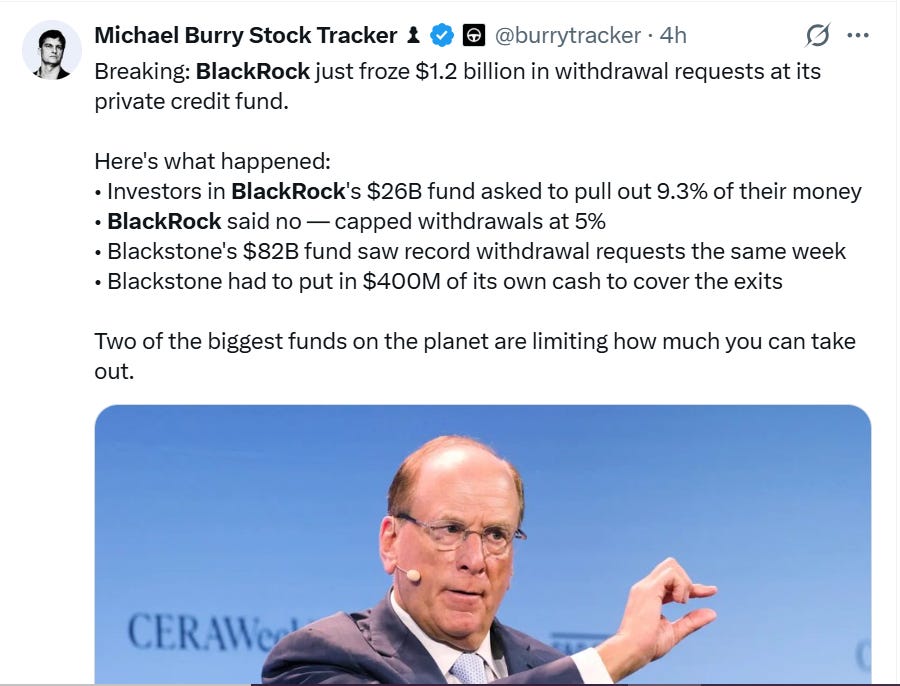
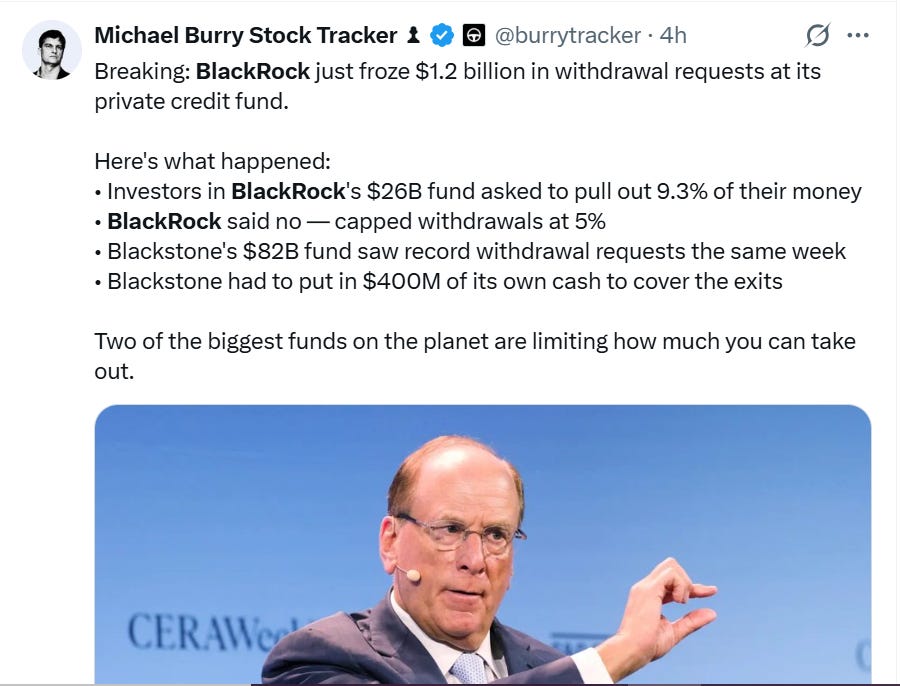
BlackRock just told investors they can’t have their money back. The world’s largest asset manager froze $1.2 billion in withdrawal requests from its $26 billion HPS Corporate Lending Fund after redemptions hit 9.3% of net asset value — capping payouts at 5%, or $620 million.
“Blackstone’s $82B fund faced record 7.9% redemption requests.”
Half the claimants got nothing. Blackstone’s $82 billion fund faced record 7.9% redemption requests the same week, forcing a $400 million cash injection from its own coffers to meet exits. Blue Owl issued IOUs. The sector cratered: BlackRock down 5%, peers like KKR and Apollo tumbling in sympathy.
This isn’t “liquidity management.” It’s triage in a $1.8 trillion shadow-banking empire built on illiquid loans to software firms and mid-market borrowers now choking on debt.
ILLIQUIDITY UNMASKED
“You don’t own cash. You own claims.”
Private credit sold the dream of yield without volatility — diversified loans, internal pricing, no daily marks. But those “assets” can’t be sold fast. When panic hits, funds gate the doors.
BlackRock even zeroed out a $25 million loan overnight — par value three months prior. JPMorgan’s Bill Eigen nailed it: “Bad news happens all at once. The opacity and leverage are concerning.”
The lie was always there: you don’t own cash. You own claims — and claims get subordinated when the house panics.
Two kill shots in 48 hours. Financial gates slam as missiles hit the pipes.
As if BlackRock’s velvet-rope blockade on ultra-wealthy withdrawals wasn’t signal enough, the same week delivers a precision strike on the digital plumbing Wall Street breathes through: Iran’s missiles just vaporized Microsoft Azure data centers in the Gulf — the classified nerve-center powering DoD Impact Level 6 ops, NATO logistics, and the settlement rails for every leveraged loan BlackRock’s frozen fund claims to own. These aren’t random server farms; they’re the custodial backbone where trillions in derivatives, repos, and private-credit exposures live — now uninsurable, offline, and repricing risk from Manhattan to Manama. When liquidity locks and the cloud custodians burn, no bailout prints fast enough. The house doesn’t just gate your cash — it torches the vault.
DIGITAL INFRASTRUCTURE GOES DARK
Iran’s not hitting servers. They’re severing arteries.
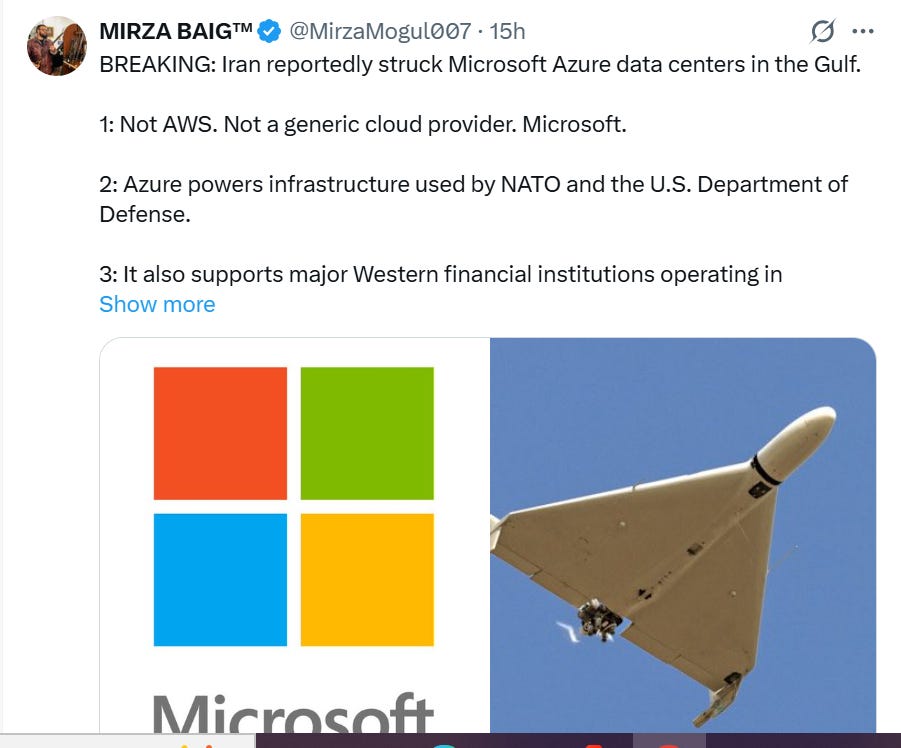
Meanwhile, Iran just struck Microsoft Azure data centers in the Gulf — not generic AWS facilities, but the defense-grade backbone running NATO operations, U.S. Department of Defense workloads, and Western financial systems expanded into UAE, Saudi Arabia, and Qatar over the past five years.
Azure isn’t commercial fluff. It’s FedRAMP High, DoD Impact Level 5/6 certified — hosting classified GovCloud ops and 5G military comms via Azure for Operators. Gulf zones were built on billions in sovereign commitments, blending enterprise AI with military adjacency. Missiles there aren’t hitting servers; they’re severing the digital artery linking U.S. defense to Gulf sovereign AI ambitions.
“Microsoft’s silence screams classification.”
Unlike AWS strikes earlier — which got quick status updates — Microsoft’s silence screams classification. Sovereign and DoD contracts muzzle disclosures. Iran’s playbook is surgical: Hormuz for shipping insurance, oil rigs for energy, now Microsoft for high-tier cloud carrying government payloads. Each hit reprices infrastructure risk deeper into the stack.
The Gulf was AI’s “safe” proving ground — hyperscalers like Microsoft, Google, AWS poured billions assuming ballistic immunity. That bet’s falsified. Every CTO worldwide is recalculating: if missile ranges make data centers uninsurable, sovereign cloud migrations halt.
Financial markets feel it instantly: cloud downtime cascades to trading platforms, settlement systems, derivatives clearing — the invisible pipes BlackRock’s frozen funds rely on.
THE CONSOLIDATION ARCHITECTURE
“Empire’s wars justify the controls they enable.”
These aren’t coincidences. Private credit gates + infrastructure strikes = systemic repricing. Liquidity freezes while digital plumbing fractures. Wall Street’s “diversified” portfolios? They’re exposed to the same chokepoints: leveraged loans backed by AI-disrupted borrowers, custodied in missile-vulnerable clouds.
The Fed can’t print server farms or insurance. Sanctions can’t deter hypersonic warheads. Empire’s endless wars — undeclared, illegal — now boomerang as market-killers, justifying the very controls they enable.
Ownership morphs to access. ETFs become gated. Brokerage claims get haircutted. Custodians above law decide who eats the loss.
“When BlackRock says ‘no’ to ultra-wealthy clients, it’s not a glitch. It IS the system.”
Shanaka Anslem Perera writes,
”Iran just struck Microsoft data centers in the Gulf. Not Amazon. Not a generic cloud provider. Microsoft — whose Azure platform runs the operational backbone of NATO, the US Department of Defense, and every major Western financial institution that has expanded into the Gulf over the last five years.
This is categorically different from the AWS strikes earlier in the war.
Microsoft Azure is not simply a commercial cloud product. It is a defense-grade infrastructure platform operating under FedRAMP High and DoD Impact Level 5 and 6 authorizations, the highest security classifications available to a commercial provider. Azure GovCloud runs classified US government workloads. Azure for Operators runs 5G military communications infrastructure. The Gulf Azure availability zones, built under billions of dollars of sovereign cloud commitments to UAE, Saudi Arabia, and Qatar, sit at the intersection of commercial enterprise and military-adjacent operations in a way no other cloud platform does. When Iran fires missiles at Microsoft data centers in the Gulf, it is not attacking a commercial storage facility. It is attacking the digital connective tissue between American defense architecture and Gulf sovereign AI ambitions.
The mechanism Iran is applying across every domain of this war is now operating at the infrastructure layer of the global digital economy. Hormuz for maritime insurance. BAPCO and Ras Tanura for oil infrastructure insurance. Manama hotels for corporate presence insurance. AWS for basic cloud insurability. Microsoft for the tier of cloud infrastructure that carries defense-adjacent and government workloads. Each successive target has moved one layer deeper into the critical infrastructure stack.
Microsoft has not yet confirmed the extent of damage or the impact on service continuity. That silence is itself data. When AWS facilities were struck earlier in the war, the company posted status updates within hours. The Microsoft situation is being handled with a different communication posture, which is consistent with facilities that carry sovereign and defense-adjacent contractual obligations that restrict what can be publicly disclosed about operational status.
The Gulf was supposed to be the proving ground for the sovereign AI thesis. Every major hyperscaler made the bet simultaneously: Gulf governments want their data onshore, under their own regulatory frameworks, close to their own populations, contributing to their own AI capability development. Microsoft, Google, AWS, Oracle, all committed multi-billion dollar buildouts to that thesis in the last three years. The thesis assumed physical security. The thesis assumed the Gulf was a stable operating environment for long-term digital infrastructure. That assumption was always geopolitically contingent. It is now empirically falsified.
Every CTO and every procurement officer running a sovereign cloud negotiation anywhere in the world is looking at the Microsoft strike footage right now and running the same calculation: if the Gulf is a ballistic missile target range, where does the sovereign AI buildout go instead?
Iran cannot win this war militarily. But it is methodically repricing every assumption the American-aligned economic order made about the Gulf as a safe jurisdiction for permanent infrastructure.
The missiles hitting Microsoft data centers today are not attacking cloud storage. They are attacking the confidence interval on a decade of digital infrastructure investment.”
When the Oil Weapon Ends an Empire
Iran has quietly executed the most devastating move you can make against a late-stage empire: it turned the Strait of Hormuz into a financial kill switch rather than a military battleground. With 20–30 percent of global oil flows and a massive chunk of LNG squeezed through that narrow channel, every drone, missile, or naval threat instantly reprices the entire energy stack and shoves crude toward and through 90 dollars a barrel—not as a spike, but as a new floor.
By letting the war “accidentally” blow up Saudi capacity and GCC logistical confidence, Tehran isn’t just hitting facilities; it’s sabotaging the petrodollar conveyor belt that took Gulf oil revenue and recycled it into U.S. Treasuries, megacap stocks, private credit, and the everything-bubble on Wall Street. Once that recycling breaks—once Riyadh, Abu Dhabi, and Doha can no longer count on safe exports or see strategic sense in stacking dollar assets—the system flips: the same oil that once underwrote American deficit spending now starves it of liquidity, drives funding costs higher, and detonates the illusion that the U.S. can run infinite wars and infinite debt on the back of someone else’s cheap energy. That is the real end-of-empire warning shot: not a dramatic battlefield defeat, but the slow, relentless realization that the petrodollar was the life support machine for the U.S. economy and stock market—and that the plug is now being yanked out in the Persian Gulf.
AMERICAN EMPIRE’S SUICIDE PACT
This isn’t chaos — it’s blowback by design from a rotting foreign policy addicted to the military-industrial complex’s endless grift. Washington’s undeclared war on Iran — the latest tired regime-change farce, just like Iraq, Libya, Syria — chases the same Rothschild-bank mirage that’s bankrupted empires for centuries, all while the Epstein files gather dust as the perfect distraction from elite pedophile networks running the show. BlackRock’s gates slam shut and Microsoft’s servers burn because the Pentagon’s forever-war lobby demanded another Middle East sandbox to launder trillions through bombs and carriers, sacrificing global liquidity and digital infrastructure on the altar of Halliburton profits and neocon wet dreams. The U.S. economy doesn’t crash by accident; it’s engineered to funnel your frozen accounts and vaporized cloud custody upward to the same creditors who scripted the chaos — a scathing final act where illegal wars justify domestic confiscation, and the public chokes on the debt of wars fought to hide the Epstein class’s crimes. This is the beginning of “The Great Taking” — David Rogers Webb called it — and America’s imperial arrogance just lit the fuse.
end of segment
-
our opinions are not our sponsors opinions
-
the editorial department is separate from promotions department
-
not financial advice