
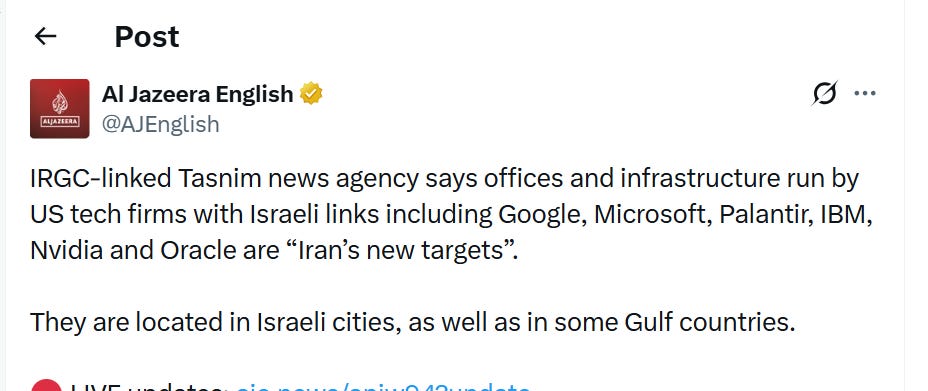
Tech is no longer a neutral bystander in this crisis; it is now on the target list alongside banks, and that radically changes where rational capital hides. The IRGC‑affiliated Tasnim news agency has published a list of offices and infrastructure run by major US firms with Israeli links whose technology has been used for military applications, explicitly branding them “Iran’s new targets.”
The companies include Google, Microsoft, Palantir, IBM, Nvidia and Oracle, with cloud and data infrastructure identified not only in multiple Israeli cities but also in key Gulf jurisdictions that underpin regional banking, logistics and payments. In Tehran’s own words, “as the scope of the regional war expands to infrastructure war, the scope of Iran’s legitimate targets expands” – a doctrine that merges kinetic conflict with attacks on the digital and financial plumbing that keeps global markets functioning.
The Day Silicon Valley Became a War Zone
The global financial system is moving from fragile to targeted, and the last 72 hours have turned simmering stress into open financial warfare. The US and Israel have already taken the unprecedented step of striking Iranian banking infrastructure, dragging nominally civilian financial institutions into the line of fire. Iran’s military command has responded by declaring US and Israeli economic and banking interests across the region as legitimate military targets, warning civilians to keep their distance. Overnight, every Western bank branch in hubs like Dubai, Bahrain and Doha has been reclassified from “financial center” to “potential strike zone” – and now, the same is true for key nodes of Big Tech’s cloud and AI infrastructure.
When the Scoreboard Is Rigged, You Default to Gold and Silver
This escalation lands on top of a crisis of confidence in the very data and debt that anchor global markets. US payroll numbers have been subject to repeated, outsized downward revisions, turning headline job gains into moving targets and eroding trust in the narrative of a robust labor market. At the same time, the US Treasury has executed record buybacks of its own bonds under the banner of “market functioning.” When the issuer of the world’s reserve asset must become the largest buyer of its own debt in the middle of a geopolitical shock, the signal is clear: paper promises are becoming political instruments, not neutral stores of value. Historically, that is precisely the environment in which gold and silver reassert their role as monetary anchors, because they do not depend on any government statistic or debt‑management operation to preserve purchasing power.
Oil, Drones and the Case for Hard Money
Energy markets now mirror the financial system’s stress. Drone activity and insurance withdrawals around the Strait of Hormuz have choked a critical artery of global oil trade, with underwriters refusing coverage and carriers suspending routes even as officials insist supplies are secure. Whipsaw price action looks less like free‑market discovery and more like controlled detonation in a market where key participants suddenly cannot hedge or insure normally. In that environment, precious metals – and especially silver, with its dual role as monetary metal and critical input for energy, defense and high‑end electronics – are not a speculative trade. Alongside gold, they function as hard‑money lifeboats outside the blast radius of banks, clouds, data centers and shipping lanes that have now been explicitly named as legitimate targets. When infrastructure, tech and sovereign paper are in the crosshairs, disciplined allocations to physical gold and silver are no longer optional; they are the default safety mechanism of a system that remembers what real collateral looks like.
end of segment
SungHong Lee writes,
”Nobody is telling you how DOOMED the financial system actually is right now.
The war just crossed a line that changes everything.
The US and Israel struck Iranian BANKS overnight. Not military bases. Not missile sites. Banks.
Iran’s response: told everyone in the region to stay 1 kilometer away from US and Israeli banks and financial centers. Then said those banks “should wait for our answer.”
Think about what that means.
Every HSBC branch in the Gulf. Every Citibank office in Dubai. Every JP Morgan desk in Bahrain. All of them just became military targets.
And it gets worse.
The same US that just bombed Iranian banks has been faking its own job numbers for 13 straight months. 710,000 jobs that never existed. Quietly revised down after the headlines moved on. Nobody noticed.
The Treasury just did the largest debt buyback in history. $14.7 billion. You don’t buy back your own debt during a war unless you’re preparing for something the public hasn’t been told yet.
The institutions are building exits in gold/silver/crypto while telling retail to stay calm.
Oil crashed 36% in 36 hours. Then 2 vessels got hit in Hormuz this morning. Dubai International Airport got struck by drones. Insurance companies are refusing to cover Gulf shipments.
The crash wasn’t real. It was manufactured. And the people who manufactured it are the same ones quietly moving billions into digital assets before the next leg down.
When a government starts bombing banks, the war is no longer about land or nukes.
It’s about who controls the financial system when the dust settles.
And right now, the people with the answers are moving money while the people without them are watching the news.”
-
our opinions are not our sponsors opinions
-
the editorial department is separate from the promotions department
-
not financial advice