
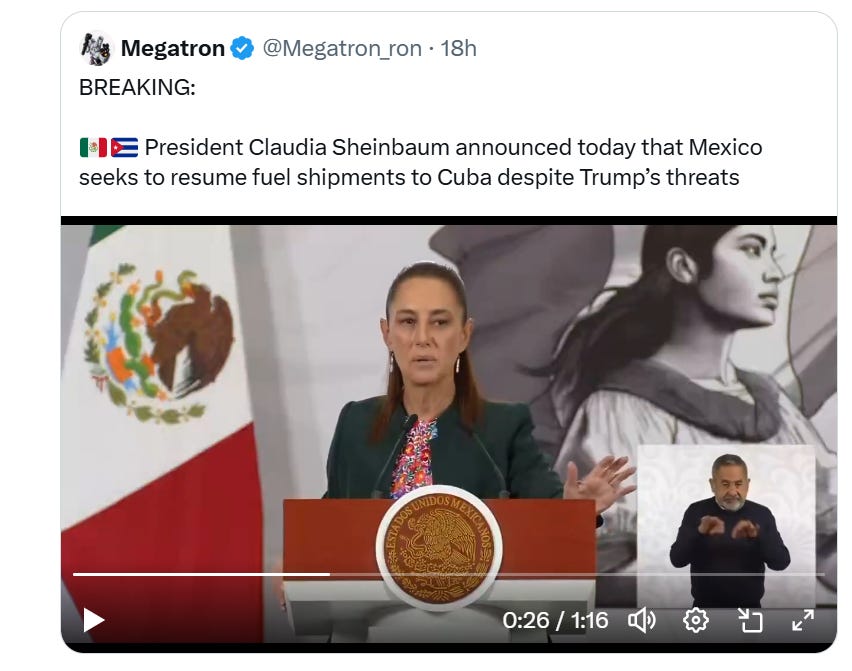
In this video above (yesterday) , President Claudia Sheinbaum announced that Mexico seeks to resume fuel shipments to Cuba despite Trump’s threats
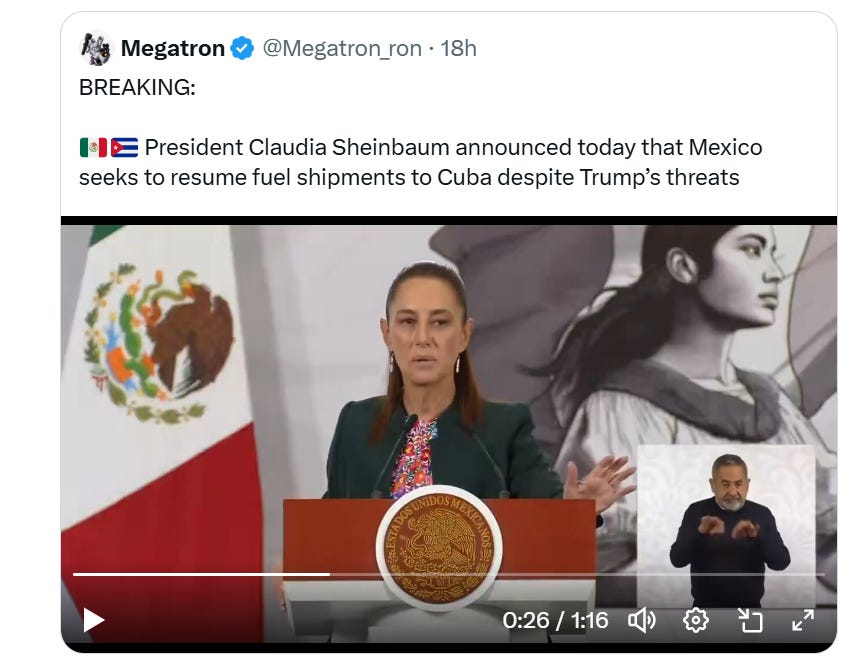
Then, the following day, President Claudia Sheinbaum—after being threatened by Trump with new tariffs—announced there would be a pause
Cuba, just 90 miles off Florida, has become a Cuban Missile Crisis 2.0—only this time the weapons are oil tankers, solar farms, and sanctions, hopefully not warheads.
Trump, egged on by Rubio and Cruz, openly talks of taking Cuba, turning the island into a live regime‑change target.
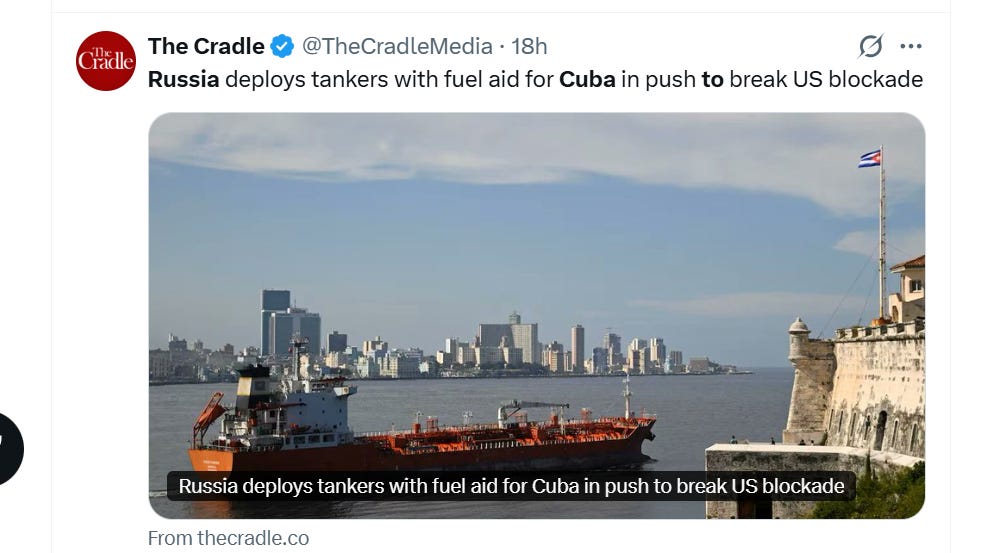
China is rushing in thousands of solar panels while Russian crude steams toward Cuban ports in open defiance. In this standoff, Mexico stands defiant, insisting that nobody tells it who it can sell its oil to.
For three decades, U.S. foreign policy has followed the same script: Democrat or Republican, Washington wraps “security” rhetoric around strategies to open, discipline, or seize other nations’ strategic resources—especially oil, gold, and silver. Sanctions and “democracy promotion” come first, regime‑change and hard power wait in reserve, with corporate and financial interests standing by.
Blueprints like “Which Path to Persia?” treat entire countries as problems to be “managed,” not sovereign equals. Engagement is just a staging round: if Tehran, Caracas, or any other capital refuses to submit, the menu escalates to economic warfare, covert action, coups, insurgencies, and direct strikes.
The goal isn’t only nuclear files or human rights—it is control over energy and mineral flows that underpin the dollar system and Western balance sheets, as seen in the sanctions “pressure” on Venezuela’s massive oil reserves.
Companion texts like “A Clean Break” show how allies are wired into this architecture. Israel is urged to reshape its neighborhood through preemption, destabilization, and regime change, while regional partners serve as staging grounds and cut‑outs. The map is to be redrawn, not negotiated, and every destabilized state becomes easier terrain for Western capital once the dust settles.
In this context, Mexico is clearly in the crosshairs. It holds major oil, gas, and mineral wealth, has dared to supply sanctioned Cuba, and maintains significant private and foreign stakes that can be squeezed via sanctions, markets, and lawfare. Its partial liberalization makes it vulnerable; leverage points abound.
Bolivia, by contrast, is more insulated. Since the 1952 revolution, COMIBOL and state control over the mining backbone have put silver and other minerals under public ownership. Bolivia has been a tier 1 jurisdiction since 1952. whereas Mexico’s semi‑privatized model is a target; Bolivia’s entrenched state ownership is a shield.
Silver is entering its sixth straight year of structural deficit just as the world’s biggest demand engines are switching on: AI data centers, solar, defense systems, EV batteries, and high‑end electronics all need more silver, the best electrical conductor on the periodic table.
In that tightening backdrop, Andean Precious Metals (ANPMF) stands out. The company owns and operates Bolivia’s San Bartolomé plant, the country’s largest commercial silver‑oxide processing facility, under long‑term supply arrangements with COMIBOL and other partners.
That plant is fed by extensive Bolivian silver ore, including material purchased from local and artisanal operators, giving Andean leverage to rising prices and community‑based supply. Their Golden Queen mine in Kern County, California adds a producing gold asset with silver by‑product, giving investors combined exposure to two tier‑one jurisdictions and a diversified, growing precious‑metals platform.
-
In case you missed it, we covered China’s emergency power assistance to Cuba two days ago.
-
The aid is being delivered via silver‑powered solar energy systems.
end of segment
our opinions are not our sponsors opinions, the editorial department is separate from the promotions department, not financial advice