
Imagine if a new amusement park opened and printed its own “FunBucks” tickets. The park owners keep most of these FunBucks for themselves, then walk over to the park’s own bank and say, “Look, we’re putting a giant pile of our own FunBucks in your vault, so let us borrow real money that people actually use in the outside world.”
The bank, which is also run by someone from the same friend group, agrees and hands them a huge amount of real cash, while the vault is now mostly stuffed with the park’s self‑made FunBucks instead of real money people need to cash out.
Kids and families who left their money in that bank thinking they could get it back anytime suddenly find that almost all the real cash has already been lent to the park owners, so when they try to withdraw, the bank says, “Sorry, most of the money is out on loan right now.” Meanwhile, the park owners quietly take a big chunk of that borrowed real money to a regular city bank and move it out of the park system altogether.
In the end, the same small group created the tickets, decided they were worth a lot, used them to grab real money from their own bank, and walked away with cash while everyone else is stuck holding FunBucks that may not be worth what they were told.
here is what we know happened — in plain, undisputed steps:
-
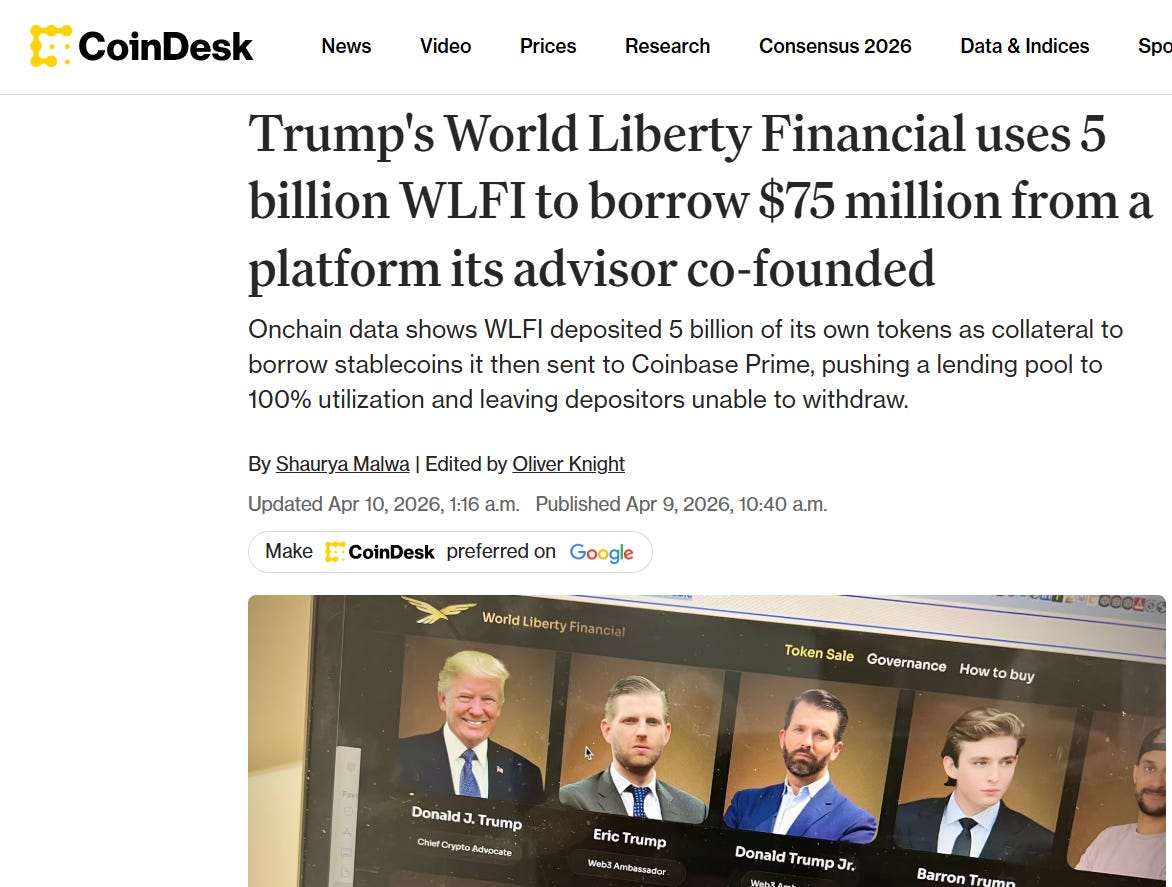
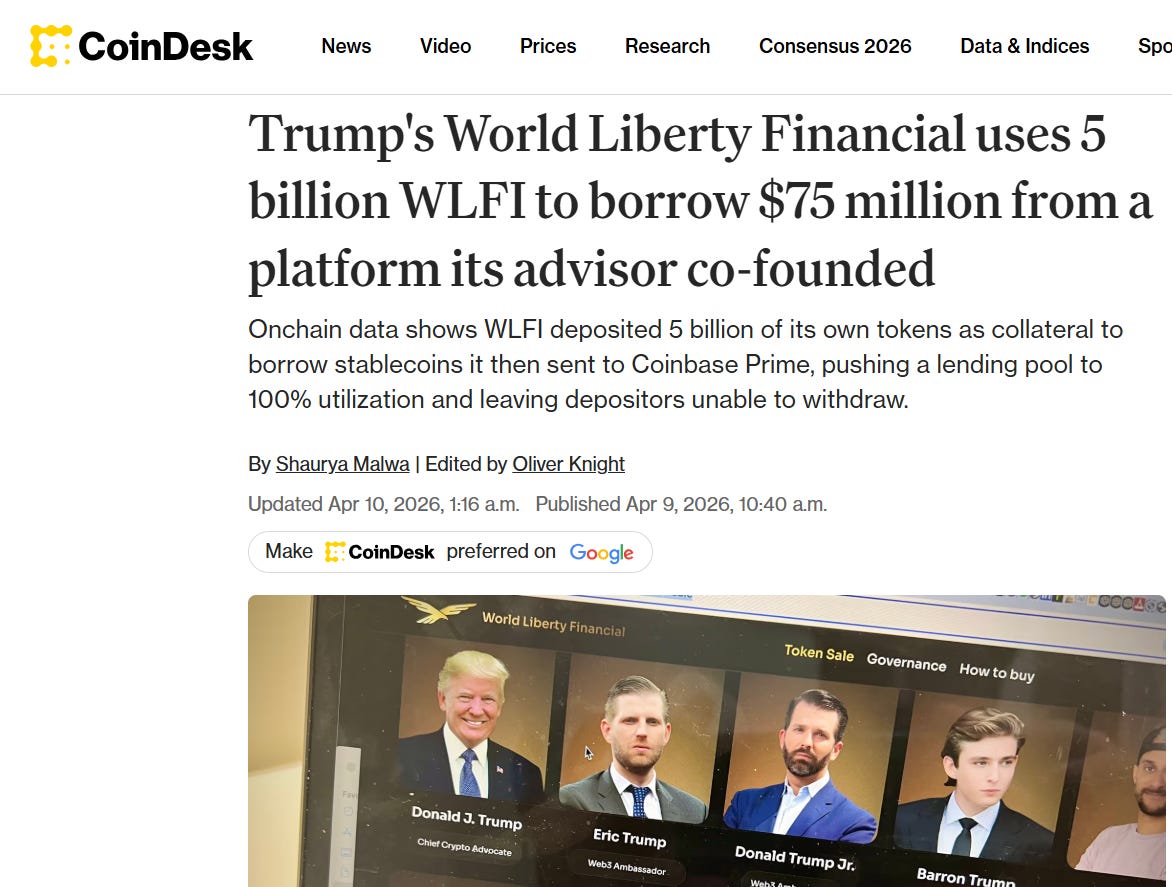
World Liberty Financial, a crypto project publicly linked to the Trump family, operated inside the Dolomite lending protocol.
-
On April 9, 2026, that project deposited roughly 5 billion WLFI tokens into Dolomite.
-
Those WLFI tokens were then used as collateral to borrow approximately 75 million dollars’ worth of stablecoins from the protocol.
-
WLFI’s token and positions accounted for around 55% of all the liquidity in the entire Dolomite system on that date.
-
In simple terms: they deposited their own token, used it as collateral, and borrowed massive amounts of stablecoins against it — and kept the loan open so long as the WLFI price stayed high enough.
-
This all occurred inside a protocol where WLFI‑linked positions dominated the liquidity, meaning they were not just another user; they were the largest, central player in the pool.
-
At the same time, the main stablecoin pool in Dolomite was reported to be around 93% utilized.
-
When a pool is that heavily used, most of the stablecoins are already borrowed out.
-
That means ordinary retail users who thought they could withdraw on demand would find that very difficult, because there simply was not enough unborrowed liquidity left in the pool.
-
In practice, funds inside that system began to feel “locked,” not by a bug, but by the sheer scale of one dominant borrower.
-
It does not stop there: Dolomite, the lending protocol being used, was co‑founded by an individual connected to WLFI.
-
So the entity providing the collateral and taking out the huge loan, and the entity running the infrastructure that enabled and sized that loan, are from the same small circle.
-
The borrower and the platform are not strangers at arm’s length; they are linked.
-
We also know that more than 40 million dollars’ worth of those borrowed funds were moved to Coinbase Prime.
-
That transfer occurred within hours of a major Trump‑related geopolitical announcement, meaning a large chunk of the borrowed, liquid stablecoins was sent to a venue that is commonly used as a fiat and institutional off‑ramp.
-
When you put that together, you do not have an open, neutral marketplace of independent actors.
-
You have a closed loop: the same tight circle is seeding liquidity with its own token, borrowing heavily against that token, dominating the protocol’s risk, and then moving tens of millions of borrowed dollars out to an external venue.
-
While they do that, retail depositors are left in a system where more than 90% of the stablecoin liquidity is already spoken for, and their ability to withdraw becomes uncertain.
That is not rumor. That is the structure, the timing, and the flow of funds. It is a self‑referential loop where insiders sit on both sides of the trade, pull out real stablecoins, and leave everyone else in a system that suddenly feels like a trap.

The Federal Reserve works similarly: it creates its own “tickets” (bank reserves and dollars) and uses them as backing to lend real purchasing power into the system. Commercial banks then multiply this by creating deposits on top of those reserves, lending out most of the money while keeping only a fraction on hand. As long as people trust the system and do not all withdraw at once, the loop keeps operating.
Why Physical Silver Can’t Be Rug-Pulled Like Crypto or Paper IOUs
With physical silver, this kind of scheme is impossible because there is no balance sheet to game and no protocol to rehypothecate your asset. You either hold the metal in your hand or you do not. There is no “printing” more claims on the same bar without turning it into paper silver: unallocated accounts, ETFs, and derivatives that are just promises and IOUs. That’s why physical silver, in your possession, is inherently safer than any paper substitute.
-
our opinions are not our sponsors opinions
-
the editorial department is separate from the promotions department
-
not financial advice