
In the late 1930s, Adolf Hitler’s Germany perfected the fusion of corporate and state power — a model of industrial militarization disguised as economic progress. Volkswagen, conceived as the “people’s car,” was soon repurposed to serve the war machine. Assembly lines built for civilian mobility were commandeered for tanks, troop carriers, and engines of destruction. This was not simply industrial redirection; it was ideological consolidation — corporations subordinated to state ambition, their production wedded to conquest.
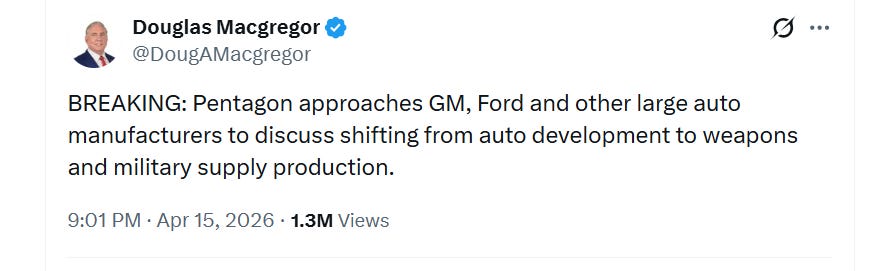
Today, echoes of that transformation resound uncomfortably within the American military-industrial complex. The Pentagon courting General Motors, Ford, and other automotive giants to shift from car development to weapons and military supply production signals a creeping metamorphosis. The rationale — “national security” and “strategic readiness” — mirrors the justification of every wartime conversion in history. The danger lies not in temporary cooperation, but in permanence: once corporate infrastructure adapts to military profit streams, reconversion becomes unlikely. Factories, workers, and balance sheets are reoriented toward conflict, not mobility.
In this arrangement, capitalism no longer competes — it obeys. State power dictates purpose; corporate power enforces efficiency. The merger of these forces produces a national economy organized around weaponry rather than innovation, destruction rather than design. When assemblies once meant for families and commuters transform into warhead processors and drone components, democracy itself is redesigned. The German experiment showed that when economic might becomes an arm of military ambition, both industry and citizenry lose autonomy.
America must heed that historic warning. The militarization of auto manufacturing blurs the line between defense and dependency — and ensures that the next great war will be fought not only with soldiers and missiles, but with the full complicity of a corporate nation that learned to profit from perpetual militarization.
-
The U.S. government has taken an almost 10% equity stake in Intel, injecting roughly $9 billion via primary share issuance to accelerate domestic chip manufacturing under a national security banner.
-
This is not a bailout of a failing firm but a strategic co-ownership, making Washington Intel’s largest single shareholder and hardwiring state priorities directly into the balance sheet of a key private tech corporation.
-
Parallel to equity stakes, Washington has cut a revenue‑sharing deal with Nvidia, taking as much as $3 billion tied to Chinese AI chip sales, effectively inserting the state into the firm’s global commercial strategy.
-
Nvidia simultaneously becomes a central pillar of the government’s “Genesis Mission” AI infrastructure, entwining its data‑center GPUs with U.S. energy, research, and national security objectives.
-
Palantir completes this architecture on the software and data side, locked into a decade‑long Army contract worth up to $10 billion and elevated programs like Maven into permanent, budgeted fixtures of AI‑driven targeting and surveillance.
-
Together, Intel’s semi‑nationalization, Nvidia’s revenue‑sharing pact, and Palantir’s entrenched defense software role form an integrated stack: hardware, compute, and battlefield analytics increasingly co‑designed with, funded by, and operationally dependent on the U.S. state
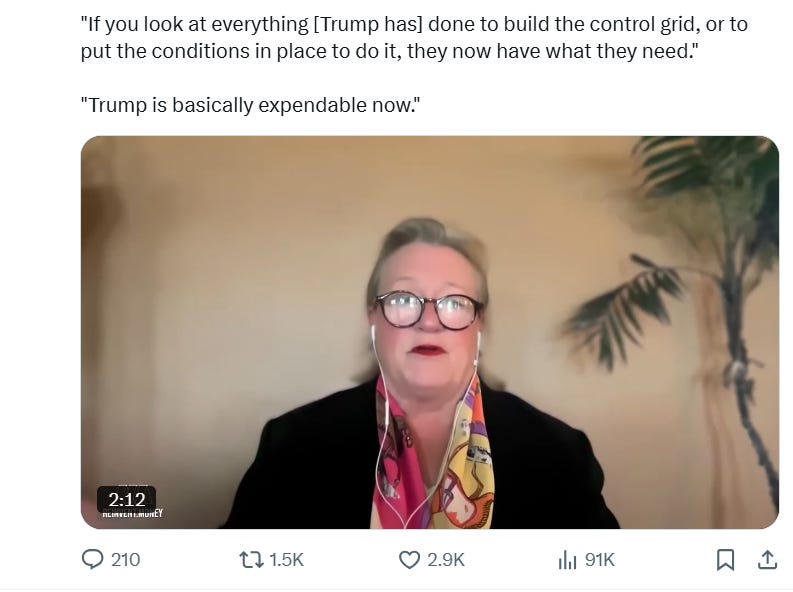
Catherine Austin Fitts argues that Donald Trump was installed by bankers to construct a digital control grid comprised of programmable money, digital ID, and a social credit system.
She maintains that Trump is expendable now that the infrastructure for this system is complete.
“So let’s look at the control grid. There are three general baskets of what you need to do. The first is programmable money. The second is digital ID… And then the third is you need the hardware and the software infrastructure to do the social credit system.”
“And so you need all the data centres… But you also need a surveillance infrastructure and enforcement infrastructure to back it.”
“So how do you persuade conservatives… to embrace building that infrastructure? The way you do it is you say, oh, we have election fraud, or oh, we have an immigration problem. And so we need a digital ID to identify who everybody is so we can’t have fraud.”
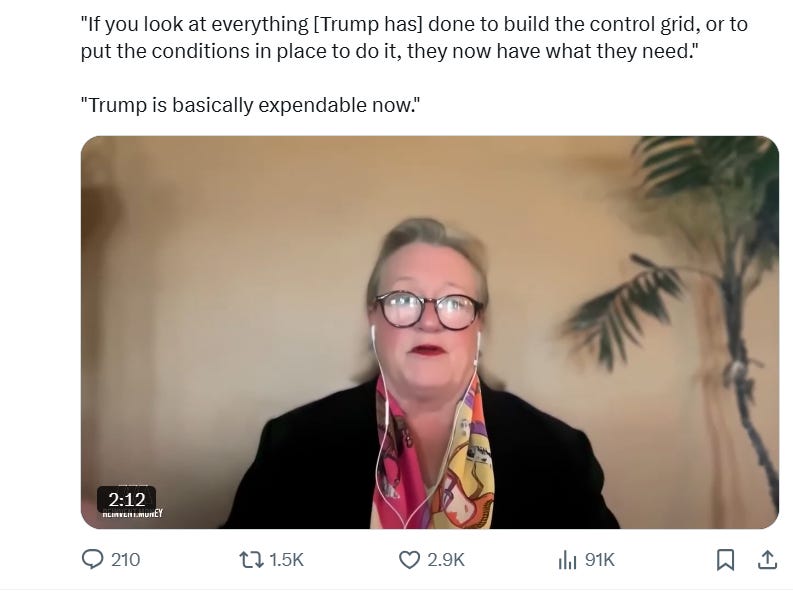
“If you look at everything [Trump has] done to build the control grid, or to put the conditions in place to do it, they now have what they need.”
“Trump is basically expendable now.”
end of segment
-
our opinions are not our sponsors opinions
-
the editorial department is separate from the promotions department
-
not financial advice