
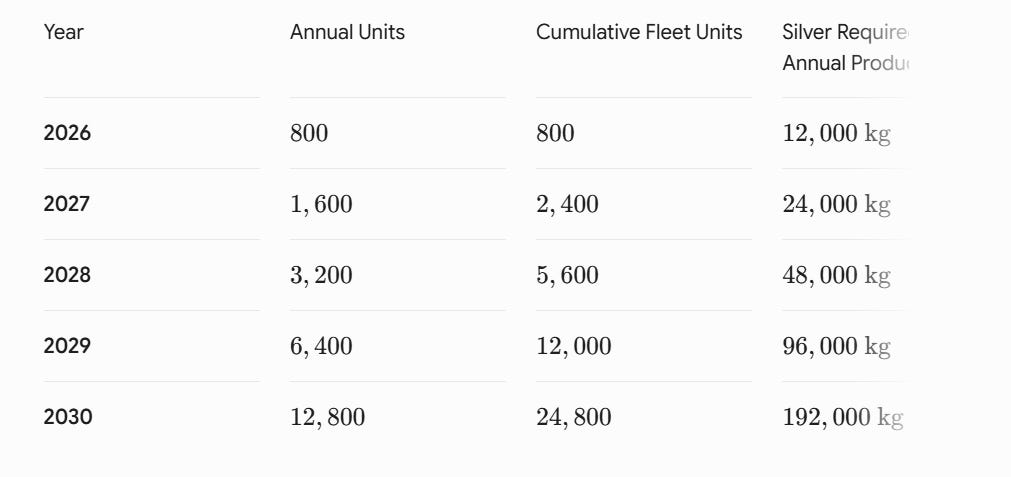
The era of mass aviation adoption has arrived with EVTOL’s AutoFlight’s historic 20-minute autonomous flight between Shenzhen and Zhuhai. By conquering a grueling three-hour, 31-mile highway commute across the Pearl River Delta in a fraction of the time, this five-seater electric air taxi proves the immense practical value of eVTOL technology. This staggering time-saving capability is the ultimate catalyst that will drive immediate passenger demand and force rapid, global manufacturing scaling.
Expanded eVTOL Production & Silver Requirements (2026–2030)
-
Utilizing silver-based solid-state battery technology is a game-changer for flight.
-
By offering twice the energy density
-
By offering twice the range of lithium ion
-
At half the weight of traditional lithium-ion batteries
-
it directly solves aviation’s greatest constraint: weight management.
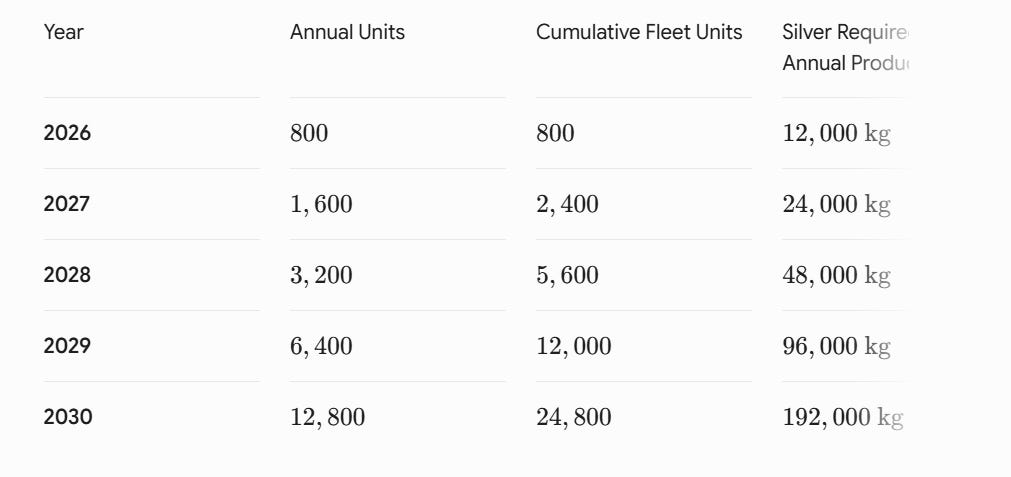
At a baseline requirement of 15 kilograms of silver per eVTOL aircraft, here is how the global silver requirements scale alongside production:
Grand Total Calculations (2026–2030)
-
Grand Total Silver Required: 372,000 kg
Ounce Conversions
Because precious metals are uniquely traded on global markets using a different weight system than standard commercial goods, here is the conversion for both standards:
-
Precious Metals Standard (Troy Ounces):
372,000 kg x 32.15 oz/kg = 11,960,078 Troy Ounces
To support the manufacturing of these 24,800high-performance aircraft, the global eVTOL industry will require approximately 12 million troy ounces of silver by the end of 2030
Aerospace Surge: eVTOL Production Set to Consume 12 Million Ounces of Silver by 2030
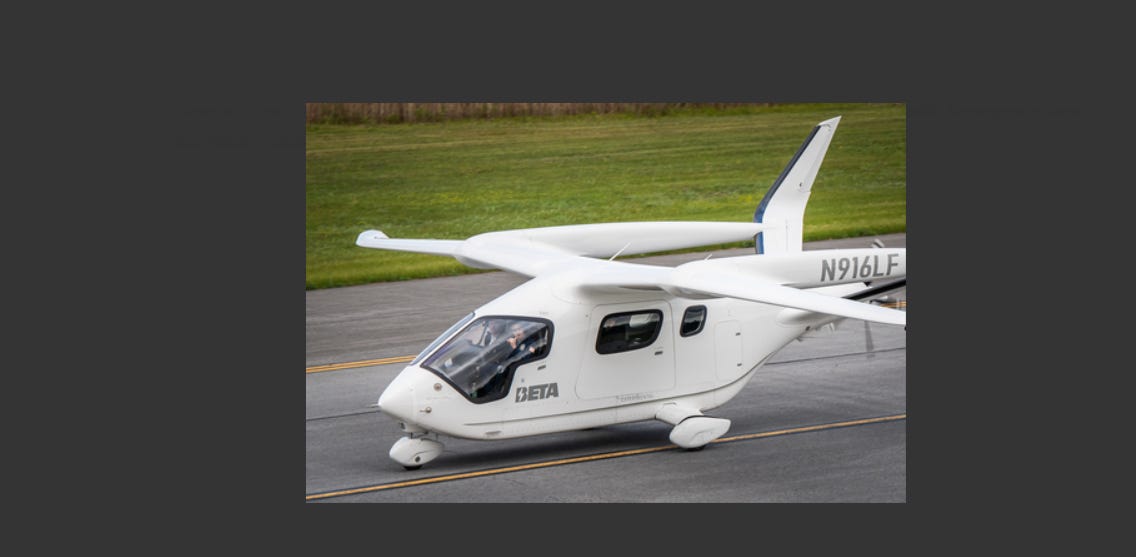
Burlington, Vermont— The rapidly accelerating electric vertical takeoff and landing (eVTOL) sector is quietly emerging as a massive driver of industrial silver demand. Following a high-profile Good Morning America broadcast featuring Transportation Secretary Sean Duffy flying in a BETA Technologies aircraft, market analysts are turning their attention to the critical, weight-saving technology making these commercial flights possible: silver-infused solid-state batteries.
Aviation presents a brutal engineering challenge where every ounce matters. Traditional lithium-ion batteries are proving too heavy for sustained commercial flight.
To overcome this, the aerospace industry is turning to solid-state chemistry similar to Samsung’s latest breakthroughs. By utilizing a silver-carbon layer, these next-generation batteries deliver twice the range, double the operational lifespan, and a blistering 9-minute charge time—all while slashing battery weight by half.
According to global industry tracking, the total fleet size is scaling rapidly. Projections show the manufacturing baseline climbing from 800 units this year to an estimated 12,800 units annually by 2030, capturing output from frontrunners like EHang, Joby, Archer, and BETA, alongside specialized regional and cargo drone manufacturers.
Engineers estimate that each aircraft requires roughly 15 kilograms of silver to achieve these necessary performance thresholds. As manufacturing output doubles annually over the next five years, the cumulative silver requirements tell an explosive supply story:
-
2026: 800 units require 12,000 kg of silver.
-
2028: Production scales to 3,200 units, pushing annual demand to 48,000 kg.
-
2030: High-rate assembly lines churn out 12,800 units, drawing 192,000 kg in a single year.
Cumulatively, the build-out of a 24,800-aircraft global fleet over this five-year window will consume a grand total of 372,000 kilograms of silver.
For precious metals markets, this translates to a massive 11.96 million troy ounces of new, high-grade industrial demand locked directly into aerospace infrastructure. As silver continues to solidify its dual identity as both a monetary hedge and an indispensable high-tech industrial commodity, the eVTOL boom represents a permanent, structural shift in global silver consumption that miners and institutional investors cannot afford to ignore.
Silver on the Brink of Extinction
Where to find high grade Silver NOW
This impending surge in aerospace manufacturing collides directly with a structural bottleneck that is already pushing the physical market to its absolute limits. As of 2026, the global silver market has entered its sixth consecutive year of a severe structural deficit. Primary mine production has flatlined around 820 million ounces annually, capped by the reality that most silver is pulled from the ground as a mere byproduct of copper, lead, and zinc mining. Meanwhile, soaring demand from solar energy, AI data center electronics, and automotive electrification has pushed total global consumption toward 1.2 billion ounces. With above-ground stockpiles relentlessly hollowed out by hundreds of millions of ounces since 2021, the tech sector faces an uncomfortable question: as cutting-edge aviation forces a collision between finite geological supply and exponential industrial necessity, where exactly are we going to get the silver?
Silver remains one of the most undervalued assets in the world today — and Aya Gold & Silver (Nasdaq: AYA | TSX: AYA) may be the cleanest, most compelling way to capture that upside. After a two-day on-site visit to Aya’s flagship Zgounder silver mine in Morocco’s Anti Atlas Mountains in April 2026, commodity analyst Nomi Prins of Prinsights Premium came away with conviction deeper than any earnings call could produce.
Zgounder isn’t just producing silver — it’s over-delivering. Prins witnessed the operation firsthand, reporting:
“The plant was designed for 2,700 tons per day. By the end of 2025 it was running 3,800 tpd consistently and crossed 4,100 tpd in December.”
With 2026 guidance calling for 5.2–5.8 million ounces of silver from Zgounder alone and total company-wide production of 6.2–6.8 million oz AgEq, cash costs guided at approximately $21.50/oz position Aya for exceptional margins as silver continues its long-overdue re-rating.
The resource base is growing, not shrinking. As Prins noted after reviewing the December 2025 NI 43-101 update on site:
“The most recent resource update increased measured and indicated resources at Zgounder up to 100 million ounces of silver at 165 grams per ton, with proven and probable reserves of 73 million ounces. Most of that increase came from drilling that pushed the deposit further west and deeper — the orebody is still open.”
Key resource highlights:
-
100 million oz of silver in measured & indicated resources at 165 g/t
-
73 million oz in proven & probable reserves
-
Mineralization extending west and at depth — with a $30 million 2026 exploration budget to keep pushing it
The operation runs on green wind and solar energy via the Moroccan national grid, delivering roughly a 15% cost savings versus diesel-dependent peers. Aya ended 2025 with $136 million in unrestricted cash — a war chest that funds both exploration and the development of Boumadine, its next polymetallic asset.
What struck Prins most, however, went beyond the numbers. With over 1,200 workers on site — 90%+ Moroccan nationals — and community programs spanning women’s literacy, a saffron agricultural initiative, and a women’s cooperative bakery, Aya has built the kind of social license that keeps long-life mines running without friction for decades.
“The strongest impression I came away with had less to do with any single number than with observing how genuinely difficult it is to bring a precious metal like silver out of the ground and through to a finished bar. Markets quote silver as a number on a screen. The work behind that number is what scarcity is in practice.”
Upcoming catalysts include the Nasdaq listing (executed May 4, 2026), a Boumadine technical report update in H2 2026, and aggressive resource drilling that targets 30,000 meters at Zgounder this year alone. For investors seeking real, tangible leverage to the silver story — backed by bars stacked in a vault — Aya is the name to know.
end of segment
our opinions are not our sponsors opinions
the editorial department is separate from the promotions department
not financial advice