
The Turning Point for Aya Gold & Silver: A Rare Institutional Catalyst
First things first: This is a defining moment for those who saw the potential in Aya Gold & Silver (AYA: Nasdaq) early.
The market has just delivered a major signal, and for the smartest investors, it confirms exactly what you already knew: Aya is not just another player; it is an emerging powerhouse in the precious metals sector.
The News: Aya Gold & Silver has officially been added to the VanEck Gold Miners ETF (GDX).
This is not a minor headline—it is a institutional seal of approval. GDX is one of the world’s most widely followed benchmarks for precious metals equities. Being included in this index changes the game entirely by placing Aya directly on the radar of the world’s largest institutional fund managers.
Why this matters for your position today, Tuesday, June 16:
The rebalancing of the GDX index is set for the market close this Friday, June 19. When a stock is added to a major index like this, it triggers a mandatory, mechanical buying event. Passive index-tracking funds are required by law to adjust their holdings to reflect the new index composition.
Analysts estimate this inclusion will force the purchase of approximately 5.7 million shares of Aya. To put that in perspective, that is roughly 2x the stock’s Average Daily Volume (ADV).
In the world of finance, this is a massive, concentrated injection of liquidity and demand.
The Strategy:
For those already holding, this is the validation of your thesis. For those watching, the window is narrowing. The market is about to undergo a significant mechanical adjustment this Friday. Historically, such inclusions act as a powerful catalyst for increased visibility, institutional support, and sustained valuation growth.
The setup is clear: A company with strong operational fundamentals is about to receive an massive, automated influx of capital. You are witnessing the moment Aya graduates to the next tier of the market.
How are you positioning yourself to take advantage of this institutional momentum before the bell rings this Friday?
The Bimetallic Imperative: Why Silver Signals a Coming Revaluation
In the unfolding narrative of global finance, gold and silver act not merely as commodities, but as the enduring pillars of monetary truth. To discuss one without the other is to ignore the historical foundation of value itself. This is the bimetallic thesis: for centuries, the global economy functioned on the fundamental reality that gold and silver are inextricably linked. Crucially, the price of gold has historically been anchored by the silver dollar at a fixed ratio of 15 to 1.
Today, this ratio serves as a vital diagnostic tool. When the market drives the gold-to-silver ratio significantly above this historical equilibrium, it is not merely a fluctuation—it is a flashing “undervalued” signal for silver. Investors who ignore this discrepancy do so at their own peril, as history shows that the market eventually forces a recalibration toward the mean.
Built on expanding debt, not hard value
U.S. Treasuries are claims on a system that continuously issues new debt to sustain itself. The underlying mechanism depends on rolling over obligations and expanding the money supply, which steadily weakens the real value behind those promises.
-
Inflation quietly destroys returns
Even when Treasuries “pay,” inflation can outpace yields and erode purchasing power. What looks like a safe return on paper often translates into a guaranteed loss in real terms. -
Deficits with no structural brakes
Persistent, trillion-dollar deficits mean constant issuance of new Treasuries. More supply requires more buyers, and if demand weakens, yields must rise—hurting existing bondholders and exposing structural fragility. -
War and crisis spending accelerate the spiral
Major geopolitical conflicts and global interventions routinely trigger massive borrowing surges. These shocks expand debt loads rapidly, increasing reliance on continued monetary support and further diluting long-term value. -
“Risk-free” depends on global confidence
Treasuries are labeled risk-free, but that assumption rests on continued global demand for dollars. As alternative systems and competing powers emerge, that confidence is no longer unquestioned.
Example: If inflation averages 5%5% while a 10-year Treasury yields 3%3%, the real return is approximately −2%−2%—a slow, systematic loss of purchasing power disguised as safety
The Shift Toward Real Assets
Recent data highlights a pivotal shift in central bank behavior. As fiat currencies face mounting pressure, central banks worldwide have been net buyers of gold, preferring to bolster their reserves with physical metal rather than relying solely on US Treasuries. This “flight to safety” is not merely about asset diversification; it is a recognition that the era of unbacked fiat dominance is approaching a critical juncture.
While some headlines suggest central banks are “dumping” gold to manage currency crises, seasoned observers note that such actions are symptomatic of desperate attempts to suppress volatility in failing monetary systems. These maneuvers are reminiscent of past instances where governments liquidated assets at historical lows in futile attempts to support weakening currencies. In retrospect, these moments often marked the “bottom” for precious metals, preceding massive appreciation cycles.
The Financial Sector Warning
A critical indicator to watch—often overlooked by the mainstream—is the relative performance of the financial sector. When the broad financial index (XLF) consistently underperforms the S&P 500, it historically serves as a lead indicator of impending economic strain. Much like the period leading up to the 2007 financial crisis, this divergence suggests that the banking and credit apparatus is struggling under the weight of unsustainable debt and rising interest rate burdens.
As maturing debt is refinanced at higher rates, the structural fragility of commercial property and private credit markets becomes apparent. In this environment, the traditional “60/40” portfolio model is increasingly viewed as an artifact of a bygone era. Sophisticated capital is actively rotating away from debt-dependent assets and into monetary metals.
The stage is set. As the divergence between the current price of silver and its historical value relative to gold continues to widen, the case for a major revaluation becomes not just a theory, but a mathematical necessity.
Back to Aya Gold and Silver
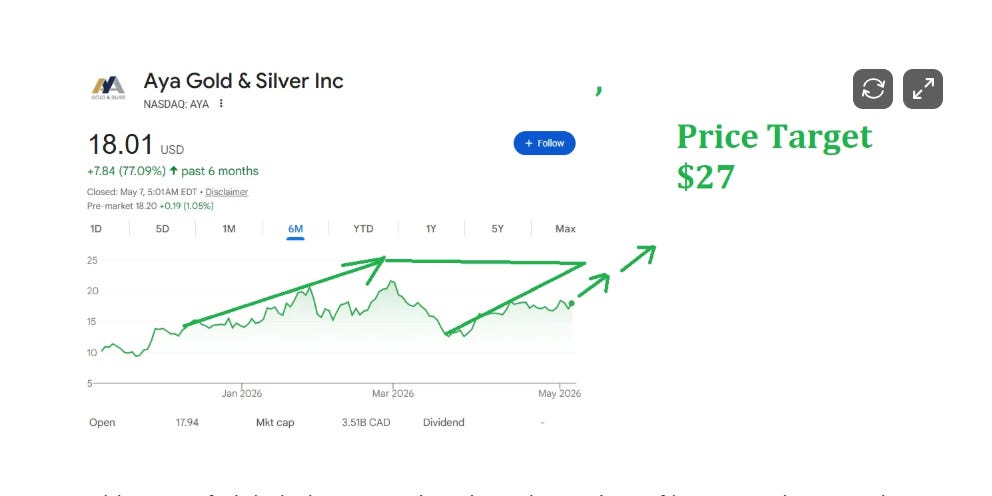
5 weeks ago we predicted a share price of $27 when Aya was trading at $18, see article below. Looks like that day is coming quicker than predicted.
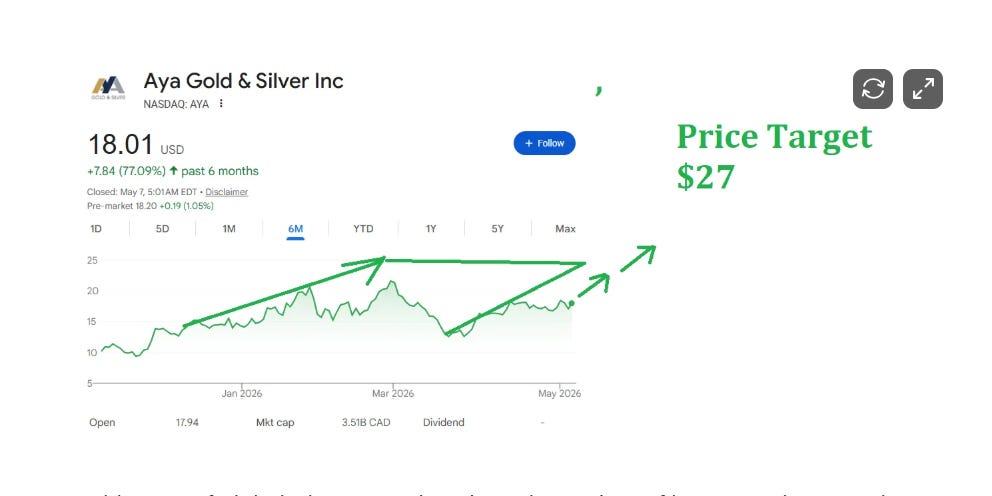
We made the call 5 weeks ago in this very article below
end of segment
-
.our opinions are not our sponsors opinions
-
the editorial department is separate from the promotions department
-
not financial advice