
First Biden, Then Trump
Same Playbook
Drain Strategic Petroleum Reserves to fool the working class
In 2022, the Biden administration conducted the largest release in the history of the Strategic Petroleum Reserve (SPR), authorizing the sale of 180 million barrels of crude oil. This action was primarily aimed at addressing global supply disruptions and rising energy costs triggered by Russia’s invasion of Ukraine.
The timing of these releases—including a final 15-million-barrel sale announced just weeks before the 2022 midterm elections—was politically motivated to lower gas prices.
During the 2026 conflict between the U.S. and Iran, the closure of the Strait of Hormuz triggered the largest energy supply disruption in history, causing a massive global price surge. To mitigate economic damage and fuel shortages, the U.S. and IEA members authorized an emergency release of over 400 million barrels of oil.
Consequently, the U.S. Strategic Petroleum Reserve (SPR) fell to 340.3 million barrels, its lowest level since 1983. While these drawdowns successfully prevented catastrophic price spikes, the reserve now faces critical operational limits, leaving the U.S. vulnerable to further supply shocks as GCC production remains heavily impacted.
Now let’s shift the focus away from oil reserves over to Silver reserves.
Here is a summary of the article regarding the distribution of global silver reserves:
-
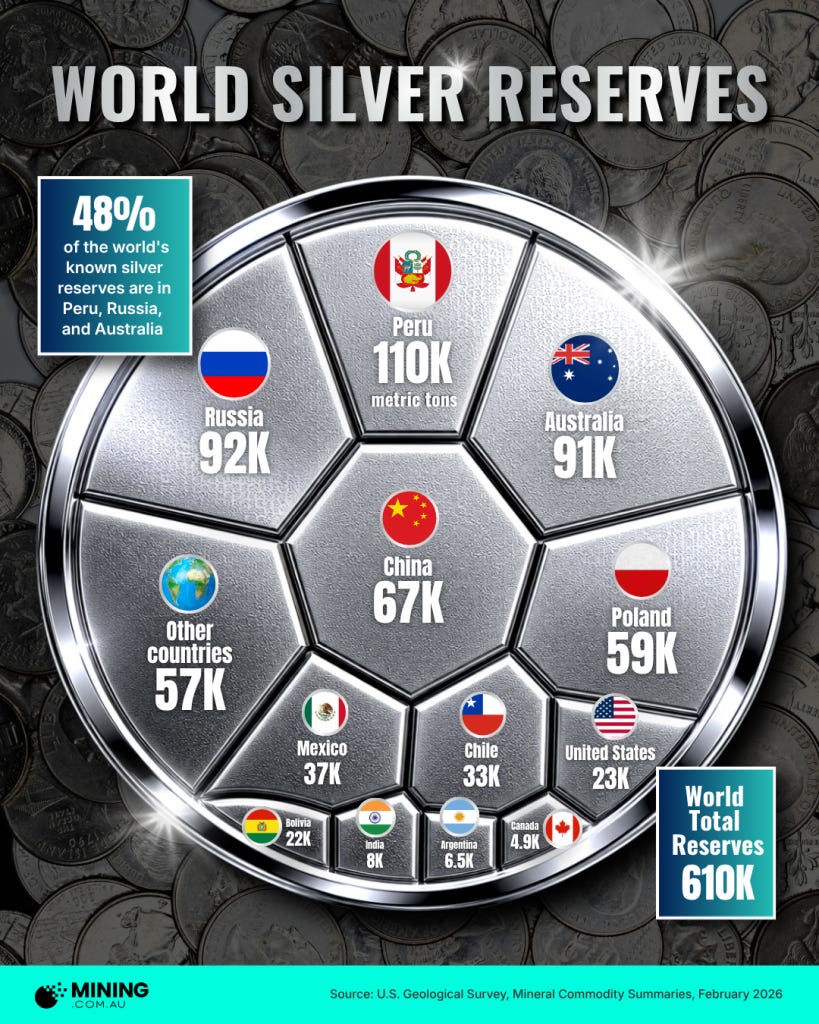
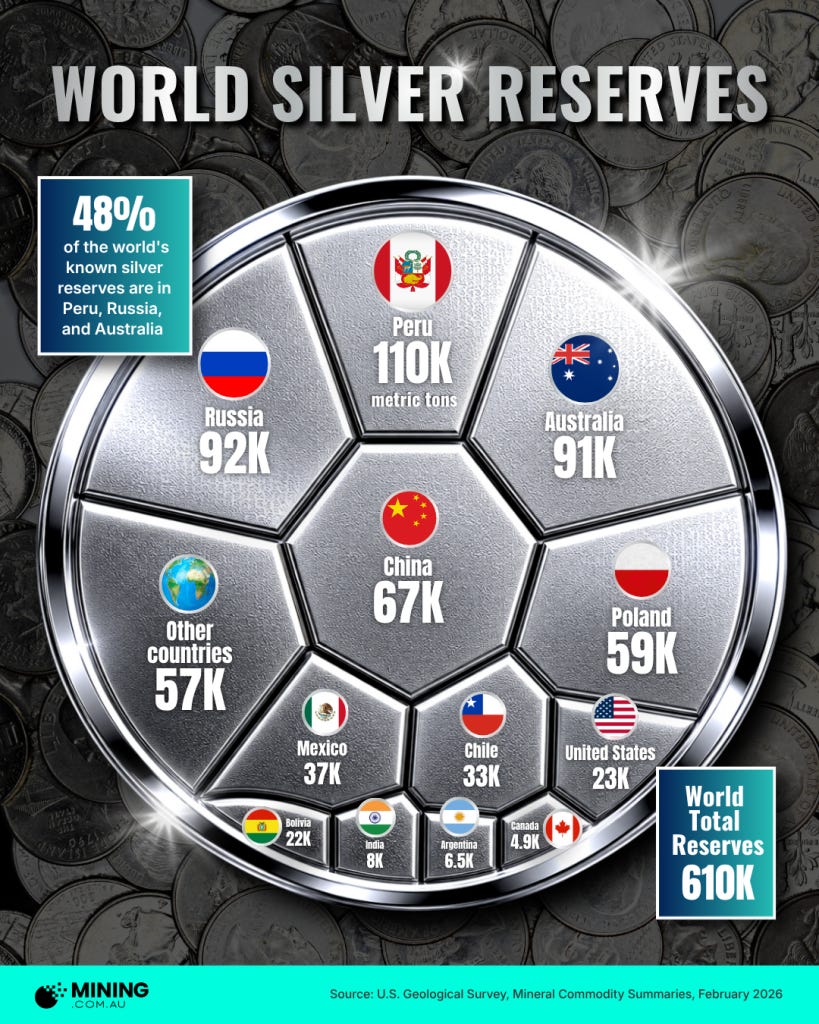
Global Concentration: Known silver reserves currently total 610,000 metric tons, with nearly half (approximately 49%) held by just three countries.
-
Leading Reserve Holders: * Peru: Remains the global leader, holding 110,000 metric tons (18% of global reserves).
-
Russia: Ranks second with 92,000 metric tons.
-
Australia: Ranks third with 91,000 metric tons, continuing to grow its influence through exploration.
-
-
Other Significant Producers: * China: Holds 67,000 metric tons (11%).
-
Poland: Holds 59,000 metric tons.
-
Mexico: Historically a top producer, currently holds 37,000 metric tons.
-
Chile, USA, and Bolivia: Also host substantial reserves ranging between 22,000 and 33,000 metric tons.
-
-
Industrial Importance: Silver’s value extends beyond traditional bullion and jewelry. It is increasingly vital for the manufacturing of solar panels, electronics, electric vehicles, and other clean energy technologies.
-
Supply Security: As industrial demand for silver intensifies, countries with significant, stable reserves and active development pipelines are becoming increasingly strategic to global supply chain security.
Philosophy of Russia
Russia treats silver as a monetary metal primarily to enhance its state reserves and ensure financial stability, rather than for direct trade settlement. By adding silver to its portfolio alongside gold, platinum, and palladium, the government aims to increase its holdings of highly liquid, value-preserving assets. This move is a strategic component of Russia’s broader effort to diversify its treasury and reduce reliance on the U.S. dollar. While market speculation suggests potential future uses—such as collateral or monetary infrastructure—Russia’s current policy focuses strictly on strengthening its reserve framework to hedge against economic volatility and geopolitical uncertainty.
Philosophy of India
India is fundamentally recalibrating its silver strategy to treat the metal as a formal, integrated financial asset. Starting April 2026, the Reserve Bank of India (RBI) officially permits loans against silver jewelry and coins, mirroring long-standing gold lending frameworks to boost financial inclusion and credit access. Simultaneously, regulators have shifted silver ETF valuation from international LBMA benchmarks to domestic spot prices from Indian exchanges, ensuring domestic demand-supply dynamics drive price discovery. While silver is now accessible for retail investors through ETFs and retirement-aligned funds, it remains a strategic hedge, blending its traditional role as a store of value with its modern industrial importance.
Our perspective
Maintain your conviction in silver; the foundational case for the metal has never been more compelling. We are currently witnessing a historic convergence of supply constraints and explosive demand that suggests the current market environment is a temporary distortion rather than a reflection of true value.
The data underscores a structural shift that cannot be ignored:
-
Persistent Deficits: The market has endured six consecutive years of structural deficits.
-
Inventory Depletion: Physical silver is being drained from COMEX vaults at an unrelenting pace, coinciding with multi-decade lows in open interest.
-
Industrial Super-Cycle: Beyond traditional use, surging demand for solar panels, AI, 5G, robotics, military and the breakthrough adoption of silver-based solid-state batteries have cemented the metal’s status as a Tier-1 critical mineral.
The volatility you are seeing today is likely a calculated attempt to shake out weak hands before systemic changes take hold. With the government’s upcoming July 13th announcement regarding critical mineral price floors—strategically positioned alongside the highly anticipated gold and bond revaluations—the window to accumulate at these depressed levels is closing.
Do not be misled by temporary price suppression tactics designed to induce panic. These maneuvers are often employed to force liquidations at artificial lows before an inevitable repricing event. Position yourself for the long term; the fundamentals are signaling a breakout that will likely leave those who allowed themselves to be shaken out at the bottom far behind.
end of segment
-
our opinions are not our sponsors opinions
-
the editorial department is separate from the promotions department
-
not financial advice