
Investing in Silver Mining Now is still once in a lifetime and the floor is in
Silver mining is no longer just a commodity story—it is a strategic imperative, and the urgency is escalating fast.
First, the market is already under strain. This is the sixth consecutive year of structural silver deficits, meaning global demand has exceeded supply year after year.
Above-ground inventories are being drawn down, and there is no quick mechanism to reverse that trend. Deficits of this duration signal a system running out of slack.
Second, nearly every high-growth sector of the modern economy is critically dependent on silver. It is not optional. Defense systems, aerospace applications, EVs and eVTOL, robotics, AI infrastructure, 5G networks, solar panels, and advanced batteries all rely on silver’s unmatched conductivity and reliability. As electrification accelerates globally, silver demand is not just rising—it is compounding across multiple industries simultaneously.
Third, supply growth is effectively stalled. There have been no major new world-class discoveries capable of materially shifting the supply outlook, with only limited exceptions like
1. Boumadine (Aya)
2. Silver47 projects across Alaska, New Mexico, and Nevada.
Put simply: shrinking supply, exploding demand, and no discovery pipeline is a recipe for a severe supply crunch. Silver mining is now a national security issue disguised as a commodity cycle.
Aya Gold & Silver is one of the few primary silver producers with scale and growth. Its Boumadine project in Morocco represents one of the only meaningful new silver discoveries globally. Aya offers direct leverage to rising silver prices, avoiding the fragility tied to base metal byproduct supply that dominates global output.
Andean Precious Metals is transitioning into a focused silver growth story with high-grade assets in Bolivia. Its operations provide strong margins and expansion potential in a tightening supply environment. As a primary silver producer, Andean avoids dependence on base metal cycles, positioning it as a more reliable play in persistent deficit conditions.
Kuya Silver is a pure-play silver developer targeting high-grade production in the Americas. Its Bethania project in Peru offers near-term production potential with strong silver exposure. Kuya represents leveraged upside to silver without the systemic risks tied to byproduct mining, which currently underpins most global supply.
Roughly 75% of global silver supply is produced as a byproduct of copper, gold, zinc, and lead mining—tying silver’s fate to unrelated commodity cycles. That structure is increasingly dangerous in an already deficit-driven market with shrinking above-ground inventories. Primary silver producers like Aya Gold & Silver, Andean Precious Metals, and Kuya Silver offer direct exposure to silver supply growth, making them critical players as the market shifts toward scarcity, security, and reliable production.
Silver mining companies mentioned in this article – pure silver plays, not silver-as-byproduct plays
Aya Gold & Silver (NASDAQ: AYA, TSX: AYA)
Andean Precious Metals (TSXV: APM, OTC: ANPMF)
Kuya Silver (CSE: KUYA, OTC: KUYAF)
Silver47 (OTC: AAGAF)
1. Gold Revaluation (Gold over $19,000 silver from $1,200 to $1,500)
2. Price floors on Silver (to incentivize mining and refining)
3. Designation of Silver as critical mineral to offset chokepoints
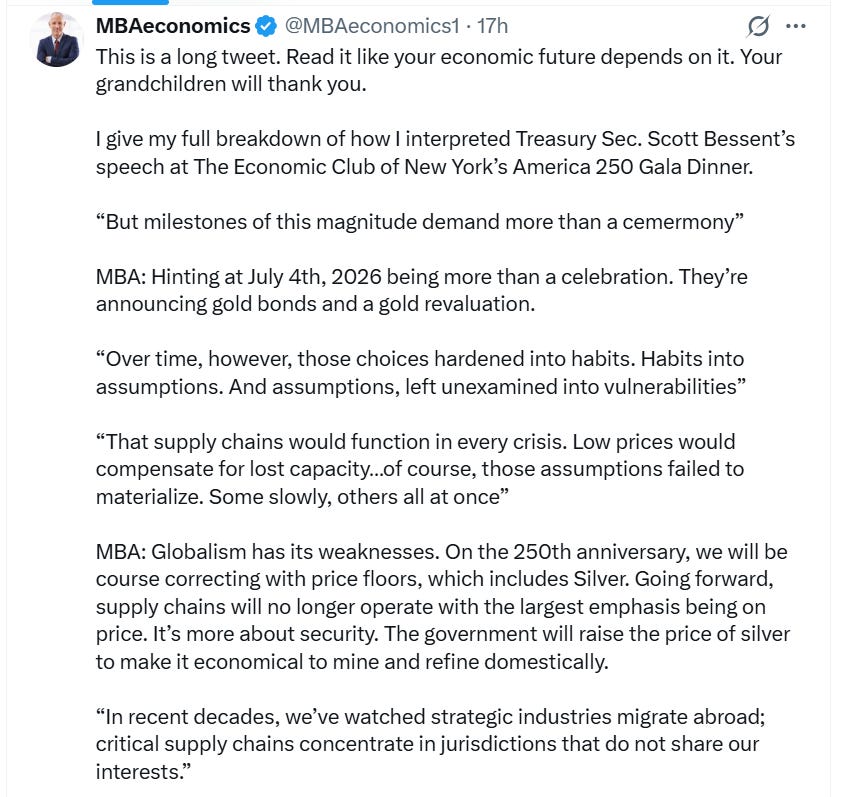
MBAeconomics delivers an outstanding analysis of the shifting monetary landscape, decoding Treasury Secretary Scott Bessent’s landmark remarks at the New York gala dinner. As the United States approaches its 250th semiquincentennial birthday, a strategic revaluation framework is taking shape. By analyzing newly proposed silver price floors and the critical implications of reclassifying silver as an official critical mineral, MBAeconomics provides an essential roadmap for navigating America’s aggressive pivot toward asset-backed economic sovereignty.
Of course this newsletter has been following this topic in hypervigilant manner and here are some further thoughts.
Treasury Secretary Scott Bessent may have just telegraphed the most important monetary shift in generations—and almost no one in mainstream finance is willing to say it out loud.
Speaking at The Economic Club of New York’s America 250 Gala Dinner, Bessent delivered what sounded less like a ceremonial address and more like a warning shot.
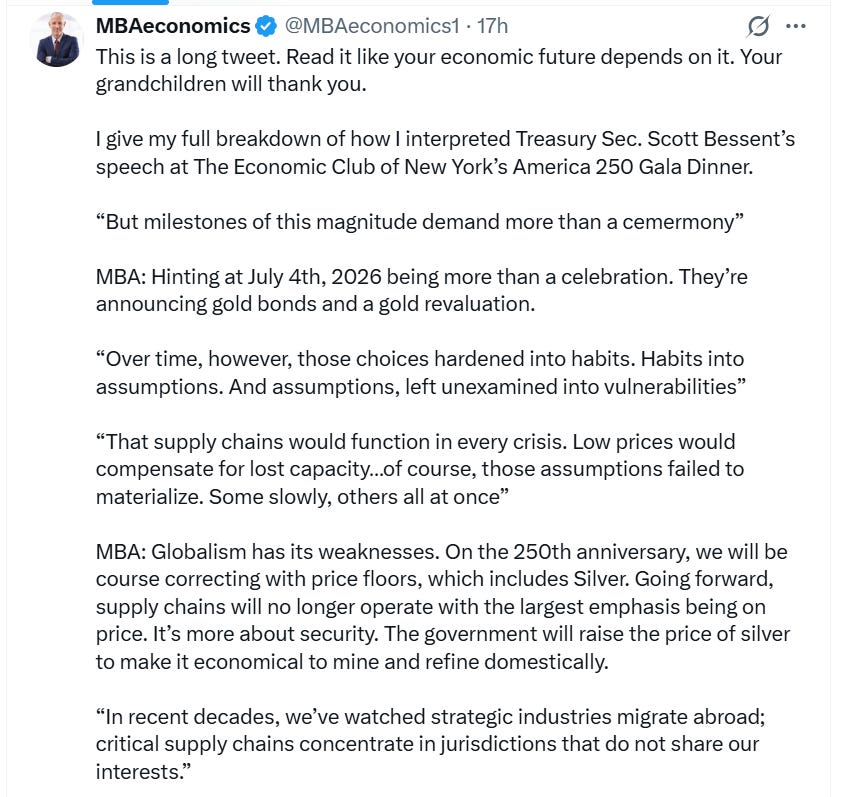
“But milestones of this magnitude demand more than a ceremony.”
That line alone has sparked intense speculation that July 4th, 2026 will mark more than a symbolic anniversary—it may mark the beginning of a monetary reset.
MBA: Hinting at July 4th, 2026 being more than a celebration. They’re announcing gold bonds and a gold revaluation.
Gold Revaluation Is Back on the Table
Bessent didn’t mention gold explicitly—but he didn’t need to.
“Habits into assumptions. And assumptions, left unexamined into vulnerabilities.”
That is a direct indictment of the fiat-era playbook. Decades of dollar dominance built on confidence alone are now being reframed as a structural weakness.
MBA: Confidence? Gold bonds.
The only credible way to “restore confidence” at sovereign scale is to re-anchor the system—and that means gold.
Analysts increasingly point toward a revaluation in the range of $19,000 per ounce. If that happens, silver doesn’t lag—it explodes. A 15:1 gold-to-silver ratio would fundamentally reset the entire metals complex.
Silver Price Suppression Is Ending
Bessent’s most overlooked comments may be the most important for silver investors.
“That supply chains would function in every crisis… low prices would compensate for lost capacity… of course, those assumptions failed to materialize.”
This is a quiet admission: the era of cheap commodities is over.
MBA: Globalism has its weaknesses. On the 250th anniversary, we will be course correcting with price floors, which includes Silver.
For decades, artificially low silver prices hollowed out domestic mining and refining capacity. The market wasn’t “efficient”—it was distorted.
Now, that distortion is a national security liability.
MBA: The government will raise the price of silver to make it economical to mine and refine domestically.
A silver price floor isn’t bullish—it’s structural. It means the U.S. is no longer willing to rely on fragile global supply chains for a metal critical to energy, electronics, and defense.
Globalization Just Hit Its Wall
Bessent made the geopolitical reality explicit:
“We’ve watched strategic industries migrate abroad; critical supply chains concentrate in jurisdictions that do not share our interests.”
MBA: Critical mineral mining and refining are wholly owned by China. The USA will be taking measures to onshore this capacity domestically. Price floors.
The old question—“where is the lowest cost?”—is dead.
“The question still matters, but it is no longer sufficient.”
MBA: Lowest cost is no longer the driving factor… it’s whether you have supply secured, no matter the price.
This is the end of price-first globalization and the beginning of security-first economics. Silver, now officially designated a critical mineral, sits right at the center of that shift.
The Dollar Is About to Be Anchored
“It now falls on us… [to build] a stronger foundation for our leadership.”
MBA: The USA is going to lead the world by re-introducing gold to the monetary system.
China is already moving in this direction. The U.S. cannot afford to lag.
“That is American economic statecraft in the 21st century. Open to the world while anchored at home.”
MBA: Anchored? The dollar is about to be anchored by gold via 50-year gold bonds.
Bessent closed with a line most analysts dismissed as generic:
“We should support innovation… that preserves the integrity of the financial system.”
MBA: Gold bonds are the newest innovation.
Call it what it is: a reset dressed up as policy evolution.
Gold gets revalued. Silver gets repriced. Supply chains come home.
And the system—quietly, but decisively—changes.
Two Previous articles written just this week on $19000 Gold and $1200 to $1500 Silver
-
our opinions are not our sponsors opinions
-
the editorial department is separate from the promotions department
-
not financial advice