

“First they ignore you, then they laugh at you, then they fight you, then you win.”
For years, sound-money advocates and precious-metals investors were waved away by mainstream finance as “gold bugs”—perma-bears supposedly hiding from the future in coins, bars, and mining shares. Yet the investment landscape is changing before our eyes. The dismissive stage is ending. The largest pools of global capital are beginning to recognize what hard-asset investors have understood all along: when paper promises multiply faster than real-world wealth, ownership of scarce, productive assets becomes priceless.
The $376 Million Tell

BlackRock, the world’s largest asset manager, recently disclosed a new position of 8.39 million shares in Pan American Silver, valued at approximately $375.9 million, or 2.01% of the company.
This is not a promotional newsletter trade. It is not an impulsive retail bet. It is a substantial institutional position in a leading silver producer—an unmistakable sign that large-scale capital is willing to own silver infrastructure, mineral reserves, operating mines, and the embedded leverage that quality miners provide in a rising-metal environment.
The point is larger than PAAS itself. Pan American Silver matters because it is a major producer with operating exposure across the Americas, but the headline is BlackRock. When an institution of that size directs capital toward a silver miner, investors should pay attention to the direction of the flow—not merely the ticker symbol at the receiving end.
Paper Promises Meet Physical Limits
The macroeconomic backdrop is increasingly hostile to complacency. Sovereign debt has expanded dramatically across the developed world. Inflation risk remains embedded in fiscal deficits, monetary intervention, supply-chain fragility, and geopolitical fracture. Traditional portfolios remain saturated with assets dependent on the stability of currencies, credit markets, and counterparties.
Silver is different. It is a tangible asset with no issuer, no default risk, and no central-bank printing press behind it. It is also an essential industrial metal—used across electrification, electronics, solar technology, medical applications, and advanced manufacturing. That dual identity gives silver an unusual role: monetary metal on one side, strategic industrial input on the other.
And unlike a bond, a deposit, or a derivative, high-grade silver deposits cannot be conjured with a keystroke. Mines take years to permit, finance, construct, and operate. Economic reserves are finite. In an environment where the world is rediscovering scarcity, that matters.
A Narrow Market Meets Vast Capital
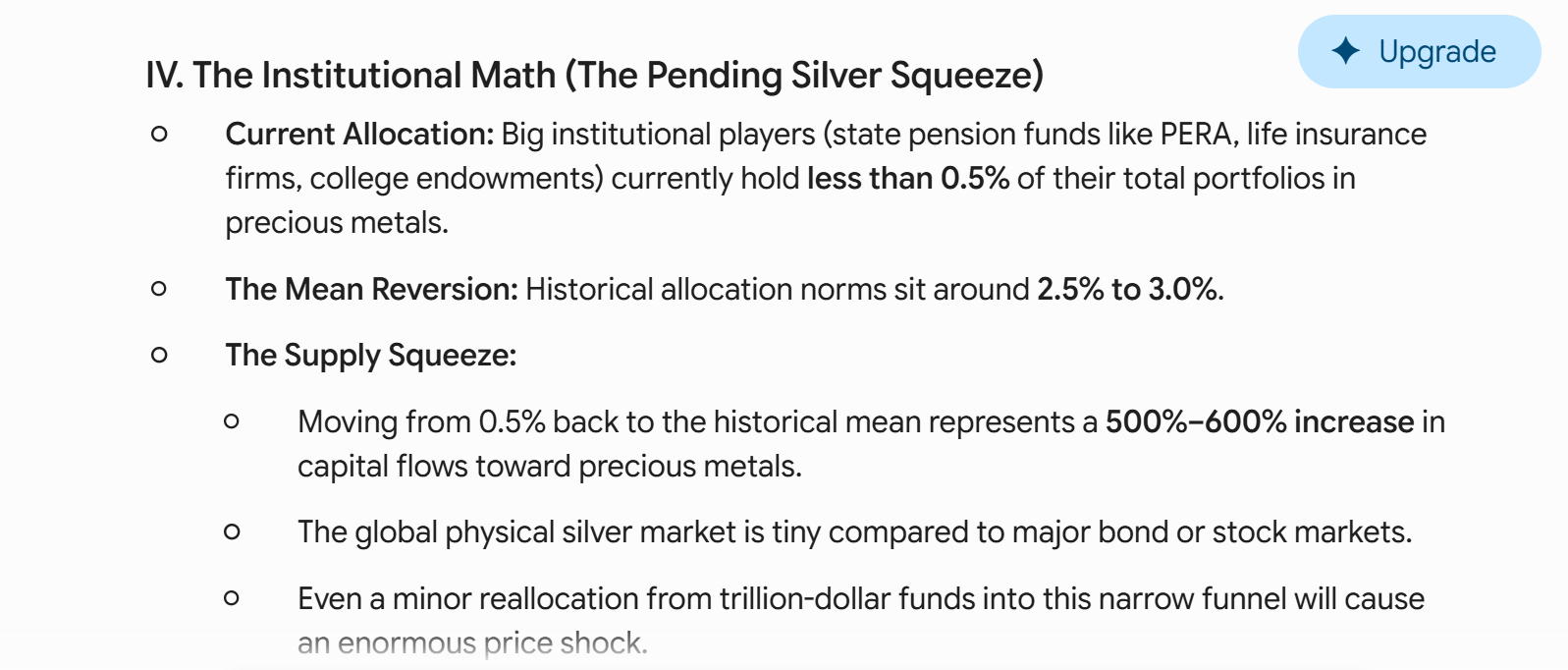
The potential reallocation math is where this story becomes explosive. Even modest institutional interest can create outsized effects in a market as comparatively small and less liquid as silver. BlackRock itself has noted that silver’s sharp 2025 rise reflected strong industrial and investment demand interacting with a less liquid market.
Meanwhile, gold alone accounts for about 3% of global financial assets outside central-bank reserves—far below the roughly 14% share it represented around four decades ago, according to World Gold Council estimates. The implication is straightforward: a renewed institutional preference for monetary metals does not require an extreme portfolio shift to become consequential.
A fractional rotation from vast pension funds, endowments, insurers, sovereign pools, and asset managers into physical metals and mining equities would be attempting to enter a far narrower channel than the global bond or equity markets. Prices do not need a universal stampede to move violently. They need marginal buyers with large balance sheets.
The Era of Dismissal Is Over
BlackRock’s PAAS position does not guarantee that silver rises tomorrow, and no single filing is a substitute for due diligence. But it is a strategic clue—and a revealing one. Pan American reported Q2 revenue of $1.124 billion, up 38% year over year, amid stronger metal prices, while it had repurchased about 7.3 million shares through August 11 under its 2026 capital-return program.
The “ignore and laugh” phase for hard assets is fading. The world’s largest money managers are beginning to take seats at the table. For investors, the smart question is no longer whether silver deserves institutional attention. It is how much higher the market must go before everyone else notices where the smart money is already flowing.
Pan American Silver May Be Next to Rethink Mexico Just Like the Endeavour Pivot to Peru.
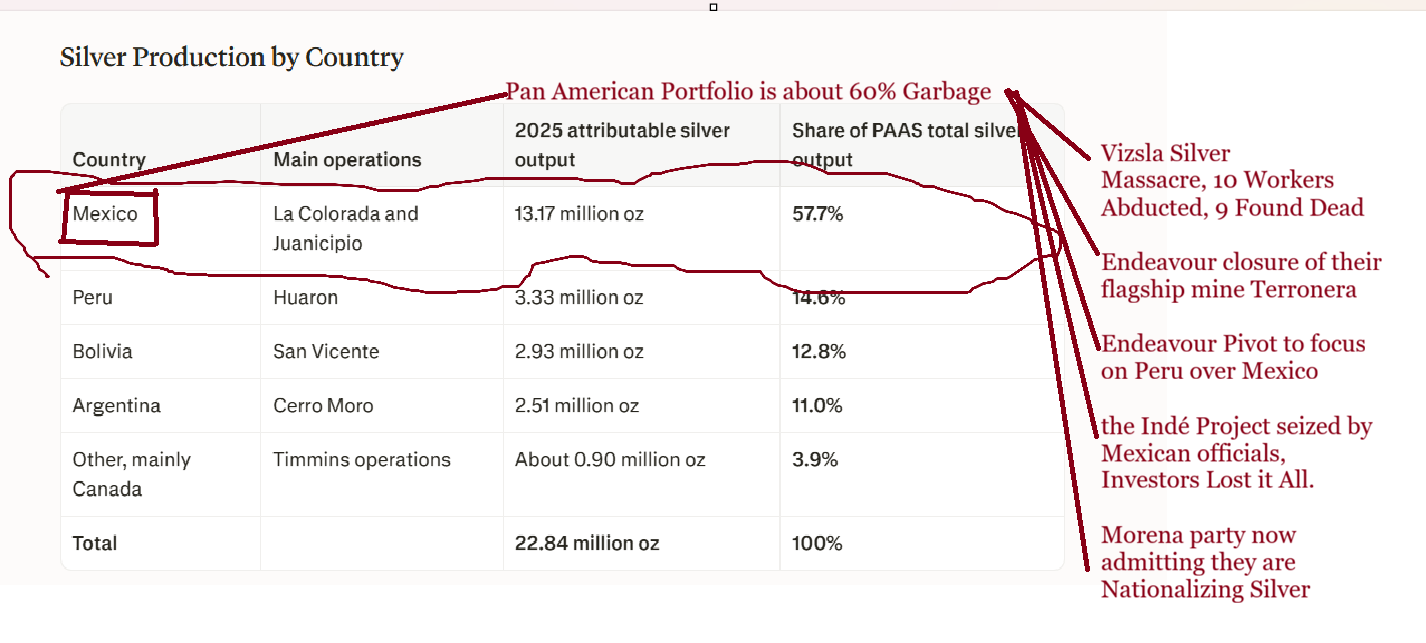
Mexico Is Not a “Jurisdiction Discount”—It Is a Red Flag
To invest there you are either one of 3 things
1. Not up to speed on what is going on there
or
2. Willing to Gamble in a high stakes game that is already speculative in nature.
or
3. Willing to say it’s OK for 10 Miners who were husbands, fathers, citizens to get abducted, tortured and murdered.
Mexico’s mining risk has crossed the line from an ordinary jurisdictional concern into a serious question of capital stewardship. Investors can debate ore grades, all-in sustaining costs, and silver-price upside all day—but none of it matters if a company’s workforce, access roads, permits, property rights, safety, human rights and operating continuity are exposed to political disorder, local coercion, or criminal violence.
The facts are brutal.
Ten people connected to Vizsla Silver’s Pánuco project in Sinaloa were abducted and killed in January, in a case Mexican officials linked to an alleged operative of a criminal organization associated with the Sinaloa Cartel. That should end the lazy habit of treating “Mexico risk” as a spreadsheet adjustment. Security is not an optional line item. It is the foundation of every ounce in the ground.
Terronera was not permanently closed, but Endeavour Silver’s new flagship mine was forced to suspend operations for nearly two weeks in August amid a community blockade before restarting August 24.
Meanwhile, President Claudia Sheinbaum has said Mexico will not grant new mining concessions, and a MORENA senator has proposed a reform that would bring mining under far tighter state control, including nationalization provisions, beginning with much higher taxes and other tactics designed to intimidate silver miners headquartered in either USA or Canada.
No serious investor should finance a system where value creation can be interrupted by blockades, threatened by political expropriation, or overshadowed by violence against workers.
PAAS should aggressively reduce its Mexico concentration and prioritize safer, more durable jurisdictions.
The broader point stands: pursue jurisdictions where lawful operations, employee security, and property rights are more than temporary privileges. Mexico cannot provide that, capital should leave—whether its next destination is Bolivia, Morocco, Peru, the United States, or Canada…Anywhere but Mexico.
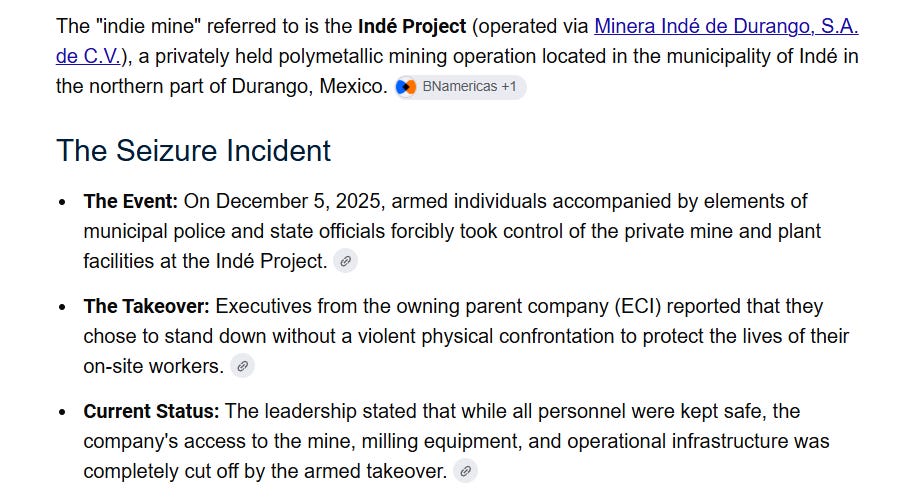
Oh, and then there is still this event factoring into any sensible investment decision (see below) and now you know why we always say
SELL YOUR SILVER MINING EQUITIES IF THEY HAVE OPERATIONS IN MEXICO
our opinions are not our sponsors opinions
the editorial department is separate from the promotions department
not financial advice