
by Adam Davis
At the 2026 World Humanoid Robot Games in Beijing, Chinese humanoid robots shattered Usain Bolt’s legendary 9.58-second 100-meter world record. Leading the pack, the humanoid sprinted the track in an astonishing 8.64 seconds, reaching speeds over 14 meters per second. If you don’t think this will be weaponized then please unsubscribe from this newsletter
CONTINUE READING
THE SILVER USE IS STAGGERING
ROBOTS ARE BULLISH SILVER
The Robot-Silver Collision
The robot race is no longer science fiction—it is an industrial mobilization. A plausible high-end scenario of 2 billion robots by 2029 would collide with a silver market already strained by demand near 1.3 billion ounces annually and mine production near only 820 million ounces. At just 25 grams of silver per robot, 2 billion machines would require 50,000 metric tons—about 1.6 billion troy ounces—of silver. That is nearly twice current annual global mine output, before solar, EVs, AI data centers, grids, military systems, phones, and investment demand take their share. Silver is becoming the physical bottleneck beneath the “digital” future.
The Two-Billion-Robot Math
The United States and China are not competing merely to make better chatbots. They are competing for control of AI, semiconductor production, drones, autonomous systems, data centers, advanced manufacturing, and robotics.
The endgame is physical AI: machines that can see, calculate, grip, move, communicate, manufacture, inspect, transport, and operate around the clock.
Every one of those machines needs conductive materials. Silver is the world’s premier electrical conductor, used in contacts, sensors, switches, electronics, power-management systems, circuit boards, and communications components.
The numbers become uncomfortable quickly:
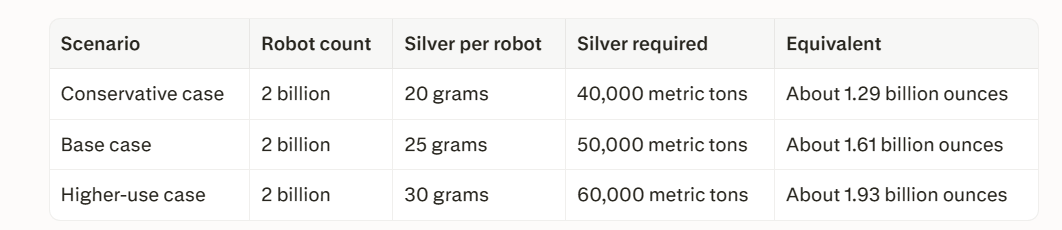
At the base-case assumption, 2 billion robots need 50,000 metric tons of silver.
That is not a rounding error. It is not a small new demand category. It is roughly 1.6 billion ounces of silver—nearly double annual global mine production near 820 million ounces.
And it is important to be precise: not all of that silver would necessarily be demanded in one year, and the 2-billion-by-2029 scenario is an aggressive upside scenario rather than a consensus forecast. But that does not weaken the point.
It makes the point clearer.
If the world truly intends to build robotics at anything remotely close to billion-unit scale, silver becomes a strategic material.
The Byproduct Trap
The silver market has a problem that cannot be solved with a bullish press release.
Approximately 70% to 75% of global silver mine supply comes as a byproduct of copper, lead, zinc, and gold mining. Primary silver mines contribute only about one-quarter of annual output.
That means silver supply is not controlled primarily by silver.
If the price of silver rises, a copper miner does not automatically build a new mine for silver. A zinc operator does not suddenly double production because robots need conductive contacts. A lead-zinc project can shut down, delay construction, lose its permit, face a blockade, or become uneconomic—even while the silver contained in its ore is desperately needed by the global market.
Silver is trapped inside the economics of other metals.
That creates obstacles most investors never model:
-
Copper, zinc, lead, and gold prices may determine whether silver-bearing mines are built or expanded.
-
New mines commonly require years of drilling, permitting, engineering, financing, construction, power access, water access, roads, skilled labor, and processing capacity.
-
Falling exploration budgets today mean fewer deposits available for production later.
-
Permitting and social-license disputes can freeze projects regardless of how high silver prices climb.
-
Crime, political risk, local blockades, taxation changes, and resource nationalism can remove supply without warning.
The 820-million-ounce global mine-production figure is a forecast, not a promise.
There is no guarantee the industry reaches it.
There is certainly no guarantee it grows enough through the next decade to meet a world simultaneously demanding solar panels, electric vehicles, weapons systems, satellites, AI infrastructure, and billions of robots.
Mexico: Becoming a No-Go Zone
Mexico is still the world’s largest silver-producing country, supplying roughly one-fifth of global mine supply. Yet its production has been declining.
For silver investors, that is not a local story.
That is a global supply warning.
Mexico is trending toward a no-go zone for new foreign mining investment—not because every mine will immediately close, and not because every Mexican community or government institution is hostile to mining, but because the combined risk stack is becoming too severe to ignore:
-
No new mining concessions are planned under President Claudia Sheinbaum’s administration through 2030.
-
Mexico’s mining reforms have tightened water rules, increased environmental and social requirements, and expanded the regulatory burden around concessions.
-
Exploration investment has weakened, shrinking the pipeline of future discoveries and future mines.
-
Illegal blockades can halt operations, disrupt cash flow, strand equipment, and undermine investor confidence.
-
Security risks can become impossible to calculate on a feasibility-study spreadsheet.
The term derecho de piso refers to extortion—criminal groups demanding payment for the right to operate. Any claim about a specific company, site, or blockade needs to be supported by law-enforcement findings and verified evidence.
But the broader risk environment is impossible to dismiss.
A miner cannot produce silver if workers are threatened, access roads are blocked, equipment is stranded, permit conditions change, water rights are challenged, or investors conclude that the jurisdiction is no longer financeable.
The Vizsla Massacre
The horrific case involving Vizsla Silver’s employees in Concordia, Sinaloa, should stop every mining investor cold.
Ten workers associated with Vancouver-based Vizsla Silver were abducted from a project site in January 2026. The company later confirmed that nine colleagues had been found dead, while one remained missing.
We must recall the facts of how Vizsla management used extremely poor judgment
The Sinaloa State Attorney General’s Office (Fiscalía General del Estado de Sinaloa), which opened the Concordia kidnapping investigation said it learned of the 10 disappearances through a January 24, 911 call from a Vizsla representative, one day after the abductions.
I challenge any reader of this publication—or anyone on Planet Earth—to identify a larger workplace tragedy than the Vizsla massacre: ten hardworking people abducted, tortured, and murdered from a work-connected setting; these were husbands, fathers, grandfathers, church members, community pillars, and providers for their families.
Pause for a moment and place this event in an ordinary workplace: a pizza parlor, factory floor, financial office, tire shop, brewery, department store, or construction site. Imagine ten employees being abducted together, and nine of them later being confirmed dead.
This was not the random, impulsive violence of a lone disturbed individual like a school shooting. The danger is far more systematic. In the context of organized criminal extortion, violence can become part of the enforcement mechanism: kidnap, kill, then return to demand derecho de piso—protection money—from those who remain.
That is the nightmare embedded in jurisdictions where criminal organizations acquire enough power to dictate the terms under which legitimate businesses are allowed to operate.
The Writing on the Wall
An investor who can read the room should see that Mexico’s silver sector is accumulating risks that no spreadsheet can comfortably discount away. This is not one isolated headline, one local dispute, or one temporary political controversy. It is a pattern:
-
The federal government has said there will be no new mining concessions.
-
Mining rules have become more restrictive, particularly around water, permitting, environmental compliance, and concession rights.
-
Exploration spending has weakened—meaning fewer discoveries and fewer new mines feeding future supply.
-
Endeavour Silver’s Terronera mine was forced to suspend operations during an illegal community blockade, demonstrating how quickly access to a producing asset can be interrupted.
-
The reported seizure controversy involving the Indé mine in Durango raises the stakes around property-rights security and state-level intervention.
-
Nine of ten abducted Vizsla Silver workers were later confirmed dead after the January 2026 attack near Concordia, Sinaloa—a human catastrophe that exposed the severity of security risk surrounding mining operations in parts of the country.
-
Organized-crime pressure, including the ever-present threat of derecho de piso extortion, adds a risk category that cannot be solved with a higher silver price or a more attractive reserve grade.
Taken together, these are not ordinary mining risks. They are warnings about whether capital, workers, contractors, and management teams can operate safely, predictably, and profitably over the multi-decade life of a mine.
An investor who sees that writing on the wall—and still waves it away as irrelevant—either has zero conscience or zero intelligence about jurisdictional risk.
That phrase may sound severe. But it fits the facts. High-grade ore cannot compensate for a jurisdiction where workers face catastrophic danger, access can be blocked, project economics can be rewritten by regulation, and property rights can be challenged by political or state action.
A mine is not simply a resource estimate in the ground. It is a living operation dependent on secure roads, safe workers, lawful access, water, electricity, community cooperation, functioning permits, predictable taxation, and a government that honors the basic rules under which capital was deployed.
When any of those foundations fail, the mine can become unfinanceable—regardless of how much silver sits beneath the surface.
The Foundation Lesson
Building a mine in a deteriorating high-risk jurisdiction is like pouring money into an unanchored foundation. You can build the best mill, define the best resource, hire the best engineers, and publish the most attractive feasibility study—but an external political, criminal, or sovereign shock can level the investment overnight.
History offers the brutal lesson.
Foreign firms built major commercial and industrial assets in Iran before the 1979 revolution. The revolutionary upheaval generated wide expropriation claims, including nationalization of American assets. Investors who believed contracts, physical infrastructure, and past profitability would protect them learned a different lesson.
South Africa offers another warning. Its mining wealth and institutional control were intertwined with apartheid’s system of racial domination, including coercive labor structures. Investors may receive returns in risky jurisdictions, but they can also become financially dependent on—and morally entangled with—systems of repression and violence.
High yield cannot compensate for sovereign expropriation.
High grade cannot compensate for a dead workforce.
And a discounted valuation cannot compensate for a mine that cannot operate.
The world wants robots. It wants AI. It wants solar, grids, electric vehicles, drones, and data centers.
But it also needs silver.
And silver increasingly appears to be the metal the world wants most—while building the conditions least capable of delivering enough of it.
-
Silver Academy is increasingly using guest writers because the news cycle is accelerating
-
We welcome Mr. Adam Davis (we call him “Penman Poughkeepsie” due to his stellar work at Vassar College)
-
our opinions are not our sponsors opinions
-
the editorial department is separate from the promotions department