
The Silver Academy has written about this development more than 35 times over the past two years. Here are a few examples. We were among the first to highlight this remarkable potential use case for silver, and other publications later picked up on our reporting.
-
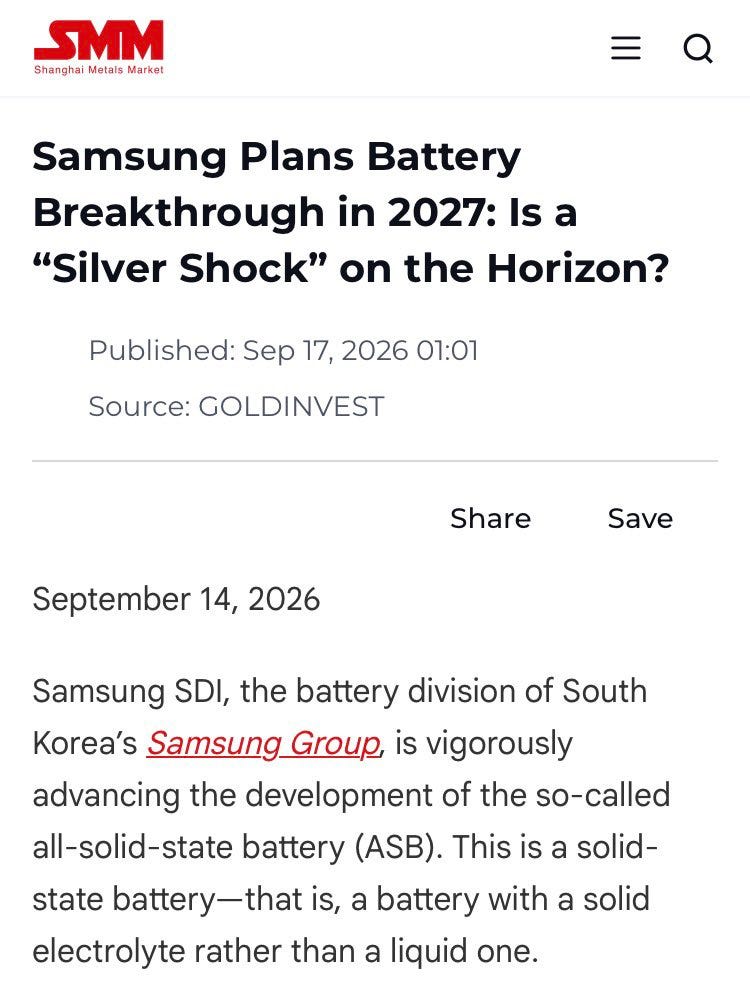
Samsung SDI’s all-solid-state EV-battery program has been reported as a potential major new source of silver demand.
https://news.metal.com/newscontent/104120442-samsung-plans-battery-breakthrough-in-2027-is-a-silver-shock-on-the-horizon -
Reports describe Samsung’s concept as using a silver–carbon composite anode layer, rather than a conventional liquid-electrolyte lithium-ion configuration.
https://www.jpost.com/business-and-innovation/precious-metals/article-816695 -
The reported performance targets include approximately 600 miles of EV range per charge.
https://www.jpost.com/business-and-innovation/precious-metals/article-816695 -
Samsung’s widely circulated battery claims also include charging from 10% to 80% in about nine minutes.
https://www.jpost.com/business-and-innovation/precious-metals/article-816695 -
The technology is presented as aiming for an operating lifespan of about 20 years, substantially longer than typical current EV-battery expectations.
https://www.jpost.com/business-and-innovation/precious-metals/article-816695 -
Analysts and industry coverage suggest that large-scale adoption could materially tighten silver supply, depending on actual silver loading per battery and manufacturing scale.
https://news.metal.com/newscontent/104120442-samsung-plans-battery-breakthrough-in-2027-is-a-silver-shock-on-the-horizon
-
“Exploring Samsung’s Silver Solid State Batteries: Key Insights and …” — Published August 23, 2024. It examines estimated silver intensity of about 1 kg per 100-kWh EV battery pack and models potential annual demand if Samsung-style batteries are adopted across passenger vehicles and other transport (https://thesilverindustry.substack.com/p/exploring-samsungs-silver-solid-state).
-
“Samsung’s Silver Solid State Battery Closer to Becoming Mainstream” — Published April 29, 2025. It covers Samsung’s Ag–C composite anode concept, claimed 600-mile range, 80% charging in nine minutes, a 20-year lifespan, and initial premium-EV positioning (https://thesilverindustry.substack.com/p/samsungs-silver-solid-state-battery-b4a).
-
“Solar and Samsung’s Silver Solid-State Battery Revolution” — Published May 8, 2025. It connects projected solar-sector silver consumption with an estimate of silver demand from Samsung-style solid-state batteries, framing their combined total as nearly 4.86 billion troy ounces (https://thesilverindustry.substack.com/p/solar-and-samsungs-silver-solid-state).
The Silver Spark Beneath Samsung’s Battery Ambition
Samsung SDI’s planned 2027 all-solid-state battery rollout could become one of the most consequential demand catalysts silver investors have seen in years. This is no longer just a promising laboratory experiment or a far-off technical dream. Samsung is preparing industrial production at its Ulsan plant and has laid out major long-term battery investment, placing a serious global manufacturer behind a technology that could require substantial quantities of silver.
Not Just a Battery—A Silver Platform
The investment case begins with the battery’s architecture. Samsung’s anode-free design uses an ultrathin silver-carbon composite layer rather than a conventional graphite or silicon anode. As the battery charges, lithium deposits onto this silver-containing layer. In other words, silver is not an incidental ingredient or marketing flourish—it is a working material tied to the cell’s proposed energy density, performance, and durability.
Samsung’s published targets are striking: roughly 900 watt-hours per liter, about 40% above current NMC battery cells; charging from 8% to 80% in approximately nine minutes; and a projected operating life of up to 20 years. If the company can deliver even a meaningful portion of those goals at commercial scale, automakers will have a strong incentive to adopt the technology—particularly for high-performance and premium electric vehicles, where range, charging time, safety, and longevity can justify higher battery costs.
The Demand Math Gets Loud
The silver-demand implications deserve investors’ full attention. Shanghai Metals Market cites a scenario in which a 100-kWh battery pack could require around 1 kilogram of silver. Under a high-adoption illustration—80% of 32 million electric vehicles in 2027—that could translate into almost 900 million ounces of incremental silver demand. This is not a forecast, and adoption will almost certainly be gradual. But it reveals the scale of the opportunity: even a modest fraction of that scenario could materially tighten a market supplied by a limited mine base.
A Tiny Metal, a Giant Bottleneck
Silver already serves critical roles across solar panels, electronics, electrical systems, and investment products. Adding a potentially silver-intensive next-generation EV battery to that demand mix would create another powerful competitor for available metal. The key point is simple: silver’s supply cannot be increased overnight, while a successful battery platform can generate demand far faster than new mines can be discovered, permitted, financed, and built.
Complexity Can Become the Catalyst
There are real hurdles. Sulfide-based solid electrolytes are chemically sensitive, and the manufacturing process remains demanding and likely costly during its early stages. But those difficulties may ultimately strengthen silver’s strategic position rather than weaken it. Technologies that solve meaningful customer problems—faster charging, higher density, better safety, and long service life—can support premium pricing and attract major capital investment.
The 2027 Clock Is Ticking
For silver investors, Samsung’s 2027 target is a date worth watching. The opportunity is not based on the claim that every EV will immediately adopt silver-based solid-state batteries. It is based on the possibility that even partial success could introduce a substantial new industrial buyer into an already strategically important metals market. If Samsung proves that silver helps unlock the next leap in electric-vehicle performance, the metal may cease to be viewed merely as a precious metal with industrial uses. It could become an essential bottleneck for the electric-transport revolution.
The Math
-
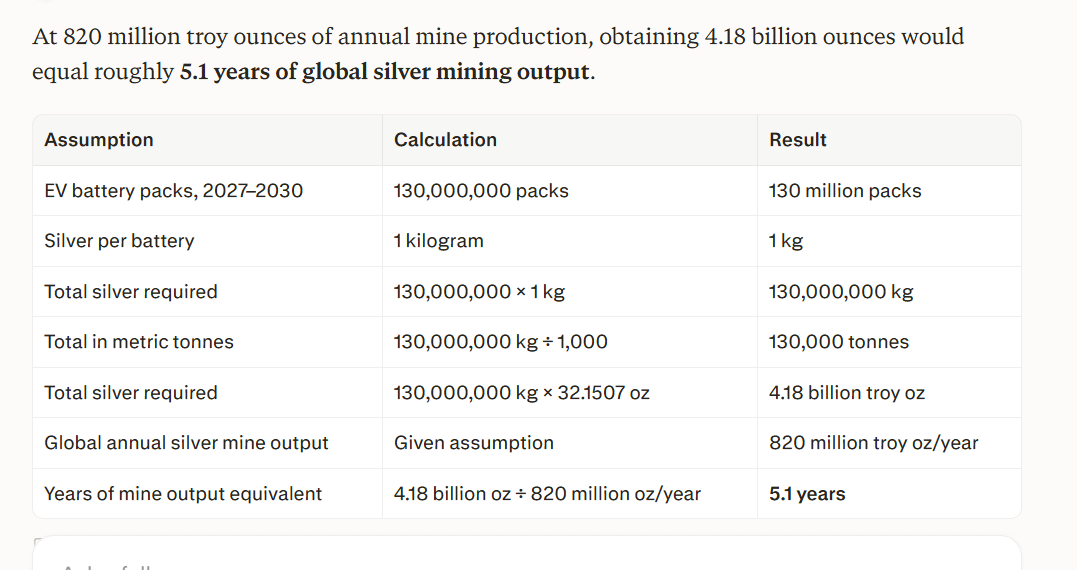
A reasonable global estimate is roughly 120–140 million EV battery packs produced from 2027 through 2030, assuming annual EV sales rise from about 30 million in 2027 toward 40 million-plus by 2030.
-
If 130 million EV battery packs each required 1 kilogram of silver, total demand would equal 130 million kilograms, or about 4.18 billion troy ounces of silver.
With most things “electrifying” and silver being the World’s #1 conductor of electricity this article clearly shows how we must invest in Junior miners advancing large deposits:
thus
Silver47 Exploration (OTCQX: AAGAF) has assembled a substantial, U.S.-focused portfolio of high-grade silver-equivalent resources across Alaska, Nevada, and New Mexico—jurisdictions with established mining histories and regulatory frameworks. The company reports approximately 236 million ounces of silver equivalent in the Inferred category, grading 334 grams per tonne AgEq, plus roughly 10 million ounces Indicated at 333 g/t AgEq. Its flagship Red Mountain project in Alaska anchors the portfolio, complemented by the Hughes project in Nevada and the historic Mogollon district in New Mexico. These are mineral resources—not reserves—and Inferred resources remain geologically speculative, but the scale, grades, and multi-project U.S. footprint provide meaningful exploration leverage.
end of segment
-
our opinions are not our sponsors opinions
-
the editorial department is separate from the promotions department
-
not financial advice