
The Empire’s Last Reflex: War, Debt, and the Silver Reckoning
The American empire is not calmly managing a transition. It is lashing out as declining empires do: expanding its coercive reach abroad while tightening control over the narrative and the money at home. The result is a world moving simultaneously toward geopolitical fracture, energy insecurity, electrification, and a renewed contest over what constitutes real money.
Washington’s posture is increasingly naked. Venezuela’s oil is no longer merely an economic asset but a strategic prize openly linked to U.S. power. Iran remains under continuing military pressure, Cuba is being subjected to intensified economic coercion, and the United States has secured expanded strategic access around Greenland. This is not the behavior of a confident system resting on voluntary consent; it is the behavior of an overstretched power trying to preserve a global order built on military reach, dollar settlement, and resource control.nytimes+1
The pattern has deep roots. Iraq’s attempt to sell oil in euros rather than dollars became one piece of a wider story about the petrodollar system and Washington’s willingness to defend its monetary sphere. The broader strategic vision associated with the “Clean Break” era—however one judges its origins or advocates—helped normalize permanent pressure on states seen as obstacles to U.S. and Israeli regional interests. Today, the target list is plainly visible: Iran, Venezuela, Cuba, and strategic territory in the Arctic.
Empire rests on three pillars: military power, information power, and monetary power. America has deployed all three. Its military enforces access and influence. Its corporate-state media complex frames intervention as security, democracy, or humanitarian necessity. And its debt-based Federal Reserve note remains the accounting unit of an empire that must constantly issue more claims on future wealth to maintain the present system.
That model has one fatal weakness: debt cannot produce energy, metals, food, machines, or electrical capacity. It can only issue claims against them.
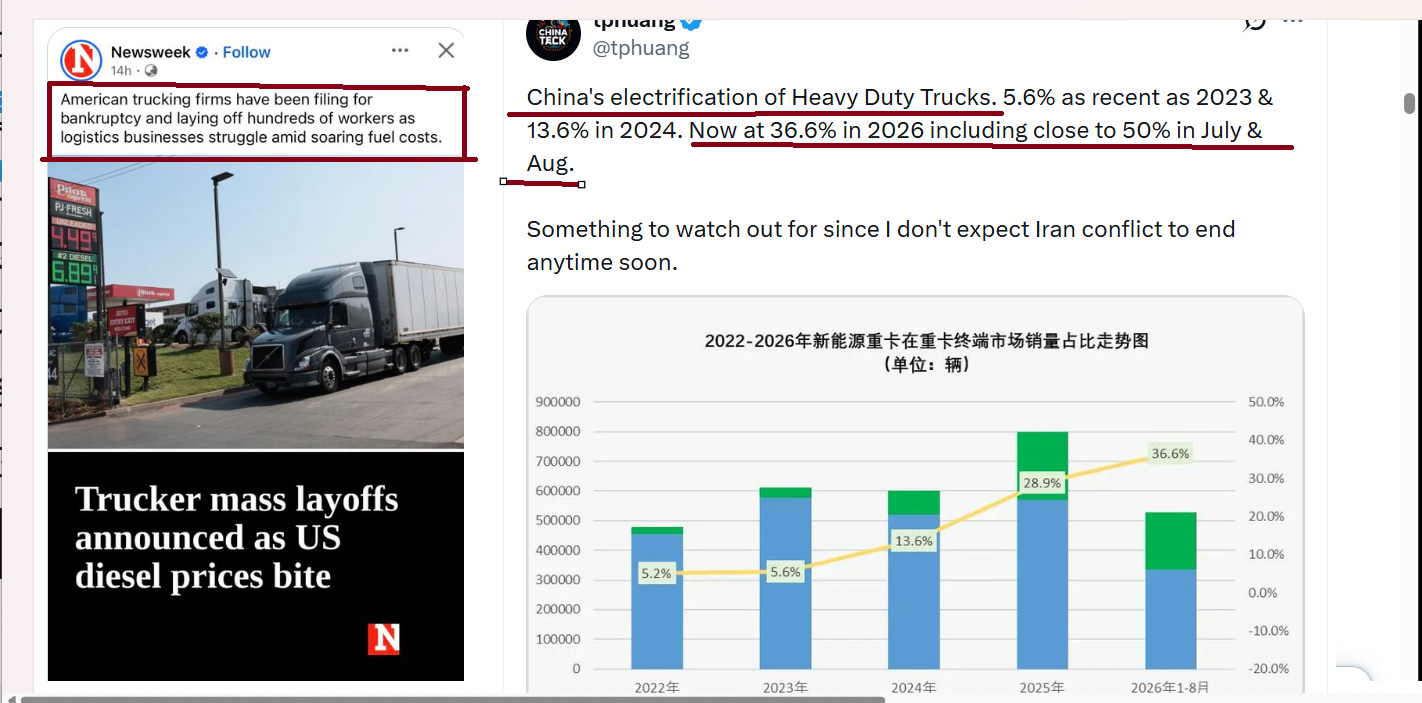
China understands this distinction. While Washington’s comparative advantage remains force projection, China’s is industrial organization: factories, grid capacity, manufacturing supply chains, railways, ports, batteries, solar modules, and electric vehicles. China’s heavy-duty truck electrification illustrates the speed of that change.
The cited figures show electric trucks rising from 5.6% of the market in 2023 to 13.6% in 2024 and 36.6% in 2026, with roughly half of sales reportedly electric in July and August. Even allowing for the need to independently verify those monthly estimates, the direction is unmistakable: the industrial world is electrifying at a pace Washington’s war-and-debt model cannot command.
And electrification means silver.
Silver is the world’s best electrical conductor. Every expansion of solar, EVs, charging systems, data centers, high-performance electronics, grid infrastructure, sensors, and advanced communications pulls on a metal whose supply cannot be increased with a keyboard stroke. Unlike dollars, silver must be mined, refined, transported, fabricated, and physically delivered.
The silver market is already running structural deficits. Industrial fabrication remains enormous—about 657 million ounces in 2025—this doesn’t capture the massive new drivers in addition to military and solar which are:
1. Silver solid state batteries
and
2. AI data centers
3. Silver as a monetary metal.
“That is the key: silver is no longer merely a monetary metal, and it is no longer merely an industrial metal. It is both. Monetary demand rises when confidence in fiat debt erodes. Industrial demand rises when the world builds the electrical infrastructure of the future.” – Jon Forrest Little
The empire may continue printing, threatening, sanctioning, and seizing. But it cannot print conductivity. It cannot bomb a silver mine into existence. And it cannot issue Federal Reserve notes that replace the physical metal required to power the electric age.
end of segment
-
our opinions are not our sponsors opinions
-
the editorial department is separate from the promotions department
-
not financial advice