
We have never begun a story with a commercial, always a first
Only 3.5% of readers currently support this newsletter, yet courageous, metals‑driven investigative journalism is an expensive undertaking. As we expand our editorial department to dig deeper into AI, surveillance, and monetary sabotage, we urgently need your help. If you value independent, fearless analysis, please become a paid subscriber today and help keep this work alive.
and now back to our regularly scheduled programming:
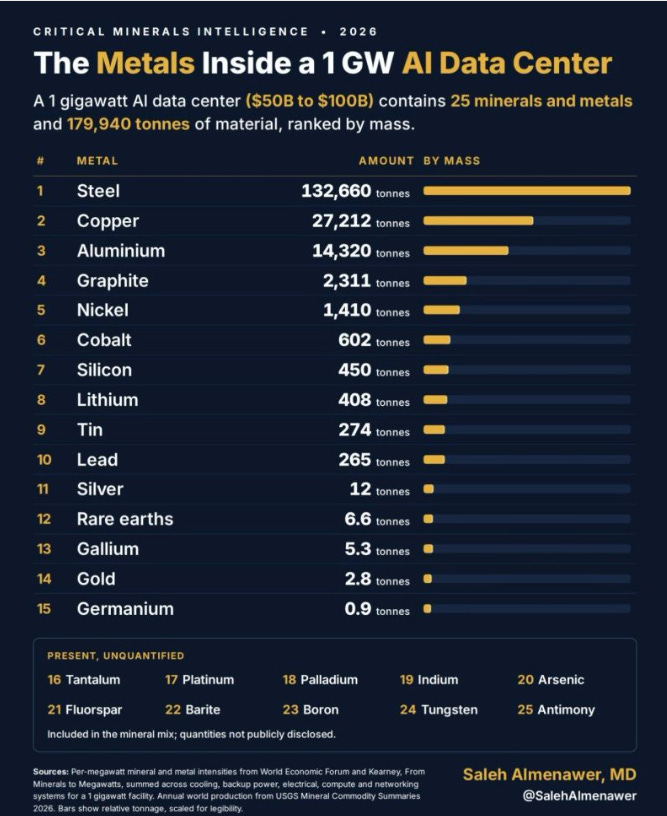
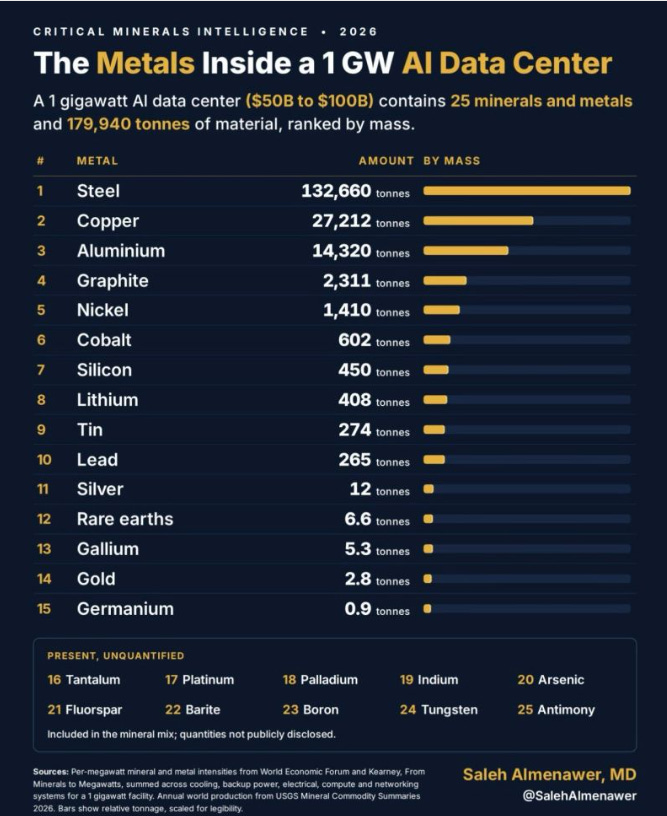
91,147 oz of gold. 385,326 oz of silver. All inside a single 1 GW AI data center.
Special SilverNews report by Carmine Lombardi
Really, yes really,
-
91,147 oz of gold
-
385,326 oz of silver.
-
All inside a single 1 GW AI data center.
I remember about 3 years ago when we broke the story about the volume of silver ounces in a large torpedo battery. 11,000 ounces of silver per battery. Tomahawk missiles about 500 ounces of silver per missile.
Those military numbers are rookie numbers compared to these hyperscalers.
One 1‑gigawatt AI data center quietly devours 91,147 ounces of gold and 385,326 ounces of silver before it ever “thinks” a single thought. At today’s prices of $4,100 gold and $60 silver, that is roughly $374 million in gold and $23 million in silver locked into a single site.
374 Million in Gold and 23 Million in Silver ain’t that much folks
Some estimates now put the most ambitious 1 GW‑class AI campuses on a trajectory toward $100 billion all‑in price tags. This isn’t just concrete and cooling; it’s a stack of GPUs, networking, metals‑intensive infrastructure, and bespoke power projects rolled into a single mega‑asset.
At that scale, you’re not looking at “a data center” anymore—you’re looking at a privately controlled, metals‑backed utility and surveillance node whose capex rivals the GDP of a small country. The fact that such numbers are even being floated tells you everything about how distorted capital allocation has become in the AI era.
The hidden bullion vaults of AI
These metals are not sitting in neat bars in a vault; they are dispersed through server boards, connectors, cooling hardware, switchgear, and control systems. Most of that gold and silver is not in the chips at all—the single biggest share of equipment metal is the cooling system, which makes up 35–45% of every kilogram of gear in the building.
A 1 GW AI campus is, in effect, a bullion‑backed machine: hundreds of millions of dollars in precious metals, architected as infrastructure rather than finance. Every incremental megawatt of AI capacity quietly ratchets up the embedded demand for high‑purity gold and silver, turning “cloud” into a metals‑intensive industrial system.
Copper: the red metal backbone
Conventional data centers consume roughly 5,000–15,000 tons of copper per facility. Hyperscale AI centers can require up to 50,000 tons—over 1.7×10^8 to 5.3×10^8 ounces of copper per site. One recent estimate equates the copper in a single 1 GW AI data center to the copper in 327,861 electric vehicles.
AI data centers already use on the order of hundreds of thousands of tons of copper annually, with projections pushing toward 1.1 million tons per year and beyond as capacity doubles and triples into the 2030s. That means each announcement of a new gigawatt campus is a stealth copper offtake agreement with the entire global mining complex.
The critical‑metal chokepoint
Gold, silver, and copper are only the headline acts. A single 1 GW AI site may also hold about 5.3 tons of gallium—around 0.59% of global annual supply—plus germanium, indium, tantalum, graphite, and other critical minerals measured in kilograms, not kilotons. These tiny quantities can halt an entire build, because they have no easy substitutes in high‑performance electronics and cooling.theoregongroup+1
China controls roughly 99% of gallium and about 80% of graphite refining, and in December 2024 it banned exports of gallium, germanium, and antimony to the United States, later suspending—but not removing—the leverage through licensing. Twenty‑five minerals go into one hyperscale AI site; a handful of them can hold the entire project hostage.
AI, metals, and time
A data center can be announced in a quarter; a new US mine can take close to three decades to move from discovery to production. AI planners can promise “compute” far faster than the earth can deliver the metals needed to build it, creating a structural mismatch between digital ambition and physical supply.bloomberg+4
Look past the marketing gloss and you see what these facilities really are: distributed, unacknowledged bullion vaults and copper engines, welded to a fragile chain of critical‑metal suppliers in increasingly adversarial jurisdictions. The question is no longer whether AI will change the world, but which metal cracks the build‑out first—gold, silver, copper, or the tiny elements most people still cannot name
Techno‑fascists aren’t innovators; they’re the new lords of digital feudalism, strip‑mining your future to build their control grid.
Larry Fink’s “open mic” moment was the quiet part said out loud: your pensions and retirement savings are the fuel for trillion‑dollar AI empires and metals‑hungry data centers. They won’t just loot your funds—they’ll debase your currency at the same time, bleeding purchasing power while telling you it’s “necessary stimulus.”
The Fed prints debt notes to buy corporate garbage, backstopping toxic balance sheets with your stolen purchasing power. Your savings become collateral for surveillance infrastructure, CBDCs, and programmable rails designed to freeze, redirect, or quietly haircut your money on command.
This isn’t progress; it’s a tightening net. Epstein‑class technocrats Trump once showed off to Beijing are now building a domestic panopticon China doesn’t even need to deploy here. The joke is on the American worker—and the punchline is enforced by code.
Will US workers begin destroying these data centers for scrap gold, scrap silver, scrap copper?
When your job’s been “optimized away” by the very AI cluster you helped fund with your pension, just remember there’s a silver lining—literally. Picture a Mad Max economy where the only “career path” left is joining the villagers as they storm the local hyperscale data center, prying gold‑plated connectors out of dead servers and hauling out busbars like sacred relics. The same fortress that once ran facial recognition on you for walking too close to a Flock camera becomes a glorified scrap yard, its cooling racks stripped for copper, its gleaming cages dismantled for a few ounces of gold and silver per board. In the end, the techno‑feudal lords built the ultimate recycling depot for the peasants who survived their grand experiment.
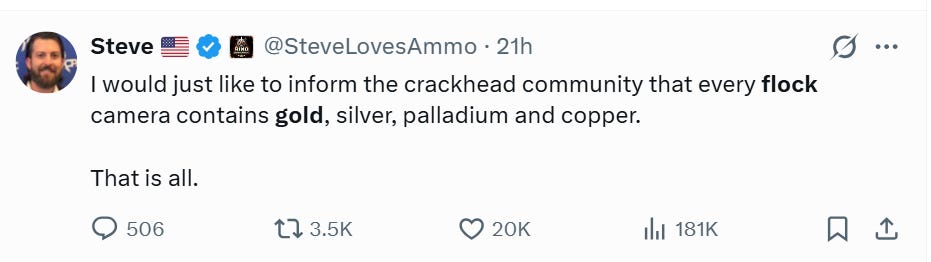
Whatever you do, don’t raid these data centers of their gold, silver and copper. That would be breaking the law.
But for those who do not heed our warning
What data centers will the villagers target?
What “1 GW‑class” means
A 1 GW‑class data center or campus generally refers to sites whose total power capacity is around 1,000 MW (1 GW) or more, often built in phases, and may span multiple buildings on one campus. Many US sites are 200–700 MW today but master‑planned to cross the gigawatt threshold over time.cleanview+2
Evidence of US 1 GW‑scale projects
Industry trackers show multiple US AI and cloud campuses at or above 1 GW capacity (operating, under construction, or planned), including:
-
Meta Prineville Campus (Prineville, Oregon) – often cited with a long‑term build‑out exceeding 1,200 MW, effectively a 1+ GW hyperscale development.
-
Meta Hyperion / Richland Parish AI Campus (Richland Parish, Louisiana) – Meta AI expansion with multi‑GW roadmap, including a Phase 2 expansion taking capacity above 5 GW over time.
-
AVAIO Digital AI Campus (Little Rock, Arkansas) – announced as a 1 GW AI compute campus.
-
Galaxy Helios Campus (Dickens County, Texas) – expansion approved to 1.6 GW (1,600 MW).
-
Tract Reno Campus (Reno, Nevada) – planned 1.5 GW campus.
-
Vantage Frontier Texas / TX12 Frontier (Albany/Abilene, Texas) – under‑construction AI campuses in the ~1.4 GW range.
-
CloudBurst Texas Flagship (Corsicana, Texas) – under‑construction 1.2 GW hyperscale site.
-
Oracle/OpenAI “Stargate” Campus (Santa Teresa, New Mexico) – multi‑GW AI campus; public commentary puts it in the 1+ GW class as build‑out proceeds.
-
AWS nuclear‑adjacent project (Pennsylvania) – analysis notes up to ~960 MW planned, effectively gigawatt‑class with margin as built out.
-
Chevron energy‑backed data‑center portfolio – about 1 GW of power‑integrated development planned across US sites.
These are identified in project trackers and analyst write‑ups as gigawatt‑scale or multi‑gigawatt AI/cloud campuses, even if the exact “1,000 MW” threshold is crossed only as future phases come online.
How many such sites exist
A 2026 AI data‑center index counts 27 facilities worldwide in the “over 1 GW” category, totaling about 66.6 GW of capacity; a significant subset of those are in the US, but the index does not publish a full, named list by country. US mapping tools show total data‑center capacity around 432 GW (operating plus planned), with many individual campuses above 1 GW but again without a clean “named list”
Given current public data, a defensible statement is that “dozens” of US campuses are designed for gigawatt‑class AI/cloud capacity, but only a portion have fully reached 1 GW yet
article sources:
-
LinkedIn – David William Scott FSCI post on metals inside a 1 GW AI data center (gold, silver, copper, cooling share, EV copper equivalence).linkedin
-
Institutional Real Estate, Inc. (IREI) – “AI data centers could consume half a million tons of copper annually by 2030” and related coverage of copper tonnage per conventional vs. hyperscale facilities.irei
-
Bloomberg – “Copper demand is set for data-center boost” and broader analysis of AI‑driven metals demand and grid expansion impacts.bloomberg
-
Georgetown / policy analysis – China’s export ban and subsequent suspension on gallium, germanium, antimony, and related critical minerals, via Ministry of Commerce notices and think‑tank summaries.
-
Here are the key sources underpinning the segment on where the 1 GW‑class AI and cloud campuses (Meta to Oracle/OpenAI “Stargate”) are located:
-
CNBC – “OpenAI’s first data center in $500 billion Stargate project is open in Texas, with sites coming in New Mexico and Ohio” (Abilene flagship, plus additional US sites).[cnbc]
-
OpenAI blog – “OpenAI, Oracle, and SoftBank expand Stargate with five new U.S. AI data center sites” (Abilene, Shackelford County TX, Doña Ana County NM, Lordstown OH, Milam County TX, Midwest/Wisconsin site).[openai]
-
DatacenterDynamics – coverage of Oracle/OpenAI Stargate Saline Township, Michigan (“The Barn”) 1 GW campus and Abilene expansion cancellation, including capacity and cost details.[datacenterdynamics]
-
Intuition Labs – “OpenAI’s Stargate Project: A Guide to the AI Infrastructure” (Stargate Michigan 1 GW, Saline Township specifics).[intuitionlabs]
-
Yahoo Finance / Reuters – “OpenAI, Oracle and Related Digital plan 1GW data centre campus” in Saline Township, Michigan, and ~1 GW port‑Wisconsin site.[finance.yahoo]
-
Epoch AI – “OpenAI Stargate: where the US sites stand” (overview of US Stargate siting, gigawatt‑scale design, and power‑first strategy).[epoch]
-
DatacenterDynamics – broader “Stargate update” features noting campuses in Wisconsin, Ohio, New Mexico, and other US locations.[datacenterknowledge]
-
LinkedIn commentary – posts and threads summarizing Meta’s targeted multi‑GW AI campuses in Louisiana, Texas, Wyoming and 1 GW ambitions.[linkedin]
-
-
Our opinions are not our sponsors opinions
-
The editorial department is separate from the promotions department
-
not financial advice